Respects were paid at the graves of Zoroastrians buried in a remote cemetery in Japan
Pablo Vazquez
Right outside the urban landscape of cosmopolitan Kobe in Japan, a land enigmatic in our imagination, there exists in the mountains a cemetery in which foreigners who have helped shape that city and country are buried. It takes a bus ride and a hike, a bit of a pilgrimage, to reach the honored dead that overlook in their eternal vigilance the valleys and seas of beauty that surround Kobe. Right near the gates are buried a small contingent of Zoroastrians, traders and teachers, managers and other types who had come to this distant land to make their fortunes. One of the keepers expressed surprise at seeing me, a Zoroastrian, there. He acknowledged that despite the cemetery not having very many Zoroastrian visitors he was quite well aware that my name among all the Parsis on record was quite unique. (When asked by Parsiana whether any details were available of a Zoroastrian cemetery in Kobe, Neville Shroff, president of the Zoroastrian Charity Funds of Hongkong, Canton and Macao, responded: "I am not aware of any exclusive Zoroastrian cemetery but understand there is a plot within the cemetery for foreigners.” — Editors)
So, what was I, an Afro-Caribbean with no ethnic ties to anything historically Zoroastrian and with a distinctly Spanish name, doing on top of this mountain intoning ancient Avestan prayers and wiping down the graves of people I had never met? What could have possibly brought me here and what gave me the audacity to do this? Well, unlike many of you fine folks reading this, I didn’t have the distinct honor of being raised as a Zoroastrian and had to become one later in my life, on a boiling hot California July day in 2018, to be more exact. I had been practicing the prayers and learning about the faith for years before my navjote and ended up getting an advanced degree studying the religion and am now, at the very least, deeply involved in my North American Zoroastrian community trying to give back as much as I can. Despite all the books, all the wonderful (and not-so-wonderful) Zoroastrians I met, all the videos I have seen, all the debates I engaged in, I can safely say that it was one thing above all others that brought me into the religion: the Gathas of Asho Zarathushtra.
Even in that high cemetery in Kobe, the bitter cold of the altitude stinging my cheeks, I sang the verses of this beautiful and ancient collection of sacred poetry aloud out into the autumn air. These words spoke to me, as they have for countless others through the centuries, in ways that nothing else ever has. Zarathushtra sang of tolerance, of standing up against oppression and greed, of enlightening people to be the best version of themselves as possible, of aligning with Asha and finding that tranquility of being a part of the cosmic flow of all things, of the spiritual equality of the genders and letting go of old, dead prejudices, and, of course, the importance of wisdom and understanding and seeking it wherever it may be found. I have no doubt that the Zoroastrians who are buried in Kobe, while wandering throughout Japan building their new lives amongst previously not encountered religions and philosophies, kept these teachings in mind and learned what they could, explored the ways of their new hosts, engaged in practices once unimaginable to them, and all without losing sight of their faith and their love for Asho Zarathushtra, the Yazatas, and Ahura Mazda, our wonderful and divine friend. Among the graves was one of the Wadia family with headstones bearing their names: Jamshed Shapurji Wadia (1901-1960), Mehru (Mary) Wadia (1915-2004) and Gool J. Wadia (born 1954; no date of death mentioned).
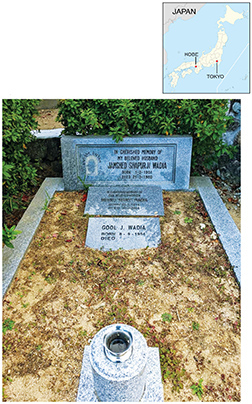
Clockwise from top: Symbol and flag of Kobe; map;
Zoroastrian graves in a cemetery for foreigners
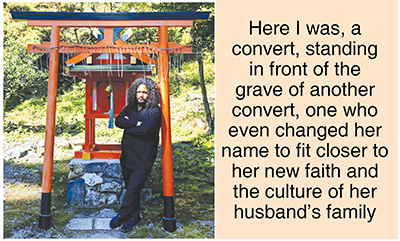
After finishing my prayers, I noticed one grave that roused my curiosity and sparked my imagination. Decorated with the image of a blazing fire surrounded by Avestan lettering, the grave was of one Monijhe Shroff, born Kikuyo Matsubara; the cemetery had noted that she had been buried with Zoroastrian religious rites. It struck me that here I was, a convert, standing in front of the grave of another convert, one who even changed her name to fit closer to her new faith and the culture of her husband’s family.
What difficulties did she face? Did the Zoroastrians in Japan spurn her as they would have in India? Or, in my dream of dreams, did they welcome her with open arms and seek to enrich and enlighten themselves through her knowledge and experiences of life, her old religion and the ways of her people? Whatever the case, here she was occupying an honored place, the caretakers careful to ensure that her resting place remained constantly in pristine condition. It gave me hope and fed my daydreams with images of those raised as Zoroastrians and those who have converted praying side by side without contention, our religion having reversed the illusory curse that it was dying out, now forever enriched by the various cultures of the world and truly universal just as Zarathushtra dreamed it to be. After all, are we not consistently proud of how we have adapted and enriched ourselves as a community no matter where we’ve gone?
It was only a century or so ago that the Zoroastrians buried in the Kobe cemetery had ventured into a distant corner of the world and made a life there, even bringing new souls into our daena. I dream that one day every remote corner of the world will have a Zoroastrian (or many) there, their fires blazing and ready to spread the wonderful spiritual teachings of Zarathushtra and Ahura Mazda to whomsoever wishes to receive them. While in Japan I saw so many shrines and temples, so many places of great spiritual energy and power, and yet visiting those graves is a memory that has etched itself into my psyche, one that I can never forget. I visited them to make sure that they were prayed for and taken care of and I’m happy to report that the combined efforts of the caretakers and yours truly have ensured that they are indeed remembered appropriately. Perhaps, one day soon, it won’t take multiple flights and much money to say hello to our spiritual cousins buried in Japanese soil but rather that someone like Kikuyo Matsubara, our own Monijhe, who has accepted the Mazdayasni way, will come and sing the Ashem Vohu for her and all the other departed souls in the cemetery with all the vigor and joy I brought to that hallowed ground.