If you believe that Parsis must only marry Parsis; that prayers cannot be recited at the Towers of Silence for those being cremated; that non-Parsis cannot view the Parsi dead at the funeral; that Parsis cannot adopt, and children of interfaith married Parsi women (IMPW) are not Parsis; you qualify as one of the mainstream orthodox.
If you believe that preservation of Parsi racial genetic purity is the essence of the faith; that children of interfaith married Parsi men are not Parsis either; that there should not be electricity in fire temples; and that Parsis are not in a demographic decline; you qualify as being ultra-orthodox.
If you believe in none of the above, you are a liberal. However, if you advocate conversion of any person irrespective of race or religion into Zoroastrianism with the same rights as persons born of Parsi parents, including entry into any place of worship and the benefit of Parsi charities, you are a radical reformist.
By the above standards, a sizable majority of Parsis are liberals. Many of these, however, are indifferent and disinterested in Parsi affairs. The mainstream orthodox, on the other hand, are vocal, well informed and control most community trusts and fire temples. The ultra-orthodox, who are a micro minority, detest their mainstream brethren more than they do the liberals; their active participation in community institutions is therefore sporadic.
In the past, some uncharitable columnists have dubbed the four categories as obscurantist and fanatic; lunatic fringe and fruitcakes; rabid reformist; heretic scum; respectively.
The orthodox are rapidly dwindling. It is difficult to deny that their insistence on exclusivity has saved the ethnic uniqueness of the community; in the absence of which this micro minority would have perhaps been lost in the great Indian melting pot. Their xenophobia may have prolonged the inevitable D-day. They have also performed an important role in preserving and managing community institutions. But now finding decent trustees is difficult. If the good and the wise continue to be reluctant to discharge their duty, adventurers trying to make a quick buck from community charities will be a likely possibility.
Unlike the ultras who steadfastly believe in the coming of the second prophet to save us from decimation, the mainstream orthodox do concede in private conversations that they are fighting a losing battle. Even if the Supreme Court soon rules that the children of IMPW are Parsis with full rights and privileges, it will have little impact on the demographic decline.
Few of the most dyed-in-the-wool liberals will advocate outright conversion into the faith. Certainly not in India. In the West, outright conversion is rare though within the coming decades Zoroastrianism, with its nature and fire worship (ignoring for the moment the nitpicking about our not being fire worshippers), environmental consciousness, no insistence on abstinence, and truth as its central plank, holds great appeal. These non-Parsi Zoroastrians (NPZ) will easily assimilate in Parsi culture and associations. Gradually, the distinction between Parsi and Zoroastrian will be obliterated.
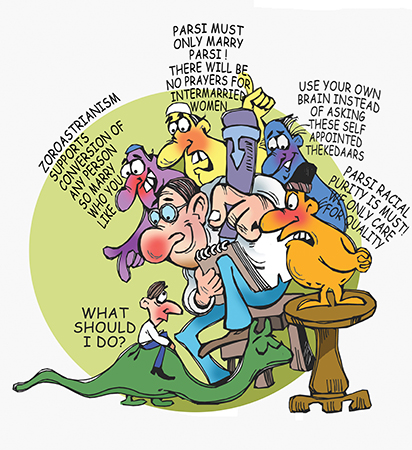
Illustration by Farzana Cooper
This will happen in India as well, not by conversion but by the relentless increase in interfaith marriages (now almost at the halfway point in Bombay). Should children and spouses of such unions be progressively permitted entry to places hitherto barred to them, the distinction between Parsis and Zoroastrians will further blur. Will the ethnic uniqueness then dissipate? Will the so-called Parsi way of life become cosmopolitanized? Maybe not. If this process proceeds sensibly, the newcomers may display the zeal of the migrant who begins to feel more loyal to his adopted country.
Non-Parsi children being adopted by Parsis and enjoying the same status as the natural born is a distinct legal possibility in the years to come. This may slow down the steep demographic decline.
It is wrongly presumed by the orthodox that a majority of Parsis in India are conservative. On the contrary. As every home (earlier it was every family) begins to have interfaith marriages, even those holding orthodox beliefs will be more accepting. Few grandparents’ hearts will not melt after interaction with their own grandchildren, irrespective of either parent’s religion.
A comprehensive sociological survey or an online referendum by the community is highly likely to establish that a majority at least wants gender equality. In the last decade or so, Bombay Parsi Punchayet (BPP) trustee aspirants have also realized that flouting orthodox credentials may not win votes. That someone like Anahita Desai is so handsomely elected is not due only to her orthodoxy but also to her exceptional work as a humanitarian social worker for the community. It is only a matter of time before an IMPW is elected as a BPP trustee. Of course, few want outright conversion or to remove entry restrictions to places of worship. Fear of being swamped is deeply embedded into the psyche even of many liberals.
Cosmopolitanism is the enemy of Parsi orthodoxy. To halt its inevitable onslaught is virtually impossible. However, a bigger enemy is the utter indifference and callousness of most Parsis to their culture and institutions. This unpardonable sin will ultimately destroy the anthropological rarity of the Parsis.