Business leaders and visionaries Meher Pudumjee and Nawshir Mirza
share experiences to guide prospective entrepreneurs
Text: Parinaz M. Gandhi Photos: Jasmine D. Driver
The audience was charged. The moderator Viraf Deboo, managing director of the Albaj Group of Companies, sparked the interview. The guest Meher Pudumjee, chairperson of Thermax Limited, generated respect when relating "Her experience as a business woman.” The fireside chat between the duo to take the assemblage on a "Walk through her Journey,” ignited interest while the symbolic fire extinguisher lay forgotten on the front stage at the Maple Room at Lonavla, the venue of some of the sessions at the global conclave of the World Zarathushti Chamber of Commerce (WZCC) on January 4, 2020.
The first qualified engineer from the family to join Thermax, a firm started by her maternal grandfather Adi Bhathena and father Rohinton Aga to manufacture industrial boilers, Pudumjee was inducted as a trainee engineer in 1990. A year later, Meher, who had completed her postgraduation in chemical engineering from the Imperial college of Science and Technology, London, and her husband Pheroz, who had earned his masters in business administration, were made responsible for a Thermax subsidiary in the UK. "It was like ‘throw them in at the deep end and let them swim.’ There were lots of mistakes we made but at the end of four years we managed to turn around the subsidiary,” she stated.
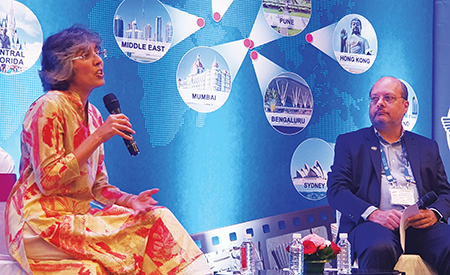
Meher Pudumjee (l) with Viraf Deboo at the WZCC global conclave
One year after the company had gone public, her father died of cardiac arrest in 1996. She was appointed to the board of directors and was involved with the finance functions at Thermax. "My biggest support was my mother Anu (who was appointed executive chairperson of the company). She is quite an amazing woman. She did a lot of reading on death. Did a course in Vipassana that she found extremely helpful. Meditation impacts the soul. It is healing,” believes Meher. The demise of her 28-year-old brother Kurush in a car accident the following year was yet another tragedy for the family. "When you know you have given the relationship your best, it is much easier to cope with the death of a loved one,” she learnt. Meher remembered her mother saying, "Let’s go for a movie,” soon after the death of Kurush. The daughter feared, "What will people say?” but the mother convinced her, "How does that matter? Do what you want to do and what heals.”
That was a difficult phase for the family and the firm. "The world was underperforming and so were we,” admitted Meher. The term used to describe the situation was "satisfactory underperformance” when things are not going well but no one asks any awkward questions so as not to offend anyone. But then Anu, whose forte is human relations, received an anonymous letter from "a poor investor” who was saddened by the value of Thermax shares dropping from Rs 426 to Rs 36.
The founder family sought help from Boston Consulting Group who advised a change in the structure and portfolio of the board with nine executive directors, four independent directors and three family members. The family was told "to decide whether we wanted to be in operations and not on the board or vice versa. It was a tough decision.” The family chose to remain on the board.
At the turn of the century, Meher played an active role in the turnaround of Thermax and in 2004 took over as chairperson when her mother summarily announced her decision to step down without preparing her. She was 38 then and her mother 62. "As you
get older, you want to hang on” which Anu did not want to do. She left the room and a nonplussed Meher saying, "I am here whenever you need me.” Anu continued on the board until two years ago when at the age of 75 she stepped down as an independent director, once again making her decision public at a press conference with no prior intimation to the daughter.
When Meher took over from her mother, she admits, "I did not have self-confidence. I was diffident. At that point I decided to go for Vipassana.” The course equipped her to see things in perspective. As non-executive chairperson Meher felt she was able "to make much more rational decisions from a distance, although she did not have the pleasure of doing things and had to learn to delegate.” Instead of giving instructions, her responsibility now was to influence thinking.
"Believe in yourself and have the right attitude,” she impresses on her staff at Thermax. Seeking to instill confidence in those ladies who feel "I am only a woman,” Meher assures them they "can do anything equal to, if not better, than men.” With her sterling leadership, she was selected Chief Executive Officer of the Year 2009 by Business Standard.
The culture at Thermax as initiated by her grandfather who was the founder of National Steel, manufacturing sterilizers and hospital equipment, believed in empowering people, trusting employees. Lacking an engineering background, her grandfather and father had brought in "people who were better than them, empowering them and granting them freedom to operate…
"Dad was like a venture capitalist.” When he was approached with a new idea, he would say, "Go and find out more about it,” and if convinced, would finance it. "My father was a true visionary who saw the company move from one business to another,” she added. Starting with boilers, they progressed to a water treatment plant, resins came next, followed by air pollution control, cooling, and finally electricity with their captive power plants. The turnover of the company for the year ended March 2019 was Rs 3,541 crores and the share price on February 6, 2020 was Rs 1,050.
Meher believes in continuing with the same approach of letting the employees flourish but after having checks and balances in place. Her grandfather’s advice has remained with her: "Make mistakes but do not make the same mistakes twice.”
"The culture of the firm is not the same” is the common refrain he hears, interjected Deboo who had started his career in Thermax as a trainee engineer when he was entrusted with projects worth crores of rupees in materials management. Concurring with the observation, Meher asserted, "The culture has to change. You have to change with the times. If an employee is not performing, it will not be tolerated. It is not professional management but good management” that helped the company bounce back. "Otherwise you may perish in a VUCA (volatile, uncertain, complex and ambiguous) world.”
When Meher was asked how she always manages to wear a smile on her face, she responded, "I love life. I really do. I learnt from my mother. Work life is but one slice of your life, so enjoy it.” In addition to her responsibilities at Thermax, she makes time for her music, chairs Akanksha Foundation and Social Venture Partners in Poona, and also sits on the boards of several not-for-profit organizations like Teach for India, Shakti Sustainable Energy Foundation and the Pune City Connect Development Foundation.
Parsis who are wont to "giving their money and time are so philanthropic,” mentions Meher. Philanthropy is different from corporate social responsibility (CSR) where two percent of the company profits are used to support social causes. "Philanthropy funds things that CSR cannot. Philanthropy is willing to take more risks.” She referred to her mother’s philanthropic temperament that made her bring home two street urchins when Meher was six years old with the intention of giving them a better life but they "ran back to the street as they felt this (new lifestyle) was curbing their freedom.” The family’s involvement with Akanksha and Teach for India commenced after the demise of Kurush who would repeatedly tell the family to donate 90% of their earnings to charity.
The Parsi youth, "especially the boys, do not have gumption in them. They should be willing to try new things otherwise it will be difficult to succeed,” she said, citing the experience of her husband Pheroz who wanted to induct two Parsi boys. When they were told they would have to work at the Thermax premises at Chinchwad, they turned down the offer saying, "Etlu door (so far)? Aapune Thermax House (in centrally located Shivajinagar) ma joiéch (We want to work at Thermax House).”
Instead of living their dreams through their children, parents should allow them to pursue careers of their choice, stressed Meher, sharing her experience at Teach for India where many erstwhile engineers feel that by teaching the underprivileged they have "found their purpose in life.”
"Understand your risk ability”
While the fireside chat was the first session after lunch, equally illuminating was the last session before lunch when Nawshir Mirza (pictured) spoke on "Pitfalls in Business and How to Prevent the Same.” Former director of Tata Power Company Limited and currently on the boards of Thermax Limited and Exide Industries Limited as an independent director, he candidly announced, "I have never done business nor done research on this subject but for more than 50 years I have been involved in businesses as an auditor or consultant and have had an opportunity to observe and see others make mistakes!” A chartered accountant whose 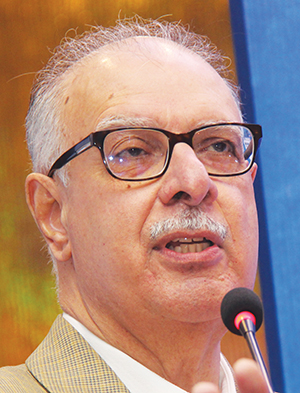 professional career has seen him gain experience at S. R. Batliboi and Company, Ernst and Young as also Jardine Matheson Limited, he lends his expertise to various professional bodies and chambers of commerce.
The first of the pitfalls listed by Mirza was to caution entrepreneurs displaying hubris, believing "they can do anything. We need to temper our enthusiasm…with our feet on the ground.” Ratan Tata’s dream project to manufacture a small, affordable car Nano was a flop, he admitted.
Timing entry in the business is equally important. "Do you think you will be successful when others are floundering because of a downturn in the industry?” he asked rhetorically and cited the instance of an entrepreneur who had a great idea, worked excellently, had found a foreign investor, the company had a huge staying power and was yet not successful.
A business that largely depends on government policies or infrastructure for its growth is asking for trouble because the "government has no rational policies… keeps changing its position. It is like wanting to get into bed with an elephant and you cannot control the elephant,” he asserted. He cited the instance of Thermax exiting the waste water management business because of the government’s warped policies and corruption. "Every business requires the government to cooperate. The government is omnipresent and omnipotent. It is for this reason that industries in the power, transport, telecom industries are floundering.”
The choice of investors also contributes to the success of a business. "The ones who are most wealthy may not have time to work with you. Young entrepreneurs need people who will stand with them through ups and downs, offer good advice.”
Absence of planning is another pitfall. "Indians culturally are not good at planning. Without clear planning as to how the business will unfold,” one is bound to fumble. Planning of cash flow is important. If taking a loan to buy an office, will the loan be repaid out of taxed income? When planning marketing, look at it from the customers’ perspective. Don’t depend on a single customer so that the freedom to make decisions is not dictated by one customer.”
Pricing the product is a challenge for "price sensitive customers are always looking for a bargain.” If it is priced too low to break into the market, it will be considered ‘cheapo,’ if too high, you may not get any customers.” Personal funds and business funds should not be mixed lest an entrepreneur reach a situation where he/she does not have any money to fall back on to avoid crisis in one’s personal life. "Understand your risk ability. Do you have reserves and resources to bear the loss?” He cited an instance of a senior couple getting a divorce as the wife could not stand creditors banging on their door.
Operations should be clearly demarcated as human relations, secretarial, taxation, leaving them to those who are good at their tasks. It is important to engage advisors. "Surround yourself with people better than you.” Finding a good partner is important. "Throughout my life I have not had a single Parsi partner,” stated Mirza voicing the misplaced apprehension of doing business with a Gujarati or Marwari.
By the time you are 50 years old, you should plan who will succeed you in your business. In your 50s you must think of exiting the business, even if you have to pay two percent commission to select a successor. Selecting a family member may not always be the best option. "When the business is doing very well, that’s the best time to get out,” to get the best value.
For the future, all businesses have to be cognizant of "two significant trends” which few large companies are giving thought to, stressed Mirza. There will be a demographic shift in population that will impact human wants. Currently India has a population of 135 crores of whom 41 crores are aged over 40 and 94 crores are under 40. By 2050, India will have a population of 160 crores of whom 74 crores will be under 40 and 86 crores will be over 40. Businesses will thus need to amend their plans to be relevant for their consumers.
Actively involved with the Energy Resources Institute and other nongovernmental organizations as he is convinced that humankind should take responsibility for destruction of the natural world, Mirza pointed out that climate change will affect companies in  different ways. With larger tracts of central India (Vidarbha) being desert land, if planning a business there, no employees will be available. He was also concerned that Tata has two huge power stations on the shores of Bombay and Mundra. In the event of floods, high tides and rising sea levels, these could stop functioning. Likewise the Bombay ports could be affected, hampering transport or impacting insurance.
"Solar power/ wind power will not solve problems. Don’t delude yourself. We have to change the behavior of consumers to retard the damage,” asserted Mirza. Despite knowing that "it is our grandchildren’s existence that is being threatened, we Indians will not change our behavior. It is no longer ‘climate change.’ It is ‘climate crisis.’”
The senior director regretted, "We are obsessed with petty things in our community… Keep in perspective the real issues that can maximize value in business.” There should be a willingness to think differently but "Can you be innovative in your workplace whilst being conservative in the rest of your life?” To be continued