Multifaceted Justice Dinshaw Madon delivered several important judgments both in the Bombay High Court and the Supreme Court
Soli Sorabjee
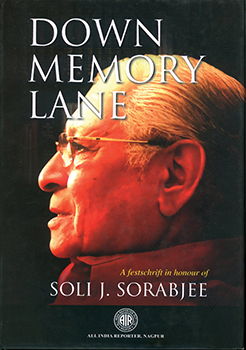
Extract from Down Memory Lane: A festschrift in honour of Soli J. Sorabjee published by All India Reporter Pvt Ltd, 2020 on the occasion of his 90th birthday, a year before he passed away. Reprinted with permission from the publishers.
I commenced my legal practice in the Bombay High Court (BHC) in June 1953, in the hallowed chambers of Sir Jamshedji Kanga. My senior was K. H. Bhalla. I used to spend time in the BHC bar library, looking up cases for conference to be held by my senior.
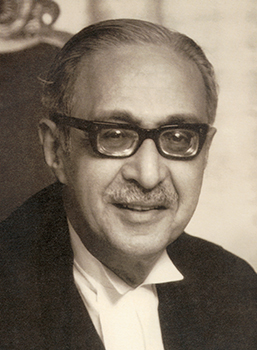 I first met Dinshaw Madon (pictured) in the High Court library where he greeted me with a friendly smile. We talked quite a bit. He enquired of my family background and my marital status. He was happy to learn that my father, whom I sadly lost in December 1949, was a freemason because it is not generally known that Madon was a keen freemason and also a Grand Master.
Madon was extremely well versed in civil and commercial law and although his advocacy cannot be described as brilliant, it was marked by thorough preparedness. He had a phenomenal memory. He was a formidable opponent who had mastered the art of interrupting opposing counsel while they were making a point apparently finding favor with the Court.
Madon was persuaded to become a judge of the BHC in September 1967, and was its Chief Justice from August 1982 to March 1983. His innings on the bench of the BHC was marked by an odd mixture of erudition and eccentricity. As a judge he irritated members of the bar by insisting on correct paging of the brief and other inconsequential matters which earned him the nickname of "Mad on.”
There are two instances which I vividly recollect. One is when advocate Ballu Desai, who mispronounced the expression ‘faux pas’ stated: "My Lord, I am sorry my French is not good,” to which Madon retorted, "Forget the French, your English is horrible.”
Another incident is when I was making my submissions in a case before him and he kept on talking and would not let me complete, about which I complained. He told me, "Mr Sorabjee, listen to me,” at which I said in a similar tone, "But My Lord I am doing nothing but listening for the last 10 minutes,” to which Madon jocularly rejoined, "Then listen for five minutes more.” One cannot really be angry with Madon.
I would like to mention a judgment he delivered, with Justice Kania in the BHC, dealing with the scope and ambit of the censorship order promulgated by the Indira Gandhi Government during the emergency in 1975. Minoo Masani, editor of a monthly journal, Freedom First, challenged certain orders passed by the censor prohibiting its publication. Masani’s petition was allowed by a single judge of the BHC, Justice Bhatt. The Government filed an appeal against the order of Justice Bhatt, which came up before Justices Madon and Kania. This landmark judgment was not reported in the All India Reporter (AIR) lest it displease the censoring authorities. It was reported in the Bombay Law Reporter. There are certain passages in the judgment which are brilliant and need to be reproduced.
"There is another important factor which the censor must also bear in mind. The Press is not only an instrument of disseminating information, but it is also a powerful medium of molding public opinion by propaganda. True democracy can only thrive in a free clearing house of competing ideologies and philosophies — political, economic and social — and in this the Press has an important role to play. The day this clearing house closes down would toll the death knell of democracy. It is not the function of the censor acting under the censorship order to make all newspapers and periodicals trim their sails to one wind or to tow along in a single file or to speak in chorus with one voice. It is not fine for him to exercise his statutory powers to force public opinion in a single mold or to turn the Press into an instrument of brainwashing the public. Under the censorship order, the censor is appointed the nursemaid of democracy and not its grave digger.”
The judgment recognizes that: "The voice of dissent cannot take the form of incitement to revolutionary or subversive activities, for then instead of serving democracy it would subvert it. It is here that the censor’s real role begins”… The censor "has to preserve a fine balance. On the one hand, he should not stifle all free expression of opinion by imagining lurking dangers in every corner and discovering sharp curves and hairpin bends, when all that exists is a straight road. On the other hand, he must be vigilant to detect all attempts at breeding violence and creating public disorder.”
The division bench whilst dismissing the appeal of the censoring authorities observed that: "The objections urged by the appellant censor are unrelated to any of the purposes or objects of the censorship order; most of the consequences contemplated are fanciful and far-fetched and the view taken such as no person acting rationally can ever possibly take. Logic rebels and reason revolts at inferences so devoid of any foundation in reality or basis in common sense.”
This landmark judgment and the language of Madon are both forceful and elegant.
Madon was elevated to the Supreme Court on March 14, 1983 and retired on April 6, 1986. During his tenure he delivered several important judgments, one of which was about the correct interpretation of the provisos to Article 311 of the Constitution which deals with the dismissal, removal and reduction in rank of civil servants.
A judgment which deserves special mention is the one in Forasol vs Oil and Natural Gas Commission [AIR (All India Reporter) 1984 SC 241]. His observations in para 40 of the judgment are remarkable, namely "the English decisions referred to by us are of courts of a country from which we have derived our jurisprudence and a large part of our laws and in which the judgments were delivered by judges held in high repute. Undoubtedly, none of these decisions is binding upon this Court but they are authorities of high persuasive value to which we may legitimately turn for assistance.”
It is said that every bawaji (Parsi) lawyer and judge has a natural predilection for English judges and their judgments. Madon, who before his elevation practiced exclusively on the original side of the BHC, was no exception and would expectedly turn to judgments of English judges for assistance.
It is further observed in the judgment that "it is but just that a man, who is in law entitled to receive a sum of money in a foreign currency, should either receive it in such currency or should receive its equivalent in Indian rupees. It is here that the question of the date which the court should select for converting the foreign currency into Indian rupees arises. The court must select a date which puts the plaintiff in the same position in which he would have been had the defendant discharged his obligation when he ought to have done, bearing in mind that the rate of exchange is not a constant factor but fluctuates, and very often violently fluctuates, from time to time. With these considerations in mind, we will now examine the feasibility of the several dates set out by us at the beginning of our discussion on this point.”
 Thereafter, the court fixed a suitable date having taken into consideration all the circumstances and the justice of the case.
After retirement, Madon acted as an arbitrator in many matters. His wit, sarcasm and sense of humor enlivened the arbitration proceedings. He also gave opinions which were remarkable for their erudition.
He departed from our midst on June 24, 1994, but his contribution to the legal jurisprudence of our country will always be cherished. A multifaceted personality, Madon will always be remembered by the legal fraternity and judges and by his numerous friends at the bar.