On the 200th birth anniversary of Dr Dadabhai Naoroji in September 2025, Parsiana carries the second extract from his papers "The Manners and Customs of the Parsees” read before the Liverpool Philomathic Society on March 13, 1861.
The text was downloaded from Google Books but also features in a booklet printed by The K. R. Cama Oriental Institute in 2005. Included in the booklet is another paper "The Parsee Religion,” read by Naoroji before the Liverpool Library and Philosophical Society on March 18, 1861.
Naoroji was a social reformer, scholar, a member of the British Parliament, a founder of the Indian National Congress and co-founder of the Zoroastrian Trust Funds of Europe. He also headed both the organizations.
The Parsis do not eat anything cooked by a person of another religion. They, however, have no objection to eating sweetmeats and confectionary made by other people. They do not eat beef, or pork, or hare. With this exception their diet or drink is in every way like that of Englishmen. They do not smoke at all. Perhaps they are the only people on earth that do not smoke though the indulgence is available to them.
Illustration of a Zoroastrian religious ritual by M. A. Kesel
The nirang (consecrated bull’s urine) has been the subject of a long and somewhat bitter controversy. The reformers maintain that there is no authority whatever in the original books of Zarathushtra for the observance of this dirty practice, but that it is altogether a later introduction. The old adduce the authority of the works of some of the priests of former days, and say the practice ought to be observed. They quote one passage from the Zend Avesta corroborative of their opinion, which their opponents deny as not at all bearing upon the point. The consequence of this controversy seems to have been that the young have almost all given up the practice, and many of the old have their faith shaken in the efficacy of nirang to drive away Satan and purify themselves.
The frequent saying of the kusti prayers, and the necessity of bathing after being shaved, are in a great degree being done away with by the young class as unnecessary and not enjoined. The institution of early betrothal and marriage has been much discussed, and seems likely to be abolished in time. The association of ladies at the domestic family dinner table is gradually becoming more general. But when, two years ago, the first attempt was made to admit ladies to the drawing and dinner room, to associate with other friends, loud clamor was raised against the "dangerous innovation.” The principal argument, and which to the old class was most telling, was the alleged bad consequence of such a social institution among Englishmen. The cases of divorce and marriage delinquencies, published in the papers, were adduced as proofs. The cry was loud and abusive, and the sensation general. But those who introduced the custom were too sensible and bold to be easily dissuaded or frightened into abandoning it. I do not mean to do the injustice to say that the whole body was against this social reform. Many approved of it, and were satisfied both as to the justice and desirability of it; but, either from fear of the public abuse of some of the scurrilous newspaper writers, or of introducing discord in their families, when the whole family circle did not happen to be of one opinion, the step has not been so well followed up by others as was expected.
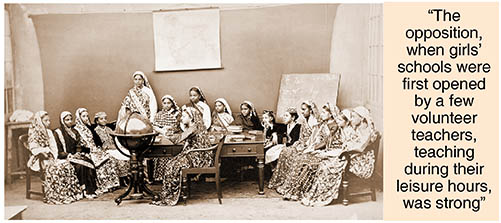
Classroom in The Alexandra Girls’ English Institution
But one great and effective move has been made, which bids fair to sweep away all superstitious and unsocial customs among the Parsis. The claim of women to a good education has not only been put forward, but fully admitted, and acceded to.
The opposition, when girls’ schools were first opened by a few volunteer teachers, teaching during their leisure hours, was strong. Twelve years have since passed; and some of the very persons who were most vehement in their opposition have themselves now taken into their own hands the management, safe preservation and growth of these schools. The feeling and conviction is now almost universal among the Parsis that it is both right and beneficial that women should be educated, and their position raised from the mere drudge of the house to the partnership of the domestic sovereignty and social enjoyment. The young class base their hopes for all social reforms among the Parsis upon the success of this important step. When the schools were first opened, several that may not be said to belong to the new class not only approved of the movement, but supported it both with their purse and influence. The general feeling, however, was opposed to it. The young volunteers were, besides, very much encouraged to persevere by the moral, and in some instances active, support rendered them by several Englishmen of position and influence.
There is one difficulty, however, yet to be surmounted — the want of female teachers — before Parsi girls can derive the full benefit of the education given in these schools. At present, a girl enters school when about six years old, and leaves it before she is 11 or 12. The institution of early betrothal and marriage is at present an obstacle to the supply of female teachers. One school, however, is at present conducted by a girl who has had her own education in the same school.
I cannot in this paper enter into the details of the history of this social revolution among the Parsis. I can only refer the more curious to the reports of the proceedings of the Student Literary and Scientific Society connected with the Elphinstone College of Bombay.
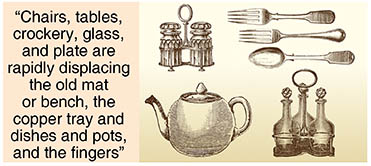
Chairs, tables, crockery, glass and plate are rapidly displacing the old mat or bench, the copper tray and dishes and pots, and the fingers. The custom of necessarily washing the hands after taking a meal, should the lips or the inner part of the mouth be touched either by the hand or by the spoon, is not much observed by the young class; they wash only when the hands are actually soiled. When they use knives, forks or spoons, they say it is not at all necessary to wash their hands, of course to the very great displeasure and disgust of the old gentlemen.
Many of the customs and ceremonies in connection with marriages, says the young class, are ruinously expensive, and altogether unnecessary, and not at all Parsi; they are almost all of them taken from the Hindoos.
Most of the Hindoo and expensive ceremonies and customs are now in a fair way of being swept away. A generation hence the wedding and funeral ceremonies of the Parsis will, I hope, be as simple and rational as those of any other people. The third day ceremony and the fourth day feast after the death of a person, and several other ceremonies not truly Zarthushti, bid fair to become soon things of the past. At this very moment there are several customs and ceremonies prevalent among one portion which are partially or wholly unknown to another. The schoolmaster is abroad, and "reform and progress” is the order of the day. God speed them, is the hearty prayer of one who is proud of his race and hopeful of its destiny.