"Wisdom, spirituality, service” is the motto of the Dadar Athornan Institute enshrined in its logo. Along with upgraded buildings and residential facility, the dedicated young staff of the Institute offers a well balanced education program, blending religious with secular education, promoting health, fitness and discipline.
A visit to the institution a year ago saw students ranging in age from seven years and more, disciplined, well informed and enthusiastic. Principal Ervad (Dr) Ramiyar Karanjia greeted guests with a smile. Earlier that morning 14 students ranging in age from 10 years onwards participated in a celebratory jashan lasting for over an hour — the recital was slow, deliberate, distinct and in unison, reminding us of a choir. A couple of youngsters, unable to maintain their attention towards the end, were ably restrained by their older brethren.
An athornan child is admitted at the age of around seven years and is trained for about seven to eight years to become a complete (sampurna) mobed. The transition from home to boarding school cannot be easy, but it is achievable and beneficial to growing youngsters.
Students acquire academic education, excelling in school topics like mathematics, science, computer usage, languages, etc, as well as in scriptures, recitation, memorization and reproduction of memorized recitals. Memorizing Yasna verses at the age of eight alongside academic studies is no burden for them. They appear for examinations and competitions in academic subjects as well as in scriptures and attain the required standard. Only after that are they allowed to graduate as navars and martabs. The examiners, not their own teachers, are honorary. Graduates and holding doctorates, the examiners are products of the same or sister institutions.
Dadar Athornan Institute; (top): principal Ervad (Dr) Ramiyar Karanjia
This education, along with boarding and lodging is absolutely free. Why would one not enroll one’s child in an institution of this caliber provided one is fortunate to be born an athornan, one may ask? This institution is a jewel in the crown of the community, and the community should proudly embrace it.
Both the athornan institutions, in Dadar and Andheri, suffer from a dearth of students. They have facilities, money, able and willing dedicated teachers and staff, but fewer and fewer children to educate, lamented the president and trustees of the Athornan Mandal and the principal. Their appeal to the media was to inform the community to send them their children and to give a measure of publicity to the achievements of their students as is given to expatriate students coming from overseas to be initiated as navar or martabs, though without the benefit of a similar level of standardized education and evaluation.
Navar and martab are the ritualistic ceremonial passages of athornan youth into the priesthood. The requirements have varied from time to time and geographically, changing the value of the title ervad that becoming a navar confers upon one. Children from the western diaspora get away with minimal ability to read the prescribed texts, pronouncing with difficulty and memorizing a mere chapter or two of the Yasna. Their parents and their community are satisfied with this. A certificate of lesser value than navar may be conferred upon such initiates as they do not go through the required curriculum. Their rationale is that since higher liturgical rituals cannot be performed in their environs their children do not require to learn them as they are already heavily burdened with their schooling and extra curricular activities. In that case they cannot and should not qualify as ervad, even if some priests in Bombay oblige by performing the rituals with exceptions made to cater to their whims and fancies. Lowered standards are hugely detrimental to the forward march of the religion and community. The serious and motivated clergy of the community in India need to give this subject thoughtful consideration and come up with a consensus document (not a fatwa) which can be implemented and followed diligently.
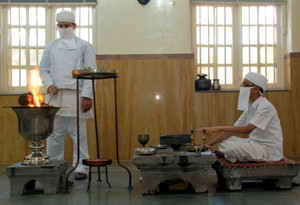
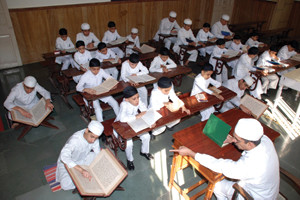
Students being taught rituals and ancient scriptures at the Dadar Athornan Institute
Some in the USA have floated the terms "mobedyar” or "paramobed” for those learning some scriptures in order to perform a semblance of the jashan, boi, funeral and uthamna rituals in their foreign milieu. These terms may fit such partially educated athornans. The Zoroastrian western diaspora may carry forward the Parsi-Irani cuisine and culture of chalk-chandan, toran, sari, gara, monajat and choir among themselves, but they tend to diminish their religion by diluting their scriptures and rituals. They express a fear that if they pressure their children to memorize scriptures and learn correct religious rituals they may "turn them off” and then there may not be enough priests (individuals) left to perform their funerals. This fear is born of ignorance. Even at present, a couple of times in the western priestly stronghold of the Zoroastrian Association of Metropolitan Chicago which boasts as many as 15 priests on their directory roster, two are not available to form the "funeral pair (jodi),” requiring a lay family member or a friend to stand by. Often ervads are not available as they are at school or are doing their regular (non religious) jobs and are unable to spare time for such voluntary priestly duties. Therefore, rather than lowering the requirements of priesthood, the community needs to consider and implement alternatives. Here are some suggestions for this:
A workshop of the community’s leading religious educators and practitioners to develop and implement a course curriculum for the education of navar and martab with minimum requirements and options;
Implementation of the curriculum without waivers and exams to be made a sine qua non for navar and martab ceremonies;
Creation of a basic level of curriculum for those opting for lesser participation with a title other than ervad, mobed, das-tur;
Facilities for serious candidates from the western diaspora for education of ervad upon the candidates having fulfilled the basic minimum curriculum at their home; a semester of concise course of theoretical and ritual practices at one of the two athornan institutions followed by clearing the examination for a full-fledged navar. Similar course-work for martab needs to be developed and implemented for locals as well as foreigners.
Advancing Parsipanu to the detriment of religion is not the way for the future of the Zoroastrian religion. Improvements are mandatory for the survival of religious education and rituals.