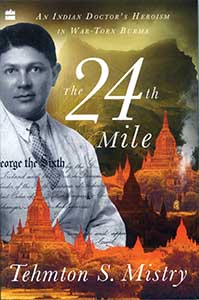
The 24th Mile: An Indian Doctor’s Heroism in War-Torn Burma by Tehmton S. Mistry. Published in 2021 by HarperCollins Publishers, A-75, Sector 57, Noida, Uttar Pradesh, 201301; website: harpercollins.co.in. Pp: xxii + 323. Price: Rs 599.
The 24th Mile is the story of Dr Jehangir Anklesaria, his courage, heroism and self-sacrifice as rightly stated in the preface by both eminent lawyer Fali Nariman and Lt Gen Kuldip Singh Brar, an Indian Army veteran of the 1967 Sino-Indian and 1971 Indo-Pakistan wars.
The book has a foreword by the highly respected physician Dr Farokh Udwadia which summarizes the sacrifice and selfless contribution towards humanity made by Anklesaria.
In the author’s disclaimer, US based Tehmton Mistry, a retired obstetrician and gynecologist states, "This is a work of creative non-fiction based on a true story.” The protagonist, Anklesaria is Mistry’s wife Aloo’s uncle. The story starts around Christmas Day 1941 when the Japanese, having completed the invasion of Hong Kong, are now targeting the Burmese capital of Rangoon.
Jehangir lived with his wife Goola and daughter Khorshed in a large bungalow in an upmarket area of Rangoon, but the advent of the Japanese invasion forced him to send his family away to India for their safety. Being the port health officer, he was in contact with shipping companies and the local administration. His work ethos, compassion and concern for his patients and colleagues are apparent from the various descriptions of his dealings with them in daily life. His ability to be calm, think and act quickly in times of crisis are apparent in the later chapters. What holds one’s attention are the detailed descriptions of the air raids, the fear and imminent danger faced by the local residents.
Goola and Dr Jehangir Anklesaria
The description of the journey from Rangoon to Mandalay, the second largest city in Burma, the heart-wrenching departure from Jehangir’s home in his Austin 12, the rigors and pressures of army life with the need for careful planning and precision never cease to amaze as we read about the retreat of the British and Indian army in the face of Japanese aggression.
Jehangir’s work to control the cholera epidemic and its further proliferation among the retreating troops and fleeing refugees makes one admire his calmness in the face of danger.
His mental strength is brought out in several chapters, such as when he embarks on the last lap of his journey from Kalewa to Tenice in the Kabow valley, and from there to Pobe in Imphal. He had to cross mountains and valleys, much of which were thickly forested and infested with stinging insects. His old Austin was stolen from him at the point of a gun by a group of rogue soldiers. He had to complete the last 24 miles on foot enduring tropical monsoon storms, the threat of malaria, typhoid, the presence of leeches and snakes and human corpses strewn along the path.
He focused on giving advice to himself, remaining motivated and resting his body by sleeping. He kept his mind active by recollecting past events, including his college days in London and Bombay, his family and his home. He also kept his spirits up by looking at the humorous aspect of his situation. The final impetus came when he realized his destination was close, that he would soon once again meet his family and friends.
Jehangir’s handling and containment of the cholera epidemic in Mandalay was recognized by the British who later honored him with the Officer of the Order of the British Empire award.
The epilog focuses on the successful retreat of the British-Indian army from Burma, the recognition by the Raj and Jehangir’s life in India after his return. Eight pages of family and other photos are included.
Credit must be given to US based Mistry for so vividly narrating Jehangir’s life’s journey. In the postscript he describes Jehangir as "an ordinary man who was dealt challenge after challenge in life’s extraordinary factory” and emerged "with solid gold in his character and a twinkle in his eyes.”
It was gratifying to read that most of the Indian doctors mentioned in the book had graduated from Grant Medical College and Sir J. J. Group of Hospitals, the alma mater from which both my husband Parvez and I graduated. Also, having lived through part of the transition from the British Raj to Independence heightened my interest in The 24th Mile.
Dr PILLOO HAKIM
Dr Hakim is professor emeritus, Grant Medical College and Sir J. J. Group of Hospitals, Department of Ear, Nose and Throat (ENT) and Head and Neck Oncology, and honorary consulting ENT surgeon at Saifee and The B. D. Petit Parsee General hospitals.