Jiyo Parsi initiates a program to better equip priests with
counseling and leadership skills
Farrokh Jijina
"I came with an open mind, to see what the organizers have to say. If I can learn anything that is new, I am open to it,” said Ervad Burzin Dastur (37), panthaky of the Bai Maneckbai Nusserwanji Chenoy Adarian in Hyderabad. Twenty-four-year-old Ervad Khurshed Behramkamdin who practices at the Seth Cowasji Behramji Banaji Atash Behram had heard about the Jiyo Mobed — Jiyo Parsi program only four days before it took place on May 13, 2017, at the Godrej Centenary Hall of the Masina Hospital. He
was there to see how he could speak more fluently, an objective that he says was fulfilled at the end of the program. The half-day workshop was intended to provide inputs for the development of leadership potential among mobeds through soft skills and to instill in them an ability to identify signs of mental distress in the populations they tend to. Inputs on self care were also scheduled. The speakers at the workshop included two psychiatrists and a psychotherapist.
Jiyo Parsi (JP), the government funded initiative to increase the community’s population through medical fertility assistance and advocacy since 2013, is implemented through the Dr Shernaz Cama led Parzor Foundation, the Bombay Parsi Punchayet (BPP) and Tata Institute of Social Sciences (TISS). The organizing team for the event, the first partnership between JP and priests, consisted of, besides Cama, World Zoroastrian Organisation Trust founder Dinshaw Tamboly, Delhi Parsi Anjuman trustee Dr Niloufer Shroff, Dr Katy Gandevia of TISS, counselors Binaifer Sahukar and Pearl Mistry, BPP trustee Armaity Tirandaz and JP public relations officer Pearl Tirandaz.
A note from Cama, inviting mobeds to the program mentioned that if this program were to be successful, "the priests would be trained in a series of workshops as per their willingness to become eloquent speakers; communicate values and ideas; deal with youth and their problems…” Speaking to Parsiana before the start of the program, Sahukar was optimistic they would be able to identify candidates from the 67 attendees who would be interested in furthering their skills.
Behdin pasbaan Marzban Wadia, fresh from the ninth residential workshop for para mobeds organized by the M. F. Cama Athornan Institute that concluded on May 10, kicked off the workshop with a song extolling the Parsi community and JP. "Phoolo phalo, aagal vadho” (prosper and move ahead),” he sang to the tune of an old Hindi film song. Tamboly reminded the audience to "let there be only positive vibrations today.” Let us put our best foot forward, he declared. It was fortuitous that the program was taking place on Aneran roz, which stood for endless light, he said. In his brief welcome address, Dr Vispi Jokhi, director of the Masina Hospital, said that the community needed to continue to thrive and this was the message the workshop should convey to the community, to the nation and to the world. He reminded the audience that the tool kits for participants had 20% discount coupons for certain medical services, with compliments of the Hospital.
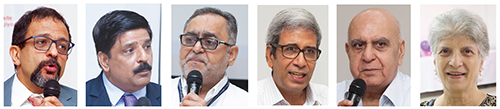
From left: Drs Kersi Chavda, Aliakbai Gabhrani, Yusuf Matcheswalla and Vispi Jokhi, Dinshaw Tamboly, Armaity Tirandaz
From left, top row: Pearl Mistry, Binaifer Sahukar, Dr Katy Gandevia, Marzban Wadia;
2nd row: Ervads Burzin Dastur, Kaizad Karkaria, Darayus Bajan, Jehan Darbari and Verzavand Dadachanji
Photos: Sarosh Daruwalla, Mazda Audio Video Lab and Farrokh Jijina
Knowledge as the base
Ervad Kaizad Karkaria, manager of Seth Rustomji Nusserwanji Rustom Faramna Agiary led those assembled in prayer. Dastur informed Parsiana that the prayer was from the Afringan where the supplicant appeals to Ahura Mazda "to bless all priests.” Laying down the broad schedule for the workshop, (a priest’s perspective, followed by sessions on leadership and self-care), Tamboly invited Ervad Darayus Bajan to provide a mobed’s angle. Bajan, a chartered accountant who practices at the Seth Bomanji Merwanji Mewawala Agiary, began with "once we know our history, we can recreate the future.” Reiterating that tending to the holy fire is but one aspect of a mobed’s work: Mukhya kaam dharam no oondo abhyaas karvaano chhè [the main work (of a priest) is to study the religion in depth], Bajan emphasized that the role of the priests is to tend to the inner fire of those in his flock too. The position given to athravans in Persian society was very high, he mentioned, and added "pehla aapru knowledge vadharvu joiyé (let us increase our knowledge first)” Twenty-five-year-old food technologist and full time mobed at Rustom Faramna Agiary Jehan Darbari talked about the inner calling that led him to take to mobedi as a career, but added that "spiritual satisfaction alone will not motivate all to join the profession.”
The importance of a priest to be armed with sound knowledge was repeated in a paper in the kit. Titled "Zoroastrian priest as pastor,” the note from Dastur (Dr) Firoze Kotwal (which was read out on the 50th anniversary of the Kaikhushru Pallonji Katrak Dar-e-Mehr in Delhi), quoted from the Vendidad, Chapter 18.6: "Him and him alone you should call a priest… who…inquires wisdom from a holy sage, wisdom which makes a man free from distress…” A welcome message from lawyer, former BPP trustee and also trustee of the Masina Hospital, Ervad Burjor Antia, also in the tool kit, said that the community needs "enlightened priests who understand the meaning of prayers and the ceremonies and explain to the laity.”
Empowering priests
Dr Yusuf Matcheswalla, professor of psychiatry at Grant Medical College, Sir J. J. Group of Hospitals, and honorary psychiatrist and head of the psychiatry ward at Masina Hospital, reminded the audience that if a Bohri priest came across an unmarried man of 30, one could be sure that in a few days, a meeting would be arranged between the man’s family and that of a prospective bride. "Our priests are very powerful,” he said, and asked the audience if they felt empowered. "Would you call yourselves community leaders?” he asked the assembled mobeds, to which there were only a few affirmative nods.
Drawing on the work done by one of his assistants who had interviewed Christian priests, Muslim maulvis and members of ISKCON (The International Society for Krishna Consciousness), the psychiatrist presented over 30 qualities of a good priest. These ranged from generic leadership qualities ("not a gossiper, sincere carer, passionate about his work, well organized, approachable and dynamic, and having good conduct”) to those which echoed Bajan’s thoughts on the need for a mobed to increase his knowledge: well versed with the scriptures, good personal relationship with God, and knowledgeable.
In his one-hour session on communication skills, Dr Kersi Chavda, Fellow of the American Psychiatric Association and The Indian Psychiatric Society provided inputs to the mobeds on how to establish a rapport with their behdins: with self-confidence, enthusiastically, with appropriate eye contact and with empathy. Emphasizing the role of non-verbal communication, the psychiatrist who practices at the P. D. Hinduja National Hospital and Medical Research Centre and the Sir H. N. Reliance Foundation Hospital and Research Centre listed what could be barriers to communication. "Give your listeners the right to feel important,” he exhorted, providing tips on how to handle conversations with angry and difficult behdins. "Accept, accept, accept,” was his mantra to the assembly. Touching on the area of self care, he advised the mobeds to "be their own best friend… You must treat others as you would like to be treated,” he emphasized. Among his other inputs: "separate the person from his (wrong) actions; state the positive without evaluating the individual; capitalize on existing strengths of people you are talking to.” Speaking on stress and its management, Chavda suggested fixed times for relaxation, and proper time management as vital. "Let us utilize these inputs, and those from future workshops, to be more effective individuals,” he ended.
A film on the genesis of JP, and statistics about the need to marry and conceive early were shown. Mistry reiterated that reimbursement of up to five lakh rupees provided to couples for fertility treatment, with a family income cap of Rs 20 lakhs. "You can go to a gynecologist of your choice,” she said, adding that cashless option was available at the D. N. Mehta Sarvajanik Hospital in Navsari. In a short talk, Gandevia exhorted the priests to become champions for JP in their areas.
Self care and parenting
"Love is the ability to create space in which something is allowed to change,” was Dr Aliakbar Gabhrani’s definition of the term. In a highly animated talk that saw the director and psychotherapist of Masina Institute of Psychotherapy & Behavioral Sciences darting energetically from table to table to make his point, Gabhrani emphasized tolerance, kindness and perception as the formula for a happy marriage. "Be monogamous in the head,” he said, adding that infidelity need not always be physical. Advising those present to live in the here and now, and to forget the past, he stated that "two imperfect people can make a perfect relationship.” Demonstrating with a bottle of aerated soft drink which bubbled over when shaken, Gabhrani asked the mobeds to be aware of what they keep bottled up within themselves. "You will explode sooner or later,” he said. What we resist will persist, he opined, harking back to Chavda’s mantra of "Accept, accept, accept.”
An important element of parenting, according to Gabhrani, is teaching stress management to children. "Be a role model to your kids… Give love and warmth from within,” he emphasized. His prescription for creating strong bonds with children: 10 minutes of eye contact, 10 minutes of physical touch, a 10-minute walk and a meal together. The three-word mantra from Gabhrani: Encourage, encourage, encourage!
Armaity Tirandaz gave a comprehensive vote of thanks, after which the audience were served a Bohri lunch sponsored by Matcheswalla.