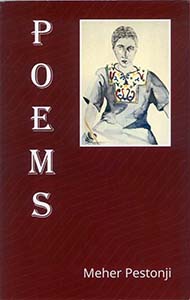
Poems by Meher Pestonji. Published in 2022 by Bluerose Publishers; website: www.BlueRoseONE.com; email: info@bluerosepublishers.com. Pp: 98. Price: Rs 295.

In her recently published Poems, Meher Pestonji (pictured), freelance journalist, theater critic, book reviewer and social activist, who has written short stories, plays and novels, confessed that though she has been writing poems for over 40 years she has always been very diffident about publishing them. What made her change her mind? During Covid she connected with poets from around the world on Zoom and found that she could read her poems to those in different countries from the comfort of her home without having to confront "a sea of staring eyes, a barrage of questions.”
The poems have been divided into three sections: Lonavala, Mumbai and Zoom Poetry. It is evident that Pestonji has a very close relationship with nature. Several poems deal with her intense passion for nature which is described with great sensitivity in her poems.
In Couple, she describes an egret which stealthily and vigilantly awaits the arrival of its mate:
The one flaps, the other dives
one soars, the other glides
crissing and crossing
the atmosphere
then together
they disappear.
It is very interesting to see how Pestonji matches the substance of the verse to the form as the lines gradually become smaller, visually illustrating disappearance. In Flower and Mountain, she conveys the idea that though "a flower is distinct from a mountain,” both are touched by the same elements and "both beautify the earth.”
However, she seems to be most attached to trees. In her very first poem, Heritage, she refers to a family bungalow in Lonavala which has been visited by three generations of her family, reveling in the fact that the trees:
standing tall they will outlive
my children, grandchildren and me.
Trees are the theme of several of her poems. In Trees, she shows her appreciation for trees which continue to be subjected to the elements, thrive under difficult and adverse conditions and don’t really need watering, yet continue to grow and in Earth Song (Tangka), she evocatively describes the interplay of music between her and a bird and the resulting harmony which mingles with "falling leaves waltzing with wind.” When the leaves tumble to the ground they carpet it with "crumbly, crisp crackles” adding to the music in the atmosphere. Nature’s Gift is a small seed a bird leaves on Pestonji’s balcony which she initially plants in a pot and later has to transplant in a larger space in Lonavala. She reflects on the future when the tree will provide her family with fruits and she takes great pleasure from the fact that future generations will remember "nature’s gift was born in a pot.”
In the section "Mumbai” Pestonji shows a great affinity to her surroundings. She admires the Streetlights which light up dark pathways and, hence, protect people from potholes. She sensitively describes the view of twinkling lights from an aeroplane and comments on the…
darkness left powerless
against the sparkling might
of united lights beautifying the night.
However, the tone changes and gradually becomes more strident. In Road and Rooftop, though she accepts the necessity for roads that lead from one point to another, she regrets that they are used for material purposes. "Roads/ know no rooftops” as they are bustling with maddening traffic, while rooftops witness flowering treetops and the infinite sky. She ends the poem thus:
Humans need roads
But rooftop is where the spirit grows.
In Ode to a Christmas Tree she describes a coniferous tree which falls to the ground without damaging man or wall or car. The tree, which gave children such joy and which was decorated year after year for Christmas, is now, within one hour, chopped and loaded into a garbage van with buyers bargaining for "good wood.”
Whereas she is critical of the city, she shows great sympathy and admiration for its inhabitants. In Amputee, she pays tribute to a one-legged girl who wins medals which, she adds in an aside, are "no match/for winning at life.” Or physically challenged servicemen who play badminton with courage and determination in wheelchairs in the poem entitled Wheel-chair. Or the Dwarf who won races in spite of having to take "three steps/ when others need only one.”
In the "Zoom Poetry” section she writes with great affection about trips to Lohagadh, a hill station in Poona district, which are marred by selfie clicking tourists and violent monkeys. She presents a very positive view of the Covid epidemic in Despite Corona… and is confident that human beings will show more resilience than the flowers, birds and trees which continued to flourish during the epidemic.
However, her concerns seem to be with violence. In America Today, she strongly criticizes the gun culture in the country where the law makers are more concerned with profit rather than the welfare of the citizens. The same idea is carried forward in A Student’s Voice, where an innocent school child is assassinated by a gunman in a maths class. She criticizes the Ukrainian war in Babies in Ukraine’s Bunkers who are born to die before they turn five. The poem is replete with stark images: "homes crumbling in fires,” "swirling smoke blackening blue.” The poem ends with a very severe indictment:
Only devils deprive babies
of smiles, gurgles, dreams
Such oppressors must die.
But is the bleak situation entirely the fault of politicians? Pestonji feels that we are each to blame and should accept responsibility. In Wild Fires, which spread around the world, she also blames man’s greed for destroying the universe:
but can we write off our own role
as consumers demanding more and more and more?
In Birds in Afghanistan, once again the imagery is very violent and distressing as all humans seem to do is to helplessly watch the widespread destruction and injustice, consoled by the fact that the situation is far removed from us. We express sorrow and comment on the state of affairs but do nothing more than turn the page of the newspaper and drink our morning tea.
However, there is some hope in Music Transcends Madness where despite the debris, the bombs, the bullets and the miserable bomb shelters, Pestonji strongly believes that it is music that:
…fuels resistance, feeds fighting spirits,
welds citizens into a power-generating force.
The beauty of Pestonji’s Poems lies in her ability to wield her pen. She is sensitive and vulnerable to nature, its splendor and beauty; she is compassionate to human beings in distress; yet, she can use violent imagery and become forceful and assertive in the face of brutality and injustice.
FIRDAUS GANDAVIA
Gandavia holds a doctorate in English literature and is a retired chartered accountant. He is a compulsive reader of fiction.