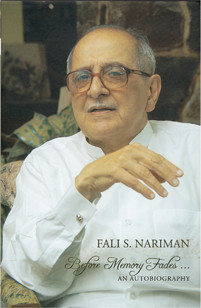
Before Memory Fades: An Autobiography by Fali S. Nariman. Published in 2010 by Hay House Publishers (India) Private Limited, Muskaan Complex, Plot No 3, B-2, Vasant Kunj, New Delhi 110070. Pp: 459. Price: Rs 599.
When India’s pre-eminent lawyer and constitutional expert pens his memoirs, it is but natural that they will evoke much interest. And when these appear at a time when a cause celebre in which he played a leading role is once again in the public glare then that interest is doubled. Fali Nariman’s autobiography Before Memory Fades has been published at the time of the Bhopal gas tragedy verdict, and coincidentally also the 35th anniversary of the imposition of the Emergency. Nariman, who famously resigned as additional solicitor general of India when the Emergency was imposed in 1975, championing human rights and opposing legislative tyranny and executive arbitrariness, was ironically also the lead lawyer for Union Carbide Corporation in the mid-eighties when the mephitic fumes of methyl isocyanate gas claimed thousands of lives in Bhopal.
Nariman’s offering is not the continuous narrative of a conventional autobiography. It is more a collection of anecdotes, reminiscences and reflections of the important events and cases that have shaped his life. Nariman says as much at the beginning of the book: "It is in this chatty way that I recall episodes from my life, commenting along the way on men and matters.” In fact one can dip into any chapter of the book and it will entertain and inform; one can pick and choose at will — you don’t have to necessarily read them in any particular order. That said, each chapter is a gem in itself. Skip what doesn’t appeal to you and dip into what you do like with profit and pleasure.
Born in Rangoon to Sam and Banoo Nariman, young Fali and his family fled to India when the Japanese invaded Burma during World War II. Fali was 12 at the time and vividly remembers the great trek from Mandalay to Imphal. He recalls that that it took the family 21 days through forests, rivers and mountain terrain (where they escaped death providentially when a stray elephant changed his mind about walking all over them), to reach Imphal. From the refugee camp in Imphal the family made its way to Calcutta via Dimapur and then onwards to Delhi.
Nariman completed his schooling at Bishop Cotton School, Simla, and his BA (Hons) from St Xavier’s College in Bombay. He graduated with unremarkable honors, but came into his own after he joined Government Law College, Bombay, passing his LLB final with a first class, placing second in the university. (He says that his two years were made that much more pleasurable because he had as part-time lecturers, Yeshwant V. Chandrachud, Nani Palkhivala and Jal Vimadalal.) The next year he topped his advocate’s exam. He started his career in November 1950 when he joined the Bombay Bar.
Some of the best parts of the book comprise anecdotes about lawyers, judges and even persons outside the legal profession. (There is a chapter devoted to Mother Teresa and the Dalai Lama.) Nariman also devotes an entire chapter (to my mind one of the best in the book), to the ‘dos and don’ts’ of how to prepare for, and argue, important cases. The most important lesson he learnt was from C. K. Daphtary, India’s second attorney general, who told him to spend more time thinking about a case rather than merely reading the brief. Nariman holds judges like M. C. Chagla, K. Subba Rao, M. Hidayatullah, M. N. Venkatachaliah, H. R. Khanna and V. R. Krishna Iyer, among others, in high esteem, apart from both high regard and affection for Daphtary who was known for his wit and humor. But some of the best anecdotes are those connected with his mentor Sir Jamshedji Kanga.
Nariman started his professional life in Kanga’s chambers. Doyen of the Bombay Bar and a former advocate general of Bombay (1922-35), Kanga was an institution in Bombay’s legal circles and his chambers was the nest which nurtured some of the greatest lawyers and judges in India: Sir Harilal Kania, Palkhivala, Hormasji Maneckji Seervai, Soli Sorabjee and the author, to name only a few. The first named was Kanga’s junior and went on to become independent India’s first chief justice. When asked about Kania many years later, Kanga described him as a "very nice and industrious boy!” Kanga was also a great raconteur and narrated many delightful stories about "the old days.”
Bapsi and Fali Nariman at their home in Delhi
There is a story about Kanga (who was like a father figure to Nariman), which bears out the author’s assessment of his mentor. "We had the most amazing leader in Sir Jamshedji Kanga — all 6 feet 4 inches of him — but much taller in heart and mind.” Initially, Kanga’s chambers were on the ground floor of the High Court. He was asked to vacate the chambers as expanding litigation necessitated a greater number of court rooms. Kanga led a delegation to Chagla, the then chief justice of Bombay, requesting alternative accommodation. When Chagla indicated that there was not much hope, Kanga said that in that case he would have to sit at home. He said that he would either sit in the High Court building or he would retire. Chagla then went out of his way to persuade the public works department to construct an extra floor on the building adjacent to the High Court with a connecting link. It was on this floor that "Kanga and his brood” were accommodated in Chamber No 1, the largest single chamber on the floor. Why did Chagla go out of his way to accommodate Kanga? Thereby hangs a tale. Years before, when Chagla was a struggling junior, and Kanga the advocate general, Chagla’s father was involved in some litigation and needed legal counsel. Chagla’s own senior, Mohammed Ali Jinnah (no less) refused to help him saying that he never appeared free of charge. Chagla then approached Kanga, whom he did not know, for help. The ever gracious and generous Kanga appeared free for Chagla’s father. Chagla must certainly have remembered this act of kindness when Kanga petitioned him for alternative accommodation.
Nariman also narrates a Chagla anecdote in which he himself figures, and which attests to the latter’s courtesy and graciousness. Nariman was only a year old at the Bar when Palkhivala had entrusted him with an appeal from a writ petition under the Bombay Land Requisition Act. Nariman was to brief Palkhivala on the points involved in the appeal. As luck would have it the appeal reached hearing in Palkhivala’s absence (he had another engagement) and Nariman found himself before a bench comprising the stalwart judges Chagla and P. B. Gajendragadkar. Chagla asked a hesitant Nariman to proceed and Nariman says that he "made a perfect mess of the appeal.” Palkhivala arrived at the time the judgment was being delivered and his attempt at damage control was met with a polite "Mr Nariman very ably put forward the same point and we have rejected it.” Chagla’s deadpan expression gave no indication of Nariman’s pathetic effort that had preceded the judgment. All this in support of a junior whom he had never seen or heard of before!
The author was either part of, or had a ringside view of, some of the most seminal cases in Indian legal history. Nariman appeared in the 1967 Golak Nath case (more properly Golak Nath vs The State of Punjab) with Palkhivala and Ashok Sen, debating whether the fundamental rights could be amended or abrogated by constitutional amendment. Chief Justice Subba Rao managed to forge a narrow majority (6:5) for the view that none of the fundamental rights were amenable to the amending power of the Constitution because an amendment to the Constitution was a ‘law’ under Article 13(2), and under that Article all laws which contravened any of the fundamental rights in Part III of the Constitution were declared to be void. The battle then was over property rights and the judgment was seen as favoring big property. (It was also during Golak Nath that the practice of submitting written arguments to the Supreme Court was started. The story goes that R. V. S. Mani, a lawyer from Nagpur who had filed an earlier petition on the same point, insisted on making the opening statements in the case. Mani kept enumerating his propositions and the judges dutifully noted them down, till he came to his 10th. That was when one of the judges on the bench, Justice J. C. Shah lost his cool, and said, "No more — you give it to us all in writing.”)
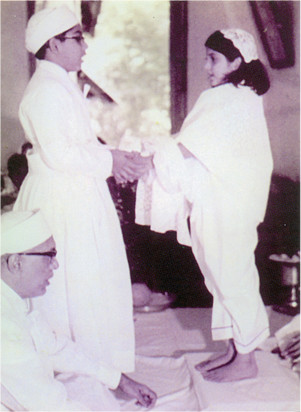
Rohinton Nariman performing the navjote of sister Anaheeta in Bombay
However, Parliament went ahead with more constitutional amendments. Six years later, in Kesavananda Bharati vs The State of Kerala a 13-member bench presided over by Chief Justice S. M. Sikri was constituted to consider the validity of some of the later amendments (24th, 25th and 29th) but more specifically to ponder the correctness of the decision in Golak Nath. Since Nariman had appeared for the petitioners in Golak Nath he could not appear for the government even though he was additional solicitor general at the time. In this historic (and arguably most famous) case in Indian legal history, the court held (7:6) that although no part of the Constitution was beyond the amending power of Parliament, the basic features of the Constitution could never be abrogated.
A ‘lawyer of his choice’
The publication of Nariman’s autobiography has coincided with the media-induced hysteria in the Bhopal gas tragedy following the conviction of several persons by a local court. Nariman who was the lead lawyer for Union Carbide Corporation devotes an entire chapter to the case, which largely comprises two articles: a 1992 response to an article criticizing him in the Human Rights Tribune and a 2004 essay in Seminar. The latter has been published along with two responses, one of them by eminent jurist Upendra Baxi — a sharp attack on the author for representing Union Carbide Corporation, and another by activists Vijay K. Nagaraj and Nithya V. Raman. A fair man, Nariman allows them their full say in the book. While public outrage may run high at present, Nariman’s arguments need to be considered dispassionately since what is being angrily denounced today was upheld by the judiciary at every level.
It has been posited that human rights activists have a degree of credibility bestowed on them once they are recognized as part of the human rights community. (Nariman served on the executive committee of the International Commission of Jurists and was even its chairman.) Such respectability also has its responsibilities and it was felt that Nariman’s hiring allowed Union Carbide Corporation to cash in on his human rights credentials. Nariman in his reply to Laurie Wiseberg, editor of the Human Rights Tribune said that the suggestion that human rights activists should not accept briefs of those who ‘violate’ the human rights of others is not only impractical but fraught with grave consequences: it not only prejudges guilt but more importantly precludes the person charged with the right to be defended by a ‘lawyer of his choice’ — a constitutional right in India. Still, with the 20:20 vision which hindsight always gives, Nariman has admitted in interviews that had he known what was to follow he would not have accepted the civil liability case. It is also a sad fact that a succession of governments did nothing for the people of Bhopal. Nariman can hardly be held responsible for the errors of omission (and commission) in what has turned out to be a huge systemic failure.
In 1993 Nariman appeared in the ‘Second Judges Case’ which he won, but now says that he would have preferred to lose. In that case the Supreme Court assumed the power to appoint judges through a ‘collegium’ thanks to a broad interpretation of Article 124(2) which Nariman says was ‘reconstructed under the guise of interpretation.’ But things were no better because the selections could not be interpreted in the spirit in which the doctrine was propounded. This was largely because the three seniormost judges could not see eye to eye in matters of appointment of judges. The ‘Third Judges Case’ (1998) increased the number to five on the somewhat dubious principle that there was safety in numbers, but the main lacuna, namely, the lack of an institutional system for making recommendations, remains. Nariman is in favor of a National Judicial Commission but stresses that the real need of the hour is transparency in procedure.
Nariman’s autobiography is almost entirely a recounting of his professional life and views. One would have liked to know more of his personal life and that of his family. Nariman, the legal-eagle, is in sharp focus, but somewhere Fali, the man, gets lost. But we must respect the narratives he shapes out of the raw material of his life. In any case, writing an autobiography is not easy. A challenge that every writer faces is the distribution of periods and phases, the right proportion among wide and varied fields of public and personal activity, and the right scale for the many episodes of one’s life. To produce an ordered impression within the compass of a few hundred pages is no easy task. And all said and done, Nariman has done a fine job in recounting without artifice, and with plenty of charm, humor and erudition, the events of his life.
A modest man, Nariman, who was awarded the Padma Vibhushan in 2007, (and has been president of the Bar Association of India since 1991), tells us in passing how he declined a High Court judgeship at the age of 38, and later at the age of 53, elevation to the Supreme Court direct from the Bar. After declining the office of attorney general of India in 1996 and 1998, Nariman accepted (on his wife Bapsi’s insistence), a nomination to the Rajya Sabha in 1999. He says that he greatly enjoyed his tenure in the Upper House, even introducing a bill — Private Members Bill No: XXXIX of 2004 called ‘The Disruption of Proceedings of Parliament (Disen-titlement of Allowances) Bill, 2004,’ which was introduced to disentitle members of Parliament from drawing allowances during days on which proceedings were adjourned due to disruptions caused by members of Parliament individually or collectively. The bill lapsed when he ceased to be an MP and went into oblivion.
Nariman recounts at the beginning of the book how his false pride had been pricked by one of his teachers at St. Xavier’s College. When asked where he had schooled he proudly said, "Bishop Cotton School, Simla,” only to get the deflating rejoinder: "Simla, but man, why did you have to go so far to learn so little?” Nariman says that this was his first lesson in keeping his ego under check. While writing an autobiography, that flirtation with immortality, is not an exercise in self-effacement, we must be grateful that Nariman’s innate modesty has not curbed his desire for confidential expansion or else we would have been deprived of this eminently readable account of not only his life, but also commentary (from the horse’s mouth as it were) on some of the important court cases which have shaped India’s polity.
* * *
"Behind the scenes”
Though Nariman does give a few details about how Sikri managed to forge a narrow majority, he does not mention a lot of "behind the scenes” activity in this case. Tehmtan R. Andhyarujina, who was a senior counsel in this case, made some interesting revelations (which Nariman must certainly have been aware of) about the case in 2007 of "several unusual happenings” in the case which if related in detail would make one doubt if the decision in the case was "truly a judicial one.” Six judges affirmed the "basic structure” theory, whereas six others were of the opinion that there were no limitations on Parliament to amend the Constitution. One judge — (Khanna) took neither side. He contended that Parliament had full power in amending the Constitution but since it had the power only "to amend” it had to leave the basic structure of the Constitution intact.
It was a hopelessly divided court. How then was the verdict given? Andhyarujina says that the story behind this is generally not known. Immediately after the 11 judges finished reading their judgments, Sikri (in whose opinion Parliament’s power was limited by inherent and implied limitations) passed on a hastily prepared paper called a ‘View of the Majority’ for signatures by the 13 judges on the bench. One of its conclusions was that "Parliament did not have the power to amend the basic structure or framework of the Constitution.” This had been taken from one of the conclusions in Khanna’s judgment. While nine judges signed the statement in Court, four others refused to sign it. It was in fact the view of one judge — Khanna. Andhyarujina says that some judges had no time to read all the judgments as they were prepared under great constraints of time owing to the retirement of the chief justice the next day. Chandrachud confessed that he hurriedly read four draft judgments of his colleagues. No conference was called, and the one that was called by the chief justice excluded those judges who held a contrary view (ie who were of the opinion that there were no limitations on the amending powers). Nor was the conclusion debated in court. The chief justice was obviously trying to create a majority that did not exist.
Ironically, it is Khanna’s judgment, with which none of the other 12 judges agreed entirely, which is now used to interpret the validity of laws in the Ninth Schedule. (Parliament added the Ninth Schedule to the Constitution through the very first amendment in 1951 as a means of immunizing certain laws against judicial review. Under the provisions of Article 31, which themselves were amended several times later, laws placed in the Ninth Schedule — pertaining to acquisition of private property and compensation payable for such acquisition — cannot be challenged in a court of law on the ground that they violate the fundamental rights.)
Khanna was of the view that fundamental rights could be amended, abrogated and abridged so long as the basic structure was not destroyed. But he held that the part of Article 31C which prevented judicial review was invalid. The curious thing is that while Khanna sided with the majority judges on the basic structure doctrine, he sided unconditionally with the minority judges while upholding the 29th Amendment. (The 29th Amendment enacted in 1972 added two Kerala Acts dealing with land reforms in the Ninth Schedule, and this was the subject matter of challenge in the Kesavananda Bharati case.)
As is well known Khanna ‘clarified’ his judgment in Indira Gandhi’s election case two years later little realizing that this clarification contradicted his judgment in the Kesavananda case as he had held unconditionally valid two constitutional amendments that nullified vital fundamental rights. (In January 2007 a nine-judge bench of the Supreme Court unanimously held in IR Coelho vs State of Tamil Nadu and Others that even though an Act is put in the Ninth Schedule by a constitutional amendment, its provisions would be open to attack on the grounds that they pertain to what the judiciary interprets as the basic structure of the Constitution.)
More famously, Khanna’s was the lone voice of dissent in another famous case, Additional District Magistrate, Jabalpur vs Shiv Kant Shukla, in which he held that basic human rights could not be violated even during an Emergency. Khanna was rewarded for his efforts by being overlooked for the office of chief justice even though he was the seniormost judge. Nariman says that Khanna resigned in a blaze of glory and it is for good reason that his portrait hangs in the court where he sat — Court No 2.