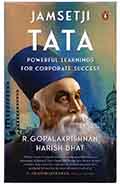
Jamsetji Tata: Powerful Learnings for Corporate Success by R. Gopalakrishnan and Harish Bhat. Published by Penguin Business, 4th Floor, Capital Tower 1, M. G. Road, Gurgaon, 122002. Pp: xiv + 247. Price: Rs 599.
Neither the enduring relevance of Jamsetji Tata nor the value of the lessons that can be learned from his remarkable legacy can be gainsaid. Both aspects of his life deserve to be publicized widely, especially in present day India where there is a lamentable lack of ethically grounded role models for the country’s teeming youth. This slim book holds out the promise of performing that educative role, and should be welcomed for that reason. But not everyone is, alas, likely to be impressed by the work.
The authors are both Tata insiders who have held prominent positions in the 157-year-old business house founded by Jamsetji. They are at pains to declaim, at the outset, that they did not set out to produce "a biography of this legendary man.” Instead, their mission has been to document "how the apparently simple business philosophy of Jamsetji Tata has been retained, renewed and reinvigorated for over a century and amongst generations of Tata leaders.” And they do this using a style which will strike many as quirky, and rather ungainly.
That style involves assembling 10 chapters ("narratives and lessons,” in their jargon), all under headings which start with the letter "P”: philosophy, purpose, progress, people, pioneering, persistence, principles, profit, perspectives and postscript. Discerning readers will immediately see how stilted — as well as grammatically clumsy — such an arrangement is. Gopalakrishnan and Bhat justify their approach in the following words: "We recognize that these Ps can apply to many entrepreneurs, both in India and elsewhere. It is the authors’ view that the simultaneous emergence of all the Ps in an entity is rare. In biology and botany, such a simultaneous occurrence of qualities is called ‘the emergence principle.’”
They make another claim as well, namely to "present an entirely different montage of facts and (sic) about Jamsetji Tata and the Tata Enterprises” — a claim on which the opinion of those who read this book is likely to be divided. However, a more fundamental question which the book raises, to which Jamsetji’s life and work provides a clear-cut answer, is: "Is the concept of an enlightened capitalist an oxymoron?” It is a question which has undeniable salience in contemporary India.
The book is full of stories which give the lie to the myth peddled by leftist demagogs and unscrupulous politicians all over the world that the profit motive, which is at the heart of capitalism, cannot be reconciled with ethical business conduct or the promotion of the public good. Those stories involve not only Jamsetji but Tata leaders who followed him decades after he died, which goes to show that the ethical foundations which Jamsetji had laid over a century-and-a-half ago were as strong as they were enduring.
The perpetuation of such values depends, of course, on both the competence and the moral uprightness of those put in place to lead. At an operational level, this means, among other things, an ability to make difficult choices and an iron will to resist temptations and blandishments which may come their way. While the Tata group has, overall, fared far better in this respect than most Indian business enterprises, its record is far from unblemished. This book refers to some tricky situations in which the group has found itself from time to time (a prominent example being the fraudulent conduct of the managing director of Tata Finance Limited, Dilip Pendse, which nearly bankrupted the company in the early 2000s), but perhaps less critically than some readers would expect.
R. Gopalakrishnan (l) and Harish Bhat: Tata insiders
The period during which stewardship of the group fell into the hands of the recently deceased Ratan Tata, which saw an unusual level of turbulence, could have done with more extensive treatment (or at the very least reasonable references): some of the developments during this period raised serious questions of managerial competence, perhaps even of corporate governance. Apart from the high-decibel spat between Ratan and his successor, Cyrus Mistry, which took much sheen off the group’s image, this period also saw other controversies, including some involving friction with politicians. There was a fiasco over the production of Tata’s Nano car in West Bengal, allegations that Tata Tea executives were dallying with militants in Assam, and insinuations that a close aide of Ratan, R. Venkataraman, had been involved in serious impropriety. None of these matters finds any discussion in the book.
Such omissions are, unfortunately, par for the course. It would require extraordinary courage and detachment for those connected with the organizations they are writing about — whether the connections are present or past ones (unless they have had a falling out) — to be truly objective in their analysis or assessments. The culture of frank, even-handed evaluation is particularly weak in countries like India, with the result that most books in the genre lean heavily towards hagiography.
A more serious complaint that percipient readers, especially of a conventional bent of mind, may level against this book is that it is littered with management-speak. Phrases like "narratives,” "ecosystem,” "learnings,” "echo chambers,” abound when there is no obvious justification for them; worse still, in what many will see as a nod to political correctness, the authors conjure up an acronym, SHE, and argue that the words behind it — sustainable, honest and enlightened — can be a substitute for socialism or capitalism, adding, rather fatuously: "The ‘feminization’ of enterprise through the acronym SHE has the added benefit of imparting humanism to profit-making.” More gobbledygook follows: "Enterprise leads to people enhancement in society, and, together, enterprise and people enhancement lead to citizen ecstasy. It is to the credit of Jamsetji that he had the foresight to figure this out and acted on it, though he did not use the words that we are using today.”
The poor man, it would be safe to say, would be spinning in his grave at this gratuitous ascription to him of such ill-advised formulations! V. I.