On reading the editorial "Others don’t need to learn” (Parsiana, December 21, 2016) I was left wondering whether along with the dwindling numbers our brains too are being affected. Parsis don’t mind washing their dirty linen in public, whether it be a public exhibition of maramari (physical fights) in the courtroom involving Bombay Parsi Punchayet trustees or their ongoing legal problems about which they love to talk and defend their stand, or the recent spat involving Cyrus Mistry, Ratan Tata and Nusli Wadia laid wide open to be debated by the whole world.
It seems ridiculous for some community members to needlessly find fault with everything that another group does. Thank God for men like Ervad (Dr) Ramiyar Karanjia who take things in their stride and go about their business. Traditionalists are against airing videos of a jashan. Why were they silent when jashans were being performed for J. R. D. Tata and Rajiv Gandhi? Shouldn’t they have objected? It’s appalling the way we behave. One wonders whether this is the 17th century!
Since Dastur (Dr) Firoze Kotwal had no objection to the heritage walk at Doongerwadi, those against it will have to quieten down, because he is regarded as a traditionalist-scholar. If he sees no wrong, the criticism will taper off. After all, they cannot club him with the renegade priests!
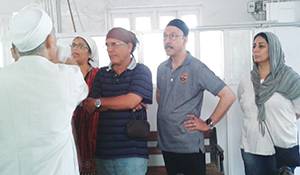
Ervad (Dr) Ramiyar Karanjia pacifying protestors at Doongerwadi
Why must those of other faiths not know about our religion and rituals? Are we ashamed of them? I remember during my school days, and even later, non-Parsis often screwed up their faces and said, "You throw your dead in a well to rot and for vultures to devour. How primitive!” It always hurt, because no explanation could halt their ridicule. There are so many such instances where we were made to feel embarrassed and different from the rest, and there was no way of changing this perception. Even drinking of taro (consecrated bull’s urine) was laughed at. Learned scholars like Karanjia should explain things to place our rituals and customs in the proper perspective. The more we keep things under wraps the more curious others become.
Another thing that upsets me is the great aplomb with which I have often been told: "Arré tamari agiary ma hamé gayaj ané badhu joyuj ané koié bhi hamuné stop nai kidha. Arré tamara Udvada na fire temple ma bhi... (Oh we have been inside your agairy and no one has stopped us. We have been to the Udvada fire temple too).” How can one stop someone entering our fire temples? After all, "I am a Parsi” is not written on our faces! I still maintain that if everyone is permitted to enter fire temples in Iran, why are we so rigid? Our places of worship are probably the most simple, with only the holy fire burning 24/7.
Change, Parsis, change! It is for our good. RODA D. HAKIM
Baroda
vadhakim@yahoo.comI received a letter from one Mahiar Sidhwa of Surat along with the photograph of a paidast ceremony in Bombay showing nassessalars/khandhias begging for alms to allow the atma (soul) to depart peacefully. Relatives and mourners are made to part with a few thousand rupees in alms to the corpse bearers. This is nothing but extortion, as money has already been paid for using the facility at Doongerwadi. In Bombay, the actual cost amounts to anywhere between Rs 15,000 and Rs 50,000 depending on whether the bungli has been used for one day or for four days of rituals.
I request Zoroastrians not to place money near the bodies of their dear ones; this is an insult to the departed souls. One can give anything to whosoever stretches out their palms at Doongerwadi, but one must not insult a departed soul after the Ahunavaiti prayers as it is against the tenets of the religion.
Also, all those who protested against the so-called heritage walk at Doongerwadi and insulted Ervad (Dr) Ramiyar Karanjia’s knowledge should know that such walks, meant to help people of different faiths to understand our ways, have been conducted for years.
In 1996 a non-Parsi historian had walked right up to the Sethna dakhma at Doongerwadi, looking for a solution to the situation caused by the absence of scavenger birds. In 2004 the chief medical officer of the Bombay Municipal Corporation (BMC), also a non-Parsi, took a round of the dakhmas when complaints were received about rotting dead bodies lying there.
Non-Parsi staff of the Bombay Parsi Punchayet (BPP) move to and fro when paidasts and uthamnas are going. There is vehicular traffic from Malabar Hill to Kemps Corner past the lower bunglis during funerals. Non-Parsi staff of the BPP, supervised by Parsi staff, clean the bunglis, laying out mattresses and bedsheets, filling water, etc for the relatives and bring them food during their four-day stay.
Between 1984 and 1988 a driver for the hearse, a Muslim named Mohammadbhai, speaking Gujarati and wearing a black Parsi cap, used to enter the bunglis to help khandhias carry bodies from the vehicle into the bunglis. I did protest but nobody, including the BPP, took heed.
Dr SYRUS D. IRANI
syrus_irani@hotmail.com