The public spirited Jamsheed Kanga was guided by the
principles of sincerity and integrity
In the 1930s in Nagpur, known primarily for its oranges and the Empress Mills (Jamsetji Tata’s first entrepreneurial venture), it was not uncommon for the small close-knit Parsi community to see a lanky schoolboy cycling precariously around the boundary of the Jumma Talao, a water body in the Mill’s staff residential area, instead of attending school like his peers.
This young truant was Jamsheed Kanga whose dramatic transformation from rebellious teen to celebrated civil servant is a story to inspire young members of the community. His journey from Hislop College to Harvard University to the corridors of power demonstrates that money or connections are not a prerequisite to success.
Perhaps Jamsheed’s daredevilry — manifested immaturely — was a reflection of things to come when his courage and outspokenness could have cost him his career.
Jamsheed’s turning point came when Nagpur University declared his Intermediate Arts results. The family was holidaying in Nainital, so sister Jeru and her husband went to check the results. They scanned the posted result sheets, starting from the bottom upwards. Third class, second class… and as they turned away to leave in disappointment, a friend approached to congratulate them. Jamsheed’s name was fourth in the first class list of honors! Thereafter, there was no looking back...
After obtaining a first division in his BA from Hislop College, Jamsheed joined Government Law College in Nagpur. He initially opted for law, probably due to his innate desire to fight for justice and social causes. However, fate had other plans for him and he decided to switch to a career with the Indian Administrative Service (IAS). He believed in this profession he could dedicate himself to his state and country. When he started his career in Bombay State, later Maharashtra, the sacrifice, zeal and devotion shown by freedom fighters and leaders greatly influenced the initial IAS officers. Hard work, sincerity and integrity were the order of the day.
Jamsheed’s maiden posting as supernumerary assistant collector in Poona tested his integrity. As a junior officer he discovered that the collectorate’s jeeps were being used for electioneering purposes by ruling party candidates with the approval of his boss, the collector. Jamsheed firmly curtailed this practice as unethical; the bureaucracy is expected to remain neutral in political matters. His stance was not taken kindly by his boss.
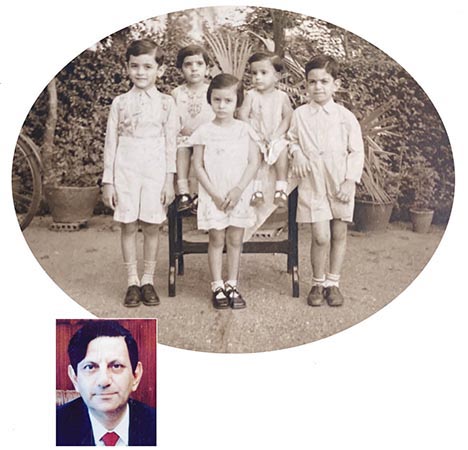
(Above, from l) Kanga cousins: Edul, Rati, Pervize, Ava, Jamsheed; inset: Jamsheed Kanga
The next appointment, as assistant collector of Satara, was fated for there he met his wife-to-be, Firoza Cooper, granddaughter of Sir Dhanjishah Cooper, Prime Minister of the State of Bombay and head of the well-known Cooper Engineering Works. Jamsheed was regularly hosted by Firoza’s dynamic mother, Homai, and her brothers Saam and Farrokh would joke that he was dropping in ostensibly to meet the family but was actually besotted with Firoza! The young couple was soon exchanging love letters through the books they shared. They married in January 1963 at the Taj Mahal Hotel, Bombay.
Jamsheed was subsequently transferred to the city of Parbhani in one of the most neglected districts in the Marathwada region of Maharashtra where government services were most deficient. He saw this as a challenge. His stint in Parbhani was fruitful; his true reward lay in the affectionate farewell he received from the people and officers of the district when his term ended. In Firoza’s words, "The whole train compartment was filled with garlands and flowers.”
IAS officers in critical departments and ministries were often approached by businessmen, builders, etc, for undue favors. At Diwali and New Year, gifts of sweets, dry fruits, etc would be sent to their homes. These would not be accepted by Jamsheed, to the puzzlement of his mother who would remonstrate, "But it’s just a box of pedas!” Until one day he showed her three gold coins hidden under a layer of mithai sent by someone who probably wanted a huge favor in return.
In Parbhani, the Ford Foundation noticed his work and selected him for a Fellowship at the John F. Kennedy School of Government at Harvard University where he spent two years earning his MA degree in public administration. Gaining international exposure in public affairs from world leaders like John Kenneth Galbraith, Henry Kissinger and Nobel laureates taught him invaluable lessons in public policy and civic engagement.
"Growing up in the Kanga household there would be a constant flurry of phone calls and the doorbell would ring incessantly with people coming in or calling to ask for help or advice,” said his elder daughter Shireen. "He always found a way through his position in government and in the Parsi community to help others. No request was too small or too big for him. There were passport papers to be signed, scholarships to be recommended, calls made to help someone find a job, a flat, a bed in the hospital and so on. He was humble, helpful and interested in everyone. No matter whom he interacted with, Dad was his congenial, kind and outspoken self,” added Shireen.
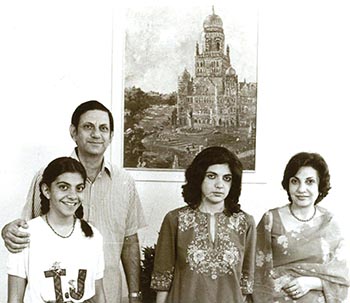
The Kangas (from l): Fareeda, Jamsheed, Shireen and Firoza
"He was never impressed by the industrialists or VIPs who would knock on his door when he held various posts at Mantralaya. One day at lunch time he bounced in and gave my mother a small locket — it was from Mother Teresa! She had just met him regarding a land matter concerning her foundation and had blessed the locket as a token of her appreciation,” recalls daughter Fareeda. "Although I didn’t get to spend much time with him, I subconsciously imbibed the qualities he nurtured and always seek them out whether in a life partner or friends. Speak with honesty, think with sincerity and act with integrity became his trademark. If he believed in the justness of a cause or issue, he would never change his stance.”
When Indira Gandhi was the Prime Minister of India she had a meeting at Doongerwadi with J. R. D. Tata and trustees of the Bombay Parsi Punchayet (BPP) along with senior bureaucrats. JRD told her they were planning to build housing for Parsis (Godrej Baug) and she turned to my Dad and asked him why it hadn’t yet been done. He pointedly looked at the then chief minister (CM) who allegedly wanted the land for some other purpose and said nothing. Gandhi, with her usual perspicacity, realized what the hindrance was and instructed the CM to ensure that it was done.
In 1985, Jamsheed was appointed municipal commissioner of Bombay. He performed his duties with grit, dignity and perseverance. It was a high pressure job and after meetings with corporators he would return home exhausted, fatigued and disillusioned with their lack of civic sense, pursuit of vested interests and apparent corruption in many departments. Still he used his position to strengthen ties between the public and private sector. He had a deep interest in the civic, social and cultural affairs of his adopted hometown, Bombay. Most notably, he persevered to protect from opportunist politicians and builders the heritage structures of Bombay. In the words of his friend and IAS colleague, D. M. Sukthankar, "His deep and abiding interest and pioneering, persistent and active efforts in collaboration with other like-minded persons as the late Shyam Chainani, Cyrus Guzder, D. T. Joseph (the then urban development secretary for Maharashtra) and others in the conservation of the rich, historical heritage of the city resulted in the formation of the Mumbai Heritage Conservation Regulations.”
He was also a member of the managing committee of The B. D. Petit Parsee General Hospital.
Being a pragmatist as well as a liberal he understood the difficulties the Parsi community faced. Along with other like-minded stalwarts of the community, he challenged the orthodox BPP trustees in the "renegade priests” battle as well as in setting up the Parsi Prayer Hall at Worli for those opting for cremation. Even though Jamsheed was totally in favor of cremation, the family was advised against availing the crematorium facility with the pandemic raging in Bombay. Reports were received that the crematorium was overloaded with corona fatalities, with bodies being lined up to await their turn and some even being made to wait till the following day. Under such circumstances, the family reluctantly agreed to consign him to the Tower.
His selfless life can be summed up with a quote from his cousin and close friend Edul Kanga. "He led his life following the Zoroastrian tenet of helping all in need of assistance. Kshathrem-cha Ahurai a | yim drigubyo dadat vastarem [Yasna 27.13 (the strength of Ahura is given unto him who unto his poorer brother giveth help) I. J. S. Taraporewala].”
Shared thoughts of his daughters Shireen and Fareeda Kanga, and sister Ava Khullar