In search of a Parsi cemetery in Canton
Dr Pervin Shroff
On one of my many teaching visits to the city of Guangzhou (erstwhile Canton) in Southern China, I had some free time on a Friday afternoon. Before I left the US for China, a Chinese colleague, aware that I was a Parsi, informed me that an old Parsi cemetery was listed as one of the top 30 attractions of Guangzhou. A Parsi cemetery in China sounded intriguing and piqued my curiosity. Having seen all the must-see sights of Guangzhou on previous visits, I decided to go in search of the Parsi cemetery.
I mentioned my plan to Lily, the administrative assistant for the China Executive MBA program in Sun Yat-sen University where I was to teach that weekend. Lily had never heard of this cemetery, but a Google search (or the Chinese equivalent) confirmed that it existed. Lily suggested that I take a student along to help navigate in Chinese. So at 1 p.m. on Friday, I met my young volunteer Edward (that’s his American name), an undergraduate student at the University who spoke fluent English, and we set out in quest of my ancestors’ last resting place.
While we were aware that the cemetery was located on an island in the Pearl River, we did not know its exact location. We travelled by subway a few stations from the University and then took a taxi to the island where we planned to make inquiries about the cemetery’s location. Very soon we crossed the bridge to the island but were at a loss where to start looking for the cemetery. We reached the other end of the island in about five minutes without coming across any road signs indicating its location. The taxi driver stopped at a restaurant to inquire. Nobody had heard of a cemetery on the island, but being the friendly and helpful people Mainland Chinese are, they gave us a map of the island. The map, however, did not indicate the presence of a cemetery and so was of no help. In the meantime, Lily called to tell us that the cemetery was supposed to be located near the bridge to the island.
We made our way back to the bridge, but could not find any sign indicating a cemetery. At this point, Edward leaned out of the cab and started asking everyone in sight if they had heard of a cemetery on the island. Someone said the cemetery was located on top of a little hill. Edward asked some women selling flowers on the pavement if they knew of a Parsi "shan” (meaning a Parsi hill). The flower-sellers pointed in different directions and we were thoroughly confused. In the middle of this chaos and confusion, with Edward shouting "Parsi shan” to every passerby, the taxi driver started yelling at the top of his voice. I was afraid he was mad at us for wasting his time, but Edward reassured me that the taxi driver was talking to his friend on his cell phone to see if he knew anything about the Parsi cemetery.
By this time, we were surrounded by a crowd of locals trying to help us. A little fellow drove up on his scooter claiming that he knew the location of the cemetery for foreigners. He wanted us to follow him by taxi and he promised to take us there for the price of 10 yuan! With no other option, we decided to pin our hopes on him to find the elusive cemetery. We drove along the edge of the island and arrived at a locked wrought-iron gate opposite a shipyard. The guy on the scooter called out to the caretaker who came out running. Edward explained that we wanted to see the cemetery. The caretaker refused to open the gate since we did not have permission. Edward was not one to take no for an answer and he started pleading with the caretaker to let us in, saying that I had come all the way from America to pay my respects to my ancestors. Finally, he was able to persuade the caretaker to permit us to enter. While taking us up the hill to the cemetery, the caretaker mentioned that the US ambassador had visited here a month ago. I had a feeling that this was not the cemetery I was looking for.
Sure enough, there were about 40 graves in the cemetery, all with western names, but no Pestonji, Pallonji or Savaksa there, or any Daruwalla, Saklatwala or Andhyarujina! It sure was a cemetery for foreigners – but not Parsis! By now, it was getting close to 5 p.m. and I decided to call it a day. We thanked the caretaker (who refused to accept a tip) and made our way back. Four hours and $100 lighter, I still was none the wiser about the Parsi cemetery in Guangzhou. Perhaps someday, a more intrepid Parsi will discover the elusive cemetery (if it does exist)!
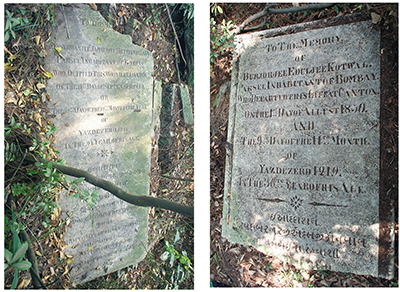
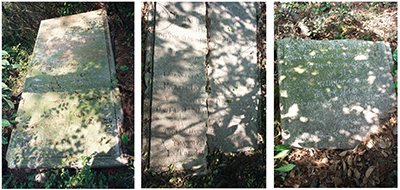
Graves in the Canton cemetery
The conclusive cemetery
Adventurous by nature, Shroff who is professor at the Carlson School of Management, University of Minnesota loves going to "way out” destinations, according to her sister Yasmin Cama. Since she had taken a spur of the moment decision to visit the cemetery, Shroff had not sought prior guidance from the Zoroastrian Charity Funds of Hongkong, Canton and Macao (ZCFHCM).
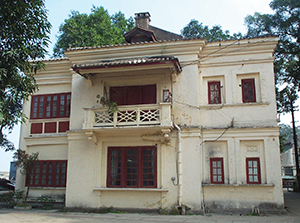
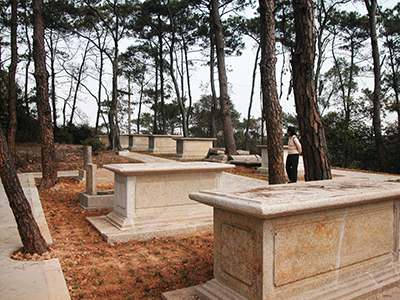
When Parsiana wrote to ZCFHCM president Neville Shroff, he reverted with photographs of the cemetery, and recalled a trip in 2008 when the "trustees took a small group of Hong Kong Parsis to visit the Parsi cemetery in Canton. The condition of the cemetery was deplorable, and the group had difficulty even visualizing the names of certain graves which had mostly faded. At a meeting with Madam Chen of the Cultural Bureau in Guangzhou, she mentioned that she would do her utmost to clear up the extensive overgrowth of shrubs and trees to make it into a heritage site which it is today. The old Parsi Picnic House still stands.”
Neville further explained that the cemetery was built in the Whampoa area of Canton and there are nine graves of which one is badly damaged. The earliest grave is dated 1847 and the last 1852. Giving a brief historical insight he added, "The Parsis came to China in the 17th and 18th centuries as agents of the British. They initially set up offices and trading businesses concentrating their activities in the Canton district of China and after 1842 started moving to other cities such as Shanghai, Nanking or Nanjing as it is known today. The Parsis played an important role in the Canton trade in the early days by accompanying the British Hongs and later setting up their own businesses. Opium was the main attraction to China which later led to trade in other commodities like tea, spices, silk and cotton.”