Farah Madon’s architectural expertise lies in improving accessibility for all
Beyniaz Edulji
"The opportunity to serve people, especially those who experience discrimination due to their disabilities is a reward in itself,” declared Sydney based architect Farah Madon who was recently conferred the 2019 Penrith Citizen of the Year award. Respected for her expertise in improving access for people of all abilities across Penrith (Western Sydney) through her 11-year-old company Vista Access Architects, Madon modestly considers her work as "nothing remarkable.”
Most of her ‘paid’ work deals with designing public buildings and planning public spaces for accessibility. Her clients are mainly architecture firms. "They send me their proposed plans and I recommend changes to improve accessibility and certify them as compliant for access requirements once the plans are updated.” Additionally her company provides pro bono services to not-for-profit organizations.
Farah Madon receiving the 2019 Penrith Citizen of the Year award from mayor Ross Fowler
"In Australia, emphasis is put on the user experience throughout the building and it is much more than just putting a ramp at the door to get in. All types of disabilities are considered during design itself. Australia is very advanced in this field,” she explained. This is possibly because of the rising population of the elderly and 20% of the Australian population identifying themselves as having a disability. Further, in Australia, it is not uncommon for people with a disability, including wheelchair users, to fully participate in the work force and all other social aspects of life with hundreds of wheelchair users able to independently drive their suitably modified cars, she commented.
"Designing for accessibility therefore provides for a more inclusive society where everyone is valued as equal members of the society,” she emphasized. "There is no ‘one size fits all’ solution to accessibility. For example design solutions for a person with low vision will naturally be different to design solutions for a person with mobility issues. For people with mobility issues, even a design for a person with more function on one side of the body will be different to a design solution for a person with more function on another side of the body,” she added.
In her individual capacity, the 42-year-old activist serves on the national committee that sets Australian Standards for access to buildings, volunteers at the Penrith Disabilities Resource Center and has been associated with the Penrith City Council’s Disability Access Committee for nearly a decade. Regarding elderly residents who live on higher floors of buildings without lifts, she notes "providing accessibility at a later stage is difficult if the designer has not thought about accessibility from the very beginning. In that case, not much can be done without major renovations.”
In her acceptance speech at the awards function, Madon quoted American author Dennis Lehane, "To have sympathy is easy. You have sympathy for starving children on late night commercials. Sympathy is easy because it comes from a position of power. Empathy is getting down on your knees and looking someone else in the eye and realizing you could be them, and that all that separates you… is luck.” She further continued, "These words have had a huge impact on me as they are so relevant to engaging with a person with a disability.” She further urged, "I would encourage you all to stand up wherever you see discrimination. Don’t be neutral; take sides and speak up. Only by standing up to discrimination and working towards changing an unfair system can we make our community a place that we can all be truly proud of.”
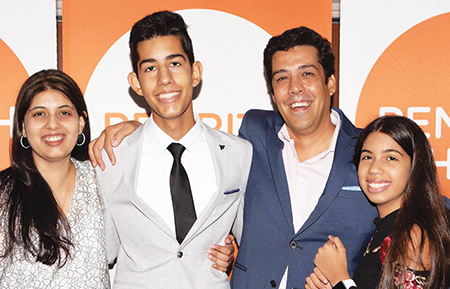
(From l-r): Farah, Zahan, Percy and Deana Madon
Winner of the 2017 NSW (New South Wales) Government Disability Access Inclusion Award for her design of outdoor spaces that could be used by people of all abilities, Madon noted, "None of my work or volunteering activities would have been possible without the support and guidance of my husband Percy, my parents Zarin and Keki Gorimar, and my aunt and uncle, Yasmin and Kersi Bhesania.”
Born in Aurangabad and brought up in Bombay’s Dadar Parsi Colony, her childhood memories are "of fun filled holidays with my cousins (Burzin, Sharmin, Xerxes, Yezdi, Sanaya and Cyrus Printer) and being spoilt by my maternal grandparents Khorshed and Dinshawji Printer and my uncles and aunts (Jangoo, Shirin, Rumi and Dilshad Printer) in Aurangabad.” She married Percy Madon at 21 and they migrated to Australia soon after as skilled migrants. Percy is a business consultant in the IT (information technology) field.
Commending her parents for being "100% supportive in whatever my brother (Behzad Gorimar) and I wanted to do,” Farah who is an alumna of Bombay’s Auxilium Convent completed her Bachelor of Architecture degree with Honours from the city’s Bharati Vidyapeeth College of Architecture, ranking first in her college. Her first job was with Talati and Panthaky. Farah is now an accredited member of the Association of Consultants in Access Australia, a member of the Australian Institute of Architects, a Registered Assessor of Livable Housing Australia and a Registered Assessor of Changing Places Australia.
For her BArch studies she received "a number of educational scholarships from Parsi organizations for which I am most thankful and I always wanted to do something to pass it forward when I was able to,” she reveals. Volunteering her time and efforts for the Zoroastrian community, Farah was conferred the Australian Zoroastrian of the Year by the Australian Zoroastrian Association (AZA) in 2017. "We, as a family, get involved in all possible volunteering activities no matter how busy we are with work or school.” Percy volunteers with an organization that helps children with disabilities, son Zahan (17) makes time for St Johns Ambulance and daughter Daena (14) is active with the Lions Club. Commenting on the active AZA in Sydney, Farah gave credit to their head priest "Ervad (Dr) Peshotan Katrak for being a huge inspiration. He received an OAM (Order of Australia Medal) for services rendered to the Australian Zoroastrian community. Our past AZA president Dr Pheroza Daruwalla does a lot for the community as well.”
Preferring to focus on the tenets of good thoughts, words and deeds, Farah mentioned, "I wouldn’t call myself very religious though I can’t do without my sudreh-kusti. And, it is a fact that my children know more prayers than me, especially my son who is a navar. My mother is very religious but she never forced us to pray or do anything religious; it was left to us. Khorshed mumma was very forward thinking and used to say that all days and times are made by Khodaiji so none of them can possibly be bad. She was a huge influence on me. She convinced me that I could do anything I put my mind to.” When Farah’s maternal grandparents passed away, her mother who always made time to go and read to the visually impaired children, decided to donate money to a school for visually impaired children instead of spending it on yearly prayers.
Fond of travelling, especially to areas that have heritage architecture, Farah says she enjoys spending time with her Labrador/Golden retriever mix dog, Connor. "We took in Connor when he was just eight weeks old to train him as a ‘seeing eye dog’ for Guide Dogs.” Since he had passed his training, he was to be returned to Guide Dogs but as luck would have it, he was brought back to them a few days later as his size was considered too large to be managed by a blind person.
For community members who like to bask in the past glory of their ancestors, Farah has a message, "The thought of meeting Ratan Tata some day and to shake his hand would be a dream come true… (Whilst) we can’t all contribute to the extent like the Tatas I think we can still contribute in our own very small way to the general community and that is what we all need to do. Every small bit counts.”