The recently inaugurated Dar-e-Mehr in Sacramento was made possible
with community support and a generous donation from the Zoroastrian Charity Funds of Hong Kong, Canton and Macao
Parinaz Gandhi
Ninety-three-year-old Ervad Sorab Chhor’s last wish was fulfilled at the Sacramento Dar-e-Mehr that was inaugurated on Fasli Khordad Sal, March 26, 2017. The seniormost of the seven priests was able to pray alongside his 18-year-old grandson Ervad Rustum Chhor and other North American priests at the first jashan led by Ervad Kobad Jamshed at the recently opened temple before breathing his last five days later. The other priests were Ervads Ardaviraf Minocherhomji, president of the North American Mobeds Council, Homyar Dastoor and Ratansha Vakil. The Sacramento Zoroastrian Association (SZA) in the capital city of California having a predominantly Iranian membership, Mobed Ashkan Bastani from Los Angeles represented the Iranian congregation. Before the jashan, the SZA provided white topis bearing an asho farohar symbol to guests. The topis were brought by a member from Iran.
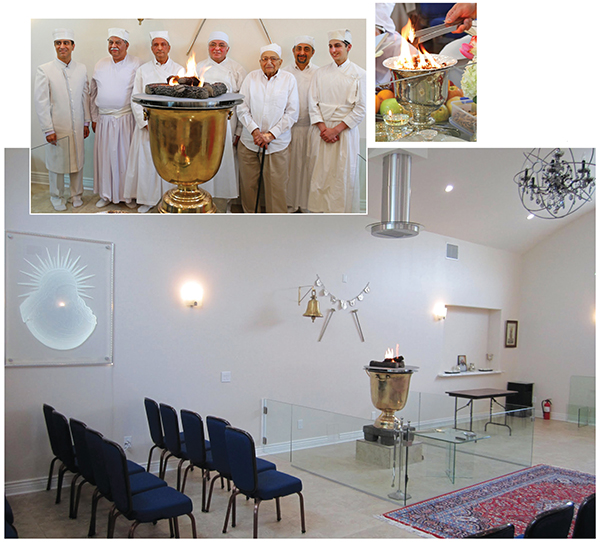
From far left: Mobed Ashkan Bastani, Ervads Ratansha Vakil, Ardaviraf Minocherhomji,
Kobad Jamshed, Sorab Chhor, Homyar Dastoor, Rustum Chhor; feeding the fire at the jashan
Photos: Rathish Jayabharathi; interiors of the Dar-e-Mehr Photo: Mehran Torki
Above, from left: Khodadad Pashutani, Gustad Irani; Manijeh Behziz, Darab Bozorchami;
Firdosh Mehta, Bomi Patel, Homi Gandhi; Darius Captain
Photos: Rathish Jayabharathi
Congregation outside the Dar-e-Mehr Photo: Ardeshir Damania
Clockwise from top left: Amu Nowruz entertains; Pervin and Ardeshir Damania beside the Nowruz table;
assembly at the Dar-e-Mehr; participants at the evening program
Sacramento Zoroastrian Center Photo: Ardeshir Damania
Above: inaugural jashan; center: devotees inside the Dar-e-Mehr
Ervads Sorab (left) and Rustum Chhor
The SZA is the youngest member of the Federation of Zoroastrian Associations of North America (FEZANA). Their 850 sq ft Dar-e-Mehr, at a distance of 15 feet from the 10,000 sq ft Sacramento Zoroastrian Center (SZC), took nearly one and a half years to construct. It was made possible with "a very generous donation of $ 200,000 given by the trustees of the Zoroastrian Charity Funds of Hong Kong, Canton and Macao. The afarganyu was donated by the H. B. Wadia Atash Behram with the help and assistance of one of their trustees, Nadir Modi,” conveyed SZA founder member Darius Captain who is on the three-member Dar-e-Mehr building committee along with former SZA president Mehran Torki and current vice president Khodadad Pashutani. While $ 175,000 has already been expended on the current edifice, there is yet some supporting construction that has to be added. "The construction and building was done quietly without any fanfare. Bravo to the community,” appreciated Dr Dolly Dastoor, editor of the FEZANA Journal.
The large afarganyu at the Dar-e-Mehr is connected to a natural gas source, fed by a flexible pipe. Explaining the mechanism, Captain wrote in response to our query, "A wooden box covered by tiles is placed over the gas connection. Over the box is the black stone indhora we got from the Atash Behram along with the afarganyu.” The main connection under the box feeds a gas burner atop the afarganyu through a flexible pipe that goes through a hole on the plate that covers the afarganyu. "On the top is a pilot lamp which lights up the main fire by remote. The wood on the top is artificial and does not actually burn. (To feed the fires in the 50 or so Bombay agiaries 2,000 trees have to be cut every year — editors) Due to city fire code restrictions, we cannot keep an unattended fire burning all the time. The sandalwood is not burnt on the main afarganyu but only a smaller one next to it (as in the case of a jashan). The priest holds the chamach with the sandalwood, touching the big afarganyu and then puts the sandalwood on the smaller afarganyu. Actual wood and ash if placed on the big afarganyu could block the holes in the burner. This is the same procedure as used in the San Jose Dar e Meher.”
The small afarganyu used in the jashan was the one that had constantly accompanied the late Ervad Jimmy Makujina at all religious functions and was gifted by his wife Amy to the SZA, wrote octogenarian Rusi Sorabji of California.
After the jashan, partaking of chasni comprising fruits, nuts, malido, sev and ravo, the nearly 270 devotees moved to a banquet facility nearby to enjoy entertainment and dinner which included Indian and Iranian dishes. The SZC in the city suburb of Rancho Cordova, California is currently being renovated and its facilities upgraded (see "Sacred in Sacramento,” Parsiana, June 7, 2016). It should be ready by the end of the year after which members will be able to assemble on their own premises that can accommodate nearly 200 individuals with parking facilities for around 60 cars.
Felicitating the major donors and families who had contributed to the completion of the Dar-e-Mehr, Pashutani lauded the project management of Torki and explained that the main challenges lay in finalizing the detailed plans and getting approvals from the city and fire departments. On behalf of the Association, president Manijeh Behziz who addressed the gathering in Farsi felicitated the priests as also Gustad Irani of Hong Kong who provided valuable and constant feedback during the construction and facilitated the sanction for the donation. As acknowledged on the Association website sacza.org, the Dar-e-Mehr would not have been possible "without the tremendous support of community members who gave us a helping hand by donating their time and effort.”
To express their solidarity with the young Association which joined FEZANA in 2016, FEZANA president Homi Gandhi of Los Angeles was present at the inaugural function as also former presidents Bomi Patel, currently president of the Zoroastrian Association of Northern California (ZANC), and Firdosh Mehta of Vancouver, Canada. Outlining the various activities and charities of FEZANA, Gandhi announced that in the last 12 months, three dar-e-mehrs had been established in USA — in New York, Los Angeles and Sacramento — signifying that after laying down roots, Zoroastrians give priority to building houses of worship. On behalf of FEZANA, a donation was presented to SZA. Some dance items were then presented by young Zarathushtis. The night was brought to a close after more music and dance, and exchange of greetings.
In addition to Behziz, Pashutani, secretary Anahita Azarkeyvan, treasurer Farzin Jahani and Torki, the 2017-18 SZA board of directors include Darab Chami and Behrouz Sohrabi. "Some of the most important goals in this organization include but are not limited to teaching Zoroastrian thought.” The objectives are also to "provide, develop and promote social, religious and educational services, workshops, recreational activities in a way that promote self esteem and self confidence (among) Zoroastrians.” In addition, SZA celebrates "religious and cultural ceremonies such as Nowruz, Mehregan, Yalda and Tirgan, sponsoring events such as family picnics, religious classes, discussions, baking and cooking classes, sports programs and dance classes,” notes their website.
Membership to SZA is open to any Zoroastrian individual over 18 years of age and resident of Northern California. Non Zoroastrian spouses of regular Zoroastrian members can also become members and exercise the right to vote at the biannual election of the board of directors and general assemblies. Zoroastrian members over 25 years of age can nominate themselves to the board of directors. Zoroastrians above 18 years of age who live outside Northern California can become associate members, and so too can their non-Zoroastrian spouses, but they do not enjoy the right to vote.
The precursor to the SZA was the Zoroastrian Women Organization founded by five Zoroastrian ladies in 2010 and registered as a non-profit corporation. The foresight of these ladies led to their investing in a community center at a cost of $ 550,000, having raised $ 285,737 and borrowed a sum of $ 350,000 for 18 months at no interest (see "Females in the forefront,” Zoroastrians Abroad, Parsiana, April 21, 2014). Once they opened their membership to men, they called themselves SZA. Catering to the needs of nearly 100 Zoroastrian families in Sacramento, they felt it imperative to have their own Dar-e-Mehr since the one closest to them in San Jose, lay at a distance of 130 miles, closer to the Bay area.
According to Sorabji who could not attend the function after attending the Navroz dinner organized by ZANC the prior night, the congregation would have been larger "if the SZA had organized the function on Saturday, March 25 instead of Sunday, March 26 so as to make it less stressful for the Zarathushtis from the San Francisco Bay Area to recoup the next day from the long 200+ miles drive.” But he realized that March 26 being "the real Khordad Sal, how can they forget Zarathushtra’s birthday?”