A survey to estimate the reformist and
orthodox leanings of the community is proposed
Dr Jamshed A. Modi
The terms "reformist” and "orthodox” are bandied around so casually in discussions within our community that it made me feel that some kind of measure of a person’s inclination towards reformism or orthodoxy is required. There are so many issues that agitate people, and a person may be a reformist on some issues while being orthodox on others. People have different levels of reformism and orthodoxy and it would be meaningful to have an index to measure the extent to which a Parsi is reformist or orthodox. I term this the "Reforth Index,” a combination of the words reform and orthodox.
Such a division is by no means unique. Western Christianity, for example, had division centuries back. In 1517 Martin Luther, a Catholic priest, dramatically nailed his "95 Theses” on the door of the Castle Church in Wittenberg, Germany, an event which marked the beginning of the Protestant Reformation. There are Protestant churches all over the world, each one with its own beliefs, practices and clergy.
Judaism too has experienced division. In 1810, Rabbi Abraham Geiger drew the community’s attention to the constantly changing practices in Judaism. That was the genesis of Reform Judaism, with its own practices, rabbis and synagogues.
Other Eastern and Far-Eastern communities have had similar divisions for centuries, each with different levels of separateness.
Fortunately, the Zarathushti community has not thus far experienced such fundamental divisions. We do have some minor ones, such as athornans and behdins, Shahenshahis, Kadmis and Faslis, but we still remain one community.
Will we remain that way? The words from a Bob Dylan song written in 1962 come to mind: "The answer my friend is blowing in the wind. Oh the answer is blowing in the wind.” On the reformist side today we have the Association for Revival of Zoroastrianism (ARZ) with its Asha Vahishta, The Zoroastrian Centre in Poona which is open to all. A Parsi prayer hall next to the Worli crematorium has been functioning since 2015.
Picture for representational purposes taken from Parsiana 2013
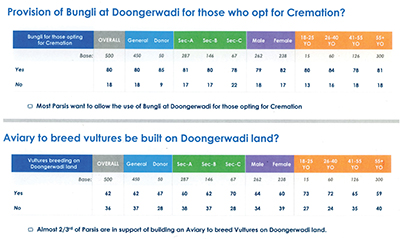
poll conducted by Hansa Research Group
An index is a number calculated from a designed procedure that is intended to give us an idea of the magnitude of some complex phenomenon or personal feelings and opinions. Usually, a form or "survey instrument” is designed, into which numerical data for calculating an index is filled. Then a procedure is specified for calculating an index from the data.
All countries have indexes which reflect the status of the stock market. In the US, the most well-known and well used stock market index is the Dow Jones Industrial Average index. In India, it is the Bombay Stock Exchange 200 Index.
We have the Body Mass Index (BMI), which is the ratio between body weight and height. In economics, there is a Consumer Price Index (CPI). For public health engineering there is an Air Quality Index (AQI), and so on. Indices provide a quantitative measure of some complex phenomena or personal opinions.
To develop an index for our community, I felt I should begin by defining the terms "reformist” and "orthodox.” In a dictionary the most appropriate definition for reform is to "improve by alteration or correction of errors or defects and put into a better condition.” So, I adopted as a working definition of a reformist: "One who wants to improve attitudes and opinions on religion by alteration or correction of errors or defects and put it into a better condition.”
The dictionary defines the adjective "orthodox” as "adhering to what is commonly accepted.” So, I adapted this to "One who adheres to what is commonly accepted about his religion.”
Selecting four heads — general, prayers and rituals, priesthood, other communities — on which reformists and orthodox are likely to differ, I have set up five statements in each topic — a total 20 statements. Five levels of agreement/disagreement are assigned numbers one through five. The user records his agreement/disagreement by entering the appropriate number in the points column for each statement and then totalling up the numbers which constitute the person’s Reforth Index.
What would a comparison between Bombay and Delhi Parsis reveal? Or a comparison between Parsis in India and the US or the UK? Between males and females? Among those in various age groups: below 20, 21-40, 41-60, 61 and above? Between athornans and behdins? The possibilities are numerous.
The Global Working Group is contemplating on conducting an international survey of the community’s viewpoints on religious, social, cultural, economic and other issues. In 2013 as part of its 50th anniversary celebrations, Parsiana had commissioned the reputed Hansa Research Group to conduct a survey of 500 Parsis/Iranis from around the 29,163 general voters and 1,186 donor voters registered on the Bombay Parsi Punchayet (BPP) electoral rolls in Bombay to ascertain their views on social community issues (see "What people believe,” Editorial Viewpoint, Parsiana, December 27, 2013). This was a special edition to mark the 10th World Zoroastrian Congress held in Bombay in December 2013.