The first ever school level G20 simulation meet in the country was conducted at The J. B. Petit High School for Girls on April 14 and 15, 2023, exulted their principal Benaifer Kutar. Conducted at the School’s campus, in collaboration with think tank Gateway House, Indian Council on Global Relations, the School "received government approval for using the official G20 logo on all the event stationery, materials and correspondence,” Kutar told Parsiana on April 15.
The G20 or Group of 20 is an intergovernmental forum comprising 19 countries and the European Union that works to address issues related to the global economy, such as international financial stability, climate change mitigation, and sustainable development. India assumed presidency of the group in December 2022 and will continue till November 2023.
Amitabh Kant, G20 sherpa for India lauded the School’s pioneering initiative. A sherpa is the personal representative of a head of state or government who prepares an international summit. The event was one of the more than 200 smaller events held in Indian states and will lead up to the summit scheduled for later this year in New Delhi.
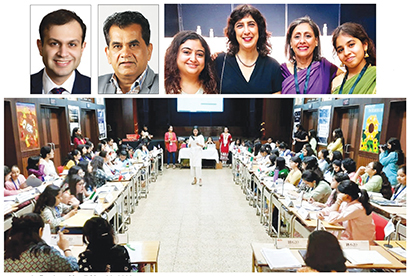
Top, from l: Burjis Godrej, Amitabh Kant, Tinaz Bana, Benaifer Kutar, Manjeet Kripalani of Gateway House,
student Sanjana Singh; above: The J. B. Petit G20 session in progress
Chief guest at the closing ceremony, Burjis Godrej, executive director of Godrej Agrovet, who "expects the global G20 to go beyond economic matters,” shared some of his learnings from his visits to international conferences in Bali and Indonesia. The Bali conference concluded that our best hope is to "get the developed countries to see commercial returns from funding sustainable green projects in developing countries.” While such ventures are risky, there are proposals for international funding agencies to cover initial losses. Godrej also informed the students of the importance of developing better communication skills, the ability to express one’s thoughts more clearly.
He cited the example of a meeting he attended while a teenager where he was asked to argue whether placing a missile defense system in Poland was a waste of money or a prudent investment. He argued for prudence and found after the talk many people appreciated the points he had raised.
Students "representing” the United Nations and other specialized agencies such as the International Monetary Fund, World Health Organization, the World Bank, the International Labour Organization, and other multilateral organizations and invitee nations "jointly discussed and put forth their stand.” Students from grades seven to 10 arrived at a consensus that was reflected in the "Leaders’ Declaration” which recommended the formation of a G21 to include the G20 nations along with the African Union.
"The experience has provided a rich platform for our students to engage in robust discussions on contemporary issues of our times,” Kutar noted. Teacher of commercial studies and coordinator for the event Tinaz Bana stated that "G20 was a completely new concept to first understand, and then to preside over.”
Appreciating the "can-do attitude and bold spirit” of the students, Bana stated, "They turned their fears into confidence, their anxiety into motivation and their challenge into passion.”