The Neo-Gothic J. N. Petit Institute won the 2015 UNESCO
Asia-Pacific Award for Cultural Heritage Conservation
Text: Parinaz M. Gandhi Photos: Jasmine D. Driver
"The restoration of the J. N. Petit Institute has successfully extended the life of one of Mumbai’s major Neo-Gothic landmarks and well-loved public institutions. The meticulously executed restoration work has rescued the building from a state of serious decay, returning it to its original glory with the reinstatement of period decorative works, notably stained glass windows, carpentry and masonry ornamentation. The project ensures that generations of Mumbaikars will continue to enjoy the Institute’s enhanced facilities, in particular the splendid Reading Room, in years to come,” noted a press release dated September 1, 2015 announcing the winners of the 2015 UNESCO (United Nations Educational, Scientific and Cultural Organization) Asia-Pacific Awards for Cultural Heritage Conservation.
Stained glass windows depicting Petit family members
There were 36 entries from five countries — India, China, Lao PDR (People’s Democratic Republic), Australia and Thailand — this year with the highest Award of Excellence being conferred on Sree Vadakkunnathan Temple in Kerala. Winning the Awards of Distinction were the Petit Institute, better known as Petit Library, located in the heritage precincts of Fort on Dr Dadabhai Naoroji Road and the Saltpans of Yim Tin Tsai in Hong Kong. The jury additionally announced four Awards of Merit, four Honourable Mentions and one Award for New Design in Heritage Contexts. "The jury were very pleased with this year’s submissions which included fascinating projects from across Asia-Pacific. This reflects a continuing trend over the years where we are seeing a broader diversity of typologies being submitted…from a wider geographical spread,” announced jury chair Tim Curtis who is chief of UNESCO Bangkok’s Culture Unit.
For conservation architect Vikas Dilawari the Petit Institute marked the 11th award he won from UNESCO, his recent prize winning projects including Esplanade House (in 2014), Royal Bombay Yacht Club and Murzban Colony at Lal Chimney (2013), Sethna Building and its surrounding buildings at Wadia Street (2012). With the majority of Dilawari’s practice constituting Parsi institutes like the Byramjee Jeejeebhoy Parsee Charitable Institution, K. R. Cama Oriental Institute, Army & Navy Building, Elphinstone Building, Bombay House, Alpaiwalla Museum and buildings on Gilder Lane, the conservation architect believes, "Parsis as a community are well known for looking after their property as is seen in the baugs and colonies unlike the cess properties of the same vintage. The community genuinely cares for and respects heritage and authenticity.”
A special honor for Dilawari was a letter addressed to him by Curtis stating, "The jury highly commends your accomplishments and hopes that you will continue to share the lessons learned from the project to encourage heritage conservation efforts in your country and throughout the region.” As concluded the UNESCO citation, "The restored building enriches the character of Fort District’s most distinctive heritage streetscape. Acting as a catalyst for change, the project sets a new bar for other property owners in Mumbai in using a conservation approach to bring renewed vitality to historic neighborhoods.”
Explaining the intricacies of restoring the Petit Institute, Dilawari conveyed to Parsiana that "I was approached by the trustees to look into the water proofing aspect of the flat terrace and after starting from there its scope started getting wider till it became a holistic conservation exercise including upgrading of MEP (mechanical, electrical and plumbing).” To make the building "watertight, we started from the top.” Commencing with the large, open terrace they tackled the exterior of the building first. "The lower part of the building being late 19th century vintage as compared to the upper floors which were added in the 20th century,” they had to adopt a dual approach. One of the major challenges was in inserting the wooden screen in the RCC (reinforced cement concrete) balconies on the south and west side. "These screens were there in the original structure and the extension too, to keep the rain away. We were fortunate that we could locate old drawings of 1938 to carry out the work,” mentions Dilawari. When handling the interiors, "the schedule of work did go haywire on account of it being a functional building,” admitted Dilawari.
On entering the CCTV installed building, a member has the option to use the lift or the grand spiral stairway. The first floor landing houses the books and periodicals in the lending section, the special "juvenile” room, the reference section, the office of the administrator Bomi Umrigar and the desks of other staff members. The cupboards and shelves were receiving a fresh coat of paint when Parsiana went visiting. The second level has the Rare and Valuable collection where carpenters were fortifying the wooden cases, the binding room and the committee room. On the third floor is the popular Reading Room, well patronized by students and senior citizens from 7 a.m. to 8.30 p.m.
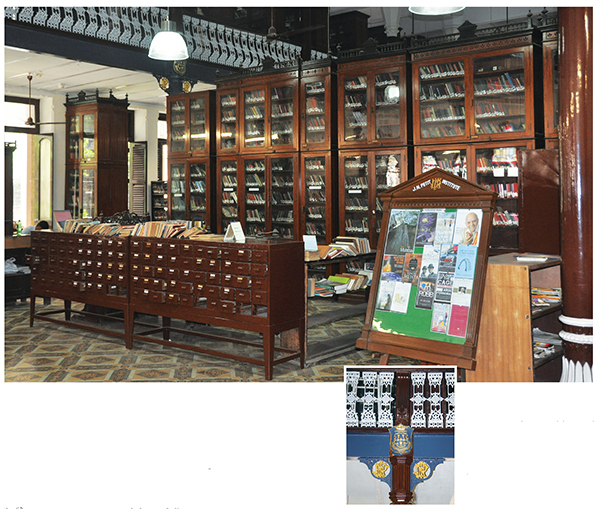
Lending section of the library and decorative Petit emblems adorning a pillar
Exteriors and interiors of the recently restored heritage structure with bust of scholar K. R. Cama; Vikas Dilawari
Reading Room with unidentified portraits
Characteristic arcades on the terrace, turret and facade
Presiding over the affairs in the Reading Room are the exquisite stained glass windows containing portraits of Petit family members: Jamsetjee and his wife, his parents Nesserwanjee and Dinbai, Framjee Dinsha Petit and his wife. These windows which front Dr Dadabhai Naoroji Road and Sir Pherozeshah Mehta Road have been carefully preserved along with the stained glass insignia, escutcheon and coat of arms of the Petit family. The Petit emblem bears the Latin words: "Consequitur Quodcunque Petit” which means "s/he attains whatever s/he attempts.”
A library, a legacy
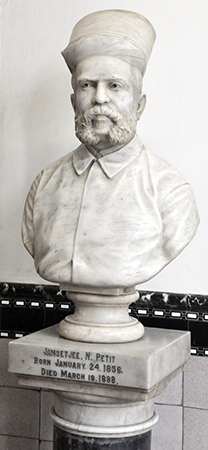
The library was named after Jamsetjee Nesserwanjee Petit following a donation of Rs 25,000 made by his father Nesserwanjee in 1891, in memory of his son who had died three years earlier, as notes a press handout from the Institute. Jamsetjee was a life member of the Fort Reading Room and Library and took a keen interest in its welfare and progress. At that time the Library was located in a big rented hall on the first floor of a building on Churchgate Street. The founders of this Library which was earlier known as the Fort Improvement Library were a dozen students of Elphinstone College who came together in 1856 to start this facility.
Nearly four decades later, on the initiative of Jamsetjee’s mother, Dinbai, to establish a public reading room and library for Bombay, a plot of land was obtained from Jamsetji Tata and the Government of Bombay on which a two-storey palatial building was erected at a cost of nearly Rs 2,47,000 borne by Dinbai. Thus came into being the J. N. Petit Institute that was inaugurated on May 1, 1898. Forty years later work commenced on raising the building and in 1939 Sir Dinshaw Manockjee Petit, 3rd Baronet, declared open the extended premises where the new storey was dedicated as a Reading Room with a seating accommodation for nearly 300 members. As commented Dilawari, "The Reading Room is a spectacular area of column free space with large ceiling heights.” Above the Reading Room is the spacious terrace inlaid with colorful, mosaic tiles.
The current trustees of the Institute are president Sir Dinshaw Petit (5th Baronet), vice president Dadabhai Patel, joint honorary secretary Rodabe Anklesaria and Homa Petit. Besides the trustees, the others on the managing committee are joint honorary secretary Nariman Patel, Soli Sorabjee, Dr Perin Marolia, Zia Mody, Naushad Engineer, Maneck Engineer, Mani Vajifdar and Muncherji Cama.
Whilst Dilawari commends "the trustees as being very accommodating,” the trustees and managing committee acknowledge in their annual report for 2013-2014 that Dilawari "spared no effort to see that the work was done in strict conformity and harmony with the aesthetic values of the building but without sacrificing the structural strength and stability of the building.” The managing committee further appreciated "the ready collaboration of senior structural consultant Cyrus Watchmaker… (and) senior experienced building contractor Cyrus Unwala of Premier Construction Company who executed the work to the architect’s and our satisfaction.” Also recorded was the "support and cooperation of the members of the Library, in complying with frequent requests to move and shift … from time to time at some inconvenience to themselves.”
The membership comprises mainly of the middle and lower income groups for whom the Library serves to bring a collection of over 90,000 books and around 85 periodicals in English, Gujarati, Hindi and Marathi. Whilst the indexing of books is computerized, the issue and return records will also be computerized soon. The website of the library is to shortly go online, inform the trustees. "Our aim is to make scholars and the general public in Bombay and all over the world aware that in the heart of the city there is a well established Institute which satisfies the need for knowledge, information and understanding and which deserves to be preserved, maintained and expanded for the benefit of not only the present but successive generations,” affirm the trustees. They have additionally taken up a project of restoring and preserving the rare books in their collection as also digitizing some works like a beautiful, rare copy of the Shahnameh.
Besides spending considerable sums on the tomes in their collection, a large part of their funds are expended on maintaining the heritage building, payment of property tax, water tax, electricity bills and other recurring expenses including monthly staff salaries and welfare measures, remind the trustees. Of immediate concern though is the Bombay Municipal Corporation communication intimating them that Phase III of the underground Metro Project from Cuffe Parade to Bandra provides for a station at Hutatma Chowk for which an entry/exit point has been planned outside their Institute premises. Fearing "a danger to our heritage properties,” the Heritage Mile Association (buildings on D. N. Road have formed this body) had meetings with the Mumbai Metropolitan Region Development Authority but the suspense continues, reports Umrigar.
Commenting on the proposed Metro Phase III development, Dilawari remarked that if the scheme is executed, "One should be careful to see that it does not undermine the cultural significance of the area (covered arcades connecting Victoria Terminus to Flora Fountain) and the buildings are not threatened structurally nor its open spaces encroached upon.” As he further explained, "The buildings on Dadabhai Naoroji Road have completed a century. These are splendid buildings with uniform urban design character in terms of its mass, volume and height and with a mandatory arcade. The J. N. Petit Institute is a landmark being a corner site with its open space… It is best to restore such buildings and reuse them in their present day context whilst upgrading the services. The government should encourage such conservation and give incentives by way of renewing the leases economically for such heritage properties. As it is many buildings on Dadabhai Naoroji Road are vacant and on the decline with the banks having formerly occupied them shifting to Bandra Kurla Complex. If this is not arrested then the unique heritage quality of this mile long stretch will be lost forever.”