The pandemic that shut down much of the world did
not deter Good Samaritans from assisting their brethren
Farrokh Jijina
Despite the hardships people faced due to the national lockdown imposed since March 25, 2020, individuals and anjumans assisted community members and others to cope with the challenges the confinement posed. Some helped the elderly and housebound with cooked food and groceries, others eased loneliness with phone calls. Some provided succor to migrant workers and the marginalized while others used social media to keep their community upbeat and connected. Parsiana spoke to representatives from 11 anjumans with sizable community members to compile this all-India report.
Among the individuals who are serving the needy of sister communities, perhaps Khushroo Poacha of Nagpur leads the pack. The full-time railway employee is a social worker by conviction. With Facebook and a fund-raising platform, the social entrepreneur has mobilized donors to contribute over 1,23,000 food packages (estimated at Rs 90.38 lakhs by him) containing staples for those unable to access food, he stated. "The Parsis of Abu Dhabi contributed an equivalent of Rs 11.50 lakhs,” he said, adding his appreciation of Nagpur Parsis who contributed Rs 1.25 lakhs. His network of 30 volunteers, banded together under "Seva Kitchen,” has reached out to thousands of stranded migrants, brick kiln workers, tribals and the malnourished around Nagpur in Yeotmal, Melghat and Pandavkavda. Poacha’s volunteer network was roped in by a nongovernmental organization and a cookie manufacturer to distribute buttermilk, water and biscuits to migrants passing through the city’s railway station. Geographically, Nagpur is in the center of the country and most east-west and north-south trains ferrying migrant workers to their home towns pass through that city.
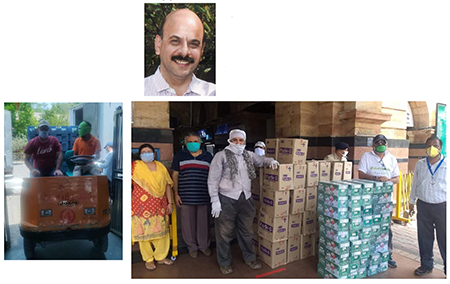
(Clockwise from above) Nagpur’s Khushroo Poacha: "I was only doing what I thought was right;"
Seva Kitchen volunteers at the city railway station; Poacha (in red shirt) supervising team at station
From food supplies to assisting in social causes was a short leap for Poacha. "We got the daughter of one beneficiary of our food parcels (who committed suicide due to poverty) married and helped her settle down with basic necessities in her new home,” he told Parsiana on June 9. Appreciation for his work has come from both beneficiaries and well-wishers: one migrant worker helped by Poacha’s network named her newborn baby Seva! India’s Swachh Bharat Mission called him a "Supply Warrior” on their social media platform while union railway minister Piyush Goyal tweeted his appreciation of Poacha’s work.
Having been made aware of his efforts and his four-year-old welfare initiative, Maharashtra chief minister Uddhav Thackeray phoned Poacha on April 7. "Aap bahut achha kaam karté ho (you are doing very good work),” the politician told the social entrepreneur. "I was awe struck...I was only doing what I thought was right,” the normally reticent Poacha told us shortly after that call. The politician queried him about difficulties his volunteers were facing in the distribution of food and told him, "Aap ko jo bhi chahiyé (Whatever you need), please keep in touch with the (state) principal secretary.”
"We are connecting those who need help with those who can assist,” Bombay Parsi Punchayet (BPP) trustee Kersi Randeria told Parsiana about their helpline set up on March 29. There have been 1,013 calls, including repeats, for aid as of June 10, Randeria explained. Assistance with "cooked food, groceries, medicines… these were the kind of requests we got,” said the trustee. Calls received at two designated phone numbers manned by BPP staffers were forwarded to the volunteer group of the area where the caller resided. Such groups were formed in "almost all colonies,” confirmed Randeria. Volunteers also assisted in case of calls received from nearby localities outside the colonies. "During the first two days, calls were mainly to enquire how the trust could assist them,” the trustee said, adding that "one lady even requested for the delivery of a pumpkin, yellow, not too soft!” The background work involved getting police passes to facilitate the travel of volunteers.
Approximately 20 volunteers drawn from Zoroastrian areas and colonies supplied about 6,000 meals between May 4 and June 10, when the service was stopped due to easing of movement restrictions. Those who could afford to were encouraged to pay for the meals. "Of the 190-200 meals supplied during the last 10 days, 45 were paid for,” Randeria told us on June 10. "This may seem like a small effort, but the food service was hugely appreciated,” he said.
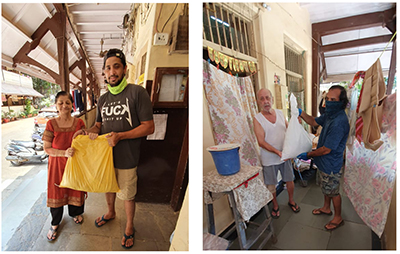
Volunteers of the Bombay Parsi Punchayet distributing food items to the housebound: "hugely appreciated"
Keeping the residents of colonies well stocked: views from Cusrow Baug
Bands of volunteers were formed to assist families of those who may have tested positive for Covid-19. "Our volunteers will also be checking on the psychological health of the patient or family as we know these can be very trying times,” stated a BPP circular.
The welfare associations, managements and volunteers of most residential colonies made arrangements to supply their tenants and homeowners with basic necessities so that they would not have to step out into markets when open (see "Covid and the colony,” Events and Personalities, pg 13).
The residential seminary Dadar Athornan Institute sent off its students to their respective homes before the lockdown. "I messaged the parents to come and collect their wards by March 22,” principal Ervad (Dr) Ramiyar Karanjia told Parsiana in early April. "We are looking forward to receiving updated government guidelines for boarding schools,” he told us on June 10. The principal keeps the parents of his students updated with information on academic matters received from The Dadar Parsee Youths Assembly High School where the priests-in-training get their non-religious education. "Online classes may start in mid-to-end June,” he hoped, looking forward to opening the doors of the Institute to boarders by August this year.
Fire temples had to keep their doors closed but boi ceremonies were held regularly, stated the priests and anjuman leaders Parsiana spoke to. All atash behrams, agiaries and dadgahs in Bombay and New Bombay have been supplied with kathi during the lockdown period by at least two suppliers, stated a few practicing mobeds. Farroakh Govadia of H. Sidhwa and Company that supplies the wood confirmed to Parsiana on June 10 that he has adequate stocks. He normally keeps stocks for a year, "sukavva maaté (to dry the freshly cut wood)” but said "havé maal ochho aavsé (now there will be less supplies)” as no baval trees were cut during the lockdown.
The Surat Parsi Panchayat (SPP) started a helpline a few days after the BPP did. Calls were largely from families in need of cooked food which was provided gratis, said SPP chairman Jamshed Dotivala. The quarterly assistance for the deserving provided by the Panchayat was enhanced by an additional Rs 1,800 for Surat residents and Rs 600 for those outside the city. The residents of the Surat Parsi Orphanage for boys and the Nariman Parsi Girls’ Orphanage returned to their homes, while the SPP’s Nariman Home (infirmary) continued to care for its long term residents. None of the senior citizens went back to their homes, said Dotivala.
Participation increased when jashans, prayers for the departed and social events at the Delhi Parsi Anjuman (DPA) went online, noted their president Ava Khullar. "At a recent uthamna ceremony conducted in our Anjuman hall there were 50-60 participants online, (with) friends and relatives from out of Delhi and abroad joining in. Normally the immediate family and close friends would number much less,” she wrote. DPA vice president Adil Nargolwala informed Parsiana on June 15 that "during the lockdown there was a worry about scarcity of firewood for our Dar-E-Meher. Our head priest Ervad Cawas Bagli came to my farm to cut logs from a fallen tree and took some in his own car to tide over. The rest was then sent later by truck. We donated over three tons of wood.” Since they could not hold their Navroz and annual gahanbar, talks on wellness, a meditation session and quiz programs took center stage. Ashdeen Lilaowala, Feroza Jassawala, Kainaz Engineer of the DPA social center "are not letting lockdown blues dampen their spirits,” stated the president. Rustom’s, the Parsi eatery that serves as the canteen of their Mengusi Dharamshala, has opened its kitchen for take-aways, she wrote on June 10. The president said that no fresh bookings were taken for rooms at the Dharamshala but long-term residents were looked after during the lockdown by the permanent staff staying on the premises. Nargolwala told Parsiana that three doctors involved in Covid care at nearby hospitals were lodged at the Dharamshala currently. He added the guesthouse had also accommodated "12 medical students but currently as institutions are closed they have gone to their hometowns.”
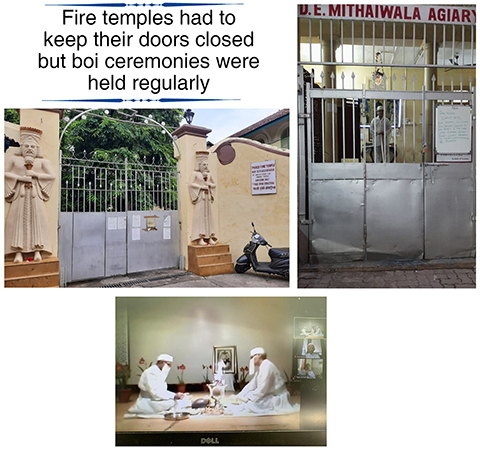
Top: Dadysett Atash Behram (l) and Mithaiwalla Agiary: bereft of worshippers;
center: jashan in progress at Katrak Dar-E-Meher, Delhi viewed online
Ervad Cawas Bagli (l) and Adil Nargolwala: organizing firewood for the Delhi fire temple
Community members kept in touch with seniors. "Most managed well,” Khullar said. The Anjuman helped sports historian and commentator Novy Kapadia, who is ill and unable to move, by getting his caregivers access passes to reach Kapadia’s home. Canine friends were not forgotten. "We have two warm hearted animal lovers, Shernaz Italia and Frenny Khodaiji who live in Connaught Place and for years have been feeding over 200 stray dogs there... This number has now grown to 400 dogs a day but they are valiantly carrying on,” she noted. The DPA opened their kitchen to Italia and Khodaiji for preparation of food for their canines till the women made alternative arrangements.
The overall "scene was pretty smooth” in Delhi, Khullar commented. "Time will tell what steps the DPA takes in future to further open up its activities. At present it is one step at a time till a new dawn appears on the horizon,” she noted.
"Soothing frayed nerves”
"We practiced social distancing, but not social isolation,” said Jehangir Bisney, trustee of the Parsi Zoroastrian Anjuman of Secunderabad and Hyderabad. With the help of their local community directory and volunteers, they identified elderly couples and singles who had little support. "Some proactive youngsters took on the responsibility to check on the elders to ensure that their basic essentials and medicine stocks are regularly replenished,” he noted. Those living outside the three colonies in the city "were kept in touch with over the phone and we provided them with whatever necessary and possible help we could.” Adding that he has personally identified such persons, Bisney said "a phone call to each one of them once in a while went a long way in soothing frayed nerves… We did well. The Anjuman office is now functioning regularly with employees maintaining social distancing to the extent possible. Life is slowly coming back to ‘normal!’” he updated us early June.
Dinshaw Tamboly, who heads the WZO (World Zoroastrian Organisation) Trust Funds that runs three senior citizens’ homes in Navsari, commented that "the residents were all very cooperative” in following the instructions regarding restricted movements. "We wholeheartedly acknowledge that senior citizens who have walked before us have given so much to society and made possible the life we enjoy,” he observed. "In spite of the lockdown all staff members reported for duty, for which the centers’ administration requested for special permission from the authorities.” He added that the Navsari Samast Parsi Zoroastrian General Fund distributed around 400 packets of essential items (oil, wheat, pulses, rice, tea, sugar) to poor Zoroastrians in that South Gujarat city on March 30.
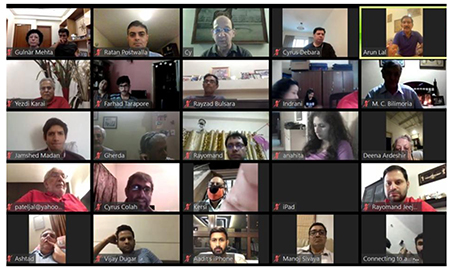
The minuscule Calcutta community bonding virtually
Tamboly, who is also trustee of the Worli Prayer Hall adjacent to the Bombay Municipal Corporation run electric crematorium in Bombay told Parsiana on June 10 that since the lockdown began, families of nine Covid-19 victims had last rites for their dear ones performed there. Corpses of those who succumbed to the virus have to be cremated.
Shiraz Gimi, honorary secretary of the Nagpur Parsi Panchayat (NPP), ensured that financial aid which is given on a regular basis to the deserving members of the community continued uninterrupted, noted Khurshid Dalal, editor of their Gymkhana’s bawabuzz. The salaries of staffers of the Panchayat were paid on time, she stated. "The outlet of Dinshaw’s (ice cream) shop which is in the colony was opened up with due police permission so that the residents could have easy access to daily essentials like milk, bread, yogurt, etc,” she elaborated.
Along with friends at his social group SOS Bikers, Nagpur’s Cyrus Watchmaker joined hands with some Rotarians to collect food from a Sikh gurudwara for relatives of patients being treated at Indira Gandhi Memorial Hospital. His wife Dr Jerestine helped the community by making house calls in case of emergencies. "Monika Bhagwagar lent a helping hand to the management of Tuli Institute of Hotel Management which has opened up its hostel to the migrant workers and other people in transit,” Dalal said. In the Tata Baug residential colony, "people help each other out, especially the old people, by buying, ordering of vegetables, groceries, medicines, etc for them.” The monthly bulletin of the Rotary Club of Nagpur shared with Parsiana by Gimi commended the efforts of "Covid Warriors” Gymkhana president Shiraz Doongaji, and Naushad and Tauby Bhagwagar for their assistance to migrant workers.
Fortuitously, the financial assistance provided by the Ahmedabad Parsi Panchayat (APP) to the needy on their list of beneficiaries was distributed just before the nationwide lockdown came into effect, shared APP trustee Shirin Kanga. Other trusts in the city are also assisting the needy, she said, notably the Dhanjishaw and Manijeh Gamir Charitable Trust and the Mowdawalla Trust. Also a trustee at the Ushta-Te Foundation, Kanga said that the Foundation has arranged to provide groceries to the old and incapacitated from stores close to their residences. She singled out Armin Commissariat who, faced with closure of her food take-away business that opened this January, catered subsidized meals for the needy supported with public donations. "The police would tell her where the food was needed and she would supply it,” stated Kanga on June 10.
The Shree Vadodara Parsi Panchayat (SVPP) was not able to distribute salaries to their staff and financial assistance to their regular constituents in the early stages of the lockdown. Former SVPP president Baman Cama said that they attempted to obtain the banking details of the beneficiaries to enable transfer funds electronically. "We send out messages to community members to take care of their health,” he said.
The office bearers of the Poona Parsee Panchayat (PPP) "kept in touch periodically with the social workers of King Edward Memorial Hospital, Ruby Hall Clinic and Jehangir Hospital in their city to ascertain if there were any Zoroastrian patients admitted to their facilities,” noted PPP chairman Polly Patel. "We were not equipped to do more” than ensuring cleanliness and enforcing restrictions on entry of outsiders at our properties. Passes were arranged for pall bearers and hearse drivers to take bodies of the deceased to Doongerwadi. The Panchayat arranged for fruit and vegetable vendors to sell their wares outside their housing colonies. PPP’s regular financial assistance to the deserving was paid in advance, in view of Jamshedi Navroz that fell on March 20 this year. "We have had no unfortunate situation so far, touch wood,” Patel said in early June. "We have adequate stocks of kathi for all our three fire temples,” the chairman noted.
"There is very little that we can actually do, though we want to...that is the conundrum,” said Zarin Mistry, honorary secretary of the Madras Parsi Association, during the early days of the lockdown. Stating that the community has not set up any emergency response system, she mentioned that committee members were instructed to keep in touch with each other over weekly phone calls. "We are all okay,” she told Parsiana on June 10.
Meeting the world
When the Calcutta Zoroastrian Community’s Religious and Charity Fund (CZCRCF) invited the elders of the community to move into their Bow Street Dharamshala, the response was lukewarm. CZCRCF chief executive officer Noshir Wadia had suggested that senior citizens struggling with "lack of domestic help or...regular meals” could avail of the lodging facilities till things got smoother. "Nobody wanted to leave their homes,” Prochy Mehta, president of the Calcutta Parsee Club told us. Prochy’s husband Numazar is a senior trustee at CZCRCF. The West Bengal capital has a high percentage of seniors within their community.
Anjuman trustee Cyrus Madan told Parsiana on June 10 that a few elderly folks did move into the Dharamshala temporarily in the later stages of the lockdown. Ratan Postwalla and Shara Madan ferried food from the Dharamshala to those who needed it, twice a week, Cyrus noted. No physical visits could take place to the community’s elders, he said, referring to the Fund’s highly regarded care program staffed by volunteers and spearheaded by Navaz Gherda. "We kept in touch with them regularly via phones.” The Fund was able to disburse all welfare payments either in cash or via bank transfers, Cyrus noted. The community lost three members during the lockdown period. The families of all opted for cremation, he said.
The Parsis of Calcutta who "as a community used to meet for sports and just gupsup (chitchat) at least three days a week, are now also meeting community members settled all over the world,” thanks to the extensive use of social media, revealed Prochy. Online activities include fitness, quizzes, Bingo sessions, virtual dance parties, sing-along sessions, antakshari (film music game shows)... basically whatever we can think of,” she stated, all spearheaded by the Club’s entertainment-in-charge Behnaz Bulsara Dugar (see "Grounded but bonded,” Events and Personalities, pg 13).
"We have to do whatever we can to keep our morale up in these bleak times,” added Prochy.