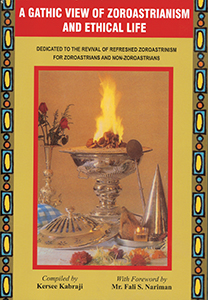
A Gathic view of Zoroastrianism and Ethical Life compiled by Kersee Kabraji. Published in 2013 by the Association for Revival of Zoroastrianism, Mahalaxmi Building, Maruti Lane, Fort, Bombay 400001. Pp: 53. Price: Rs 300.
This rather small book of 53 pages of which about 13 are full page illustrations done by Farzana Cooper, has a Foreword of five pages by jurist Fali S. Nariman.

The Foreword itself is a good contribution to the central theme of the book. Nariman deals with Zarathushtra’s message of one universal God, Ahura Mazda, the importance of individual choice and personal responsibility for the fate of a person’s soul. He stresses the importance for a Zoroastrian to fight evil in all its forms. This has to be done actively; evasion of this fight is not in the Zoroastrian spirit. Nariman points out that it is this constant battle against evil that helps develop traits of character such as courage, justice, truthfulness and self-sacrifice. Avoiding evil through asceticism and distancing oneself from worldly concerns is not a Zoroastrian way of life.
Kabraji divides his book into four chapters followed by the Declaration of Cyrus the Great, a conclusion, an appendix and a Declaration of Faith for persons of non-Zoroastrian heritage who wish to follow the religion.
Chapter one is essentially a single page on Zarathushtra’s life, the society he lived in and his search for the divine message. It is bereft of all the usual miracles attributed to Zarathushtra during his lifetime.
Chapter two deals with the philosophy of the Gathas as expressed in 238 stanzas and 17 chapters. Here Kabraji introduces the concept of Ahura Mazda as expressed in the Gathas. This is followed by the concept of the six Amesha Spentas and others that are mentioned in the Gathas such as Sraosha and Athra, the twin forces or mentalities Spenta Mainyu and its opposite Angre Mainyu (not mentioned by this name in the Gathas).
Kabraji also points out a salient feature of Zarathushtra’s teaching, the concept of man as co-worker with Ahura Mazda in bringing His creation to perfection. He then mentions good thoughts, good words and good deeds as an encapsulation of the Zoroastrian philosophy.

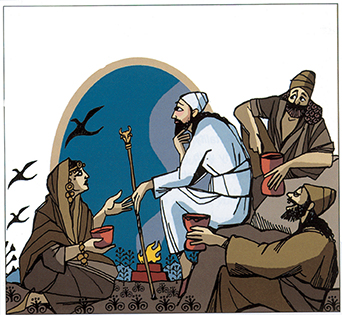
Gathic revelations; (above) illustrations liven up the book
Chapter two continues with the basic prayers Ashem Vohu, Ahunavar (Yatha Ahu Vairyo), Yenge Hatam and Airyama Ishyo. These are transliterated followed by a translation in English with a brief explanation, all of which are quite satisfactory.
For some reason the Ahunavar is repeated twice in transliteration which is probably a typographical error. The word Vanhaush is usually transliterated as Vangheush. The way the transliteration is broken up into lines is also unusual and seems to lead to only two messages from the prayer while there are actually three (see the translation by Ervad Kavasji Edulji Kanga).
Chapter three is the most important one in the book where the author makes a case for Zoroastrianism as the most rational of religions based on the concepts of freedom of choice and free will; personal responsibility for one’s actions; the spirit of service to others; the spirit of independent inquiry; eschatology; acceptance into Zoroastrianism; equality of sexes; the concept of mankind as co-worker with Ahura Mazda; protection of the environment and ending with a sentence on how the concepts of the Amesha Spentas and Spenta Mainyu work towards living the good life.
Each of the above is substantiated with passages selected from the Gathas followed by a brief explanation of their meaning. While most of the passages are appropriate for illustrating these concepts, protection of the environment does not seem to be substantiated by the passages selected from the Gathas, beautiful though they may be in their own right.
In the last part of this chapter Kabraji states that the Gathas do not mention destiny because according to the divine verses one creates one’s own destiny by the use of one’s own good mind to understand and act in accordance with the principles of Asha.
He also mentions that sin and atonement are not mentioned. Zoroastrianism is not a prescriptive religion and has no commandments which can be broken leading to sin. However, the Gathas clearly mention in a number of passages that there is punishment for those who are evil. Leading a life of evil is sin.
Chapter four is a compilation of quotes from various non-Zoroastrian authors, praising Zarathushtra’s teachings. Many Parsi authors have indulged in this, as if favorable views of some non-Zoroastrians are needed to substantiate their own work!
The next chapter is on the Declaration of King Cyrus the Great. Contrary to what Kabraji maintains, the declaration was not issued at the King’s coronation. The proclamation on the Cylinder was made after his conquest of Babylon. It is a paradigm shift in the behavior of conquerors towards the conquered and as such an important "document.” However, it is not really a declaration of human rights. The fanciful translation of the Cyrus Cylinder inscription given by Kabraji is far removed from what it actually says as translated by the British Museum authorities who have studied it. Cyrus never mentions Ahura Mazda on the Cylinder; if he had there would be no controversy over his religion. In fact, the Cylinder repeatedly mentions the Babylonian god Marduk. If the Cylinder was all we knew about Cyrus, one could assume that he was a Mardukian. This chapter needlessly devalues the credibility of the book.
The concluding chapter is a reproduction of Dastur (Dr) Maneckji Dhalla’s final paragraph from Zoroastrian Theology. Kabraji has chosen well how to end the book. He could not have done better.
The Appendix is actually advice on how to become a follower of Zoroastrianism and the basic requirements, in the author’s view, of the knowledge required for being initiated. This is followed by a suggested declaration that the person should make at the time of initiation.
In the opinion of this reviewer the book is too brief to do justice to the Gathic teachings. On the other hand, it does not require an extended attention span to get an inkling of what the Gathas teach. In that sense it is useful as a brief introduction to the Gathas for Zoroastrians and those of other faiths. If it helps readers to appreciate that Zarathushtra never wanted his followers to have blind faith in anyone’s teachings, including his own, but wanted each one to examine and choose the good life, then it will have served its purpose.