The Mistress of Bhatia House by Sujata Massey. Published in 2023 by Penguin Random House India Pvt. Ltd., 4th floor, Capital Tower 1, M. G, Road, Gurgaon 122002. Pp: 420. Price: Rs 499.

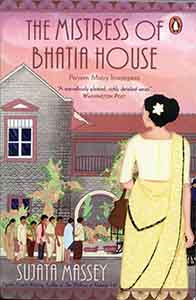
A new novel by Sujata Massey (pictured) is always an event to look forward to. In The Mistress of Bhatia House we once again meet Perveen Mistry, the feisty woman solicitor cum detective. The novel is set in the 1920s in Bombay. Ghatkopar, where much of the action takes place, is not yet the crowded suburb it has now become and Perveen transits from Colaba to Ghatkopar without a thought. Massey also does an excellent job in capturing the locale and customs of the period — race, caste, class, and above all the privilege of belonging to the male sex. The British are equally class conscious and supercilious in their treatment of an Australian singer who has married the Prince of Varanpur. Lady Hobson-Jones, the mother of Perveen’s best friend, does not even bother to return the singer’s greeting.
The novel starts with two enigmatic sentences. "Sisters will fight. It’s true whether they are raised together or meet as sisters-in-law in a joint household.” The two sisters-in-law in the Bhatia household are Uma, married to Parvesh, the elder son of Sir Dwarkanath Bhatia, who runs a stone business, and Mangala, married to the younger son. Whereas Uma has one son, Ishan — whom Perveen refers to as "a crown prince of sorts,” as he is the heir apparent — Mangala has three sons. Through the elderly, faithful and long-serving servant Oshadi, we learn about the bickering between the two sisters-in-law. There is a parallel situation in the Mistry household. Perveen’s sister-in-law and childhood friend, Gulnaz, has just given birth to a baby girl. The young women, who were formerly very close, now seem to be treading divergent paths. Gulnaz is very short with Perveen and reluctant to allow her to hold the baby or to have anything to do with her. Keeping in mind Gulnaz’s economic privilege, with servants at her beck and call, the entire Mistry family too tends to her every need. She also has access to medical care, which makes the reader feel that she could be suffering from a more complex problem.
However, the rivalry between sisters-in-law does not form the crux of the novel as the reader would expect — hence, the sentences are enigmatic. The novel starts with a gathering of women at a party to raise funds to found a charity hospital for women. Massey uses this opportunity to introduce the reader to the various characters who will play an important role in the novel as well as the various tensions amongst the guests. One person who plays a crucial role in the novel is the Jewish Dr Miriam Penkar, the only Indian female obstetrician-gynecologist in the city. It is interesting to note that Massey has chosen both the principal characters from minority communities to play a pivotal part in the novel.
During the party Ishan gets burnt. Is this an act of malevolence? Is Mangala to blame? All the women rush to the spot and wring their hands ineffectively. The boy is saved by a servant, Sunanda, who has the presence of mind to throw herself on the burning boy even though she sustains severe burns as a result. Penkar treats both the boy and the servant and things end on a rather abrupt note with Sir Dwarkanath bringing the party summarily to a close.
Through a strange coincidence Perveen finds Sunanda, who had saved Ishan’s life, at the police station, charged with a misdemeanor under the colonial reproductive rights law (an illegal abortion). It is here that matters turn very murky. As Perveen delves deeper into the case she identifies a trio of powerful men who have either known her client Sunanda, or who seem to be unusually involved in the case. But where is the accuser? As the prosecution proceeds, Massey comes to the real heart of the problem. The question she poses is not whether the servant has undergone an illegal abortion or not but who has put her in this predicament in the first place. And to what extent will he go to safeguard his identity?
Perveen is a woman in a male dominated profession and has to constantly prove herself. A client, though pleased with her work on a contract, would be happier if her lawyer father checked it out. When she initially tries to speak in court on behalf of Sunanda, the judge mockingly reminds her that she is not entitled to represent clients in a courtroom and has her dismissed. Despite this, Massey produces a well-knit thriller and builds up the suspense as Perveen tries very hard to investigate the case and identify the culprit.
Perveen fights a battle on several fronts: on a personal level there is the estrangement with Gulnaz which needs to be sorted out. Massey has in her earlier novels written about a clandestine love affair between Perveen and an Englishman, Colin Sandringham. The love they feel for each other is sensitively portrayed in this novel as well. But, in keeping with the decorum of India of the 1920s she is, once again, a slave to social conventions which are complicated by the fact that she had been married earlier and has not yet obtained a divorce. Whereas we see a lot of Perveen as a lawyer and a supporter of women’s rights, a little more on the progress of her relationship with Colin would have presented a more rounded picture of her character.
One of Massey’s new and extremely well drawn characters is the doctor, Penkar, and we hope to see more of her in her future novels. Her character has been inspired by Dr Jerusha Jhirad, the first Indian woman gynecologist, a member of the Bene Israel community. When we first meet Penkar at the party for the hospital, Massey emphasizes the doctor’s dedication to her profession by revealing that she does not carry a fancy purse but has "a large leather bag under her left arm.” Through Penkar’s conversation with Perveen, Massey skilfully informs readers all they need to know about the Dwarkanath family. Massey depicts Penkar’s genuine concern, especially when it comes to high mortality rate among newborn female children. Though she advises her patients against early pregnancies, her advice remains largely unheeded. Massey shows the doctor’s commitment to the hospital and the welfare of patients. Penkar’s disappointment when she is informed that the plans for the hospital have been shelved is palpable.
At the end of the novel, Perveen and her father go with all the evidence they have collected to meet advocate general Jamshetjee Kanga who gives them a patient hearing and an impartial judgment. The reader will be pleased to learn that the character was based on Jamshedji B. Kanga, the first Indian advocate general of the Bombay High Court who had mentored several famous Parsi lawyers like Homi Seervai, Nani Palkhivala, Soli Sorabjee and Fali Nariman.
The novel is tightly plotted and the suspense held till the very end. Not only has Massey created a Parsi lawyer but has given her a distinctive personality and a will of her own. The novel is sensitively written and we hope in future to encounter Perveen yet again.
FIRDAUS GANDAVIA
Gandavia holds a doctorate in English literature and is a retired chartered accountant. He is a compulsive reader of fiction.