Values imbued from childhood stood the family in good stead
Khorshed Javeri
The controversy in the Parsi Press over who is eligible to propose a candidate for trusteeship to the Bombay Parsi Punchayet or stand as one (that they should be Parsi Zoroastrians only) has me wondering whether I would qualify as a Zoroastrian.
My credentials are that I am born of two Zoroastrians, special beings whom God in his bounty chose to give me as parents. My father was a navar and maratab, entitled to practice as a Zoroastrian priest, should he have chosen to do so. However, he became a lawyer and was renowned for his knowledge of and expertise on the Rent Act.
We five children had our navjotes performed but did not follow rituals. We did our kusti regularly, but were not threatened with punishment if we did not recite the prayers. We went to the fire temple on occasions. My father’s obsession was to ensure a sound education for his children and according to our inclinations three of us became lawyers and two doctors. The parjat in our household, our domestic help (usually a Rosy or Mary), ate what we ate and was taught embroidery and drawing by my mother in her spare time. We wept when the maids left, usually to get married.
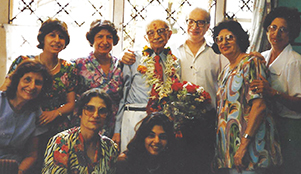
The Andhyarujina family at patriarch Rustomji’s 93rd birthday
with Khorshed Javeri (2nd from r)
My father, unlike most Parsis, was a follower of Mahatma Gandhi. We learnt from our mother that early in their marriage he would sit up late in the night writing fiery articles in support of the freedom struggle. She did not like Gandhiji too much — partly because under his influence my father had suggested that she wear khadi — a suggestion that was promptly shot down.
I think some of my father’s philosophy must have rubbed off on us because we grew up devoid of the belief that "pure blood flowed in our Zoroastrian veins.” We felt genuine brotherhood towards all. I recall that when I worked in the corporate world people who assumed I came from "the upper crust” (a totally wrong assumption) were surprised that I could be comfortable with persons of all ranks. They wondered why I always took up for the underdog.
There was one rule in our home that could never be broken: crossing the line between right and wrong. We emulated our parents’ lives. I recall the incident, with the pounding of the blood in my head, when a person I had assumed was a shareholder came to discuss the company’s accounts with me while I was a company secretary. He turned out to be a steel stockist who had come to offer me a bribe for an out-of-turn allotment of a scarce commodity! My siblings must have faced similar situations.
We often discussed the three simple tenets of Zoroastrianism: good thoughts, good words and good deeds, humata, hukhta, hvarshta in Avesta which, according to my father, was all that should be followed in life. I myself found it was all I needed to guide me along the path of righteousness and fulfilment.
Recently I was reading the book Good Thoughts, Good Words, Good Deeds brought out in 2019 by Tata Archives. T. R. Doongaji, its honorary advisor has, in his excellent preface, explained beautifully the relationship between this philosophy and the success of the Group.
In the evening of my life, I take stock of what I have done and whether I have followed these tenets. By worldly standards I could have done better. I did not reach the top of the corporate ladder which I should have had I fully used my talents. I spent a large part of my time writing — some books on my subject, and some entirely for pleasure — because I love to write. Perhaps the first provided knowledge and the second some pleasure to those who read them.
I have spent a considerable time working for the aged destitute and a school for underprivileged deaf children. I would not want to give up the joy these have brought into my life. The poor are uninhibited. The warmth of a spontaneous hug from a resident on seeing me after a long absence is even today one of my cherished memories. At a school function, when an ex-student who had graduated and holds a high position got up to speak and thanked his mother and us, speaking more fluently and better than many of us, I thought my heart would burst with joy and pride and gratitude for having been allowed to be a part of this miracle!
I do not believe that my grandchildren (born of a talented parjat) whose single hug can cure me of my severest depression can affect the efficacy of any prayers said for me, or that the presence of any juddin can do so either.
I do not particularly care after I die whether I am buried or burned or taken to Doongerwadi. But I have this terrible longing to meet my loved ones who have gone before me, coupled with the irrational hope that this would be more likely if my final resting place is the same as theirs. For that reason alone, I would like to take this path.
I rest my case. Am I a Zoroastrian?