Banoo Lashkari studied and spread the
message of Zoroaster in her own quiet way
Khorshed Javeri
Banoo Lashkari (pictured) passed away in the early hours of August 5, 2020, a day few Bombayites are likely to forget as there was unprecedented rain causing irreparable damage. One of the prime casualties was Doongerwadi, which necessitated Banoo’s funeral being postponed by a day. Her exit was in sharp contrast to the quiet life she led. Few were aware that she had a doctorate in microbiology and was entitled to be addressed as "doctor.”
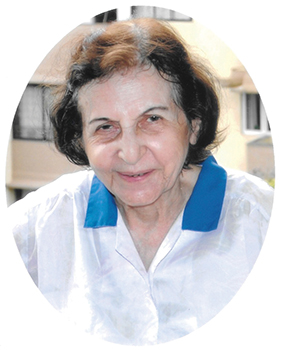 Banoo and I were first cousins, her mother being my father’s sister. We met often and being nearly the same age were very close although our careers took different paths. Banoo and her brother Jemi Curravala came from a middle class family. Their father worked with the railways, a much coveted employment then, and their mother was a homemaker. They were honest, decent people whose lives revolved around educating their children, finding happiness in their success and imparting the family values of respect for elders and never deviating from the right path.
Both children were hardworking, well-mannered and excelled academically. Jemi qualified as a chartered accountant and worked for most of his life with Guest Keen Williams, rising to be managing director and chairman. After toying with the idea of becoming a medical doctor, Banoo settled for a doctorate in microbiology and research. She joined Hindustan Lever Research Centre where she started the microbiology department.
Banoo believed in total commitment to whatever she did. She devoted her physical and mental energy and knowledge to her job as well as to any other task she undertook. At Hindustan Lever she developed processes for ripening of cheeses and had to her credit three global patents for reducing the maturing time from six months to a few days. These patents were sold to Unilever. She co-authored a book, High Blood Pressure, with Dr V. K. Mehra where her knowledge of microbiology assisted in explaining certain aspects of the disorder. The book went into seven editions. For her role in condensing and clarifying their articles, the international magazine Chemical Abstract Service of USA awarded her a certificate of appreciation. Later in life she gave the same attention to the study and spread of the Zoroastrian religion which became her passion.
While with Levers, she met her future husband, Zerxes Lashkari, a chemical engineer. Banoo quit her job after the birth of her children. She devoted her time to her family and the study of Zoroastrianism. She joined Zoroastrian Studies (ZS) founded by Khojeste Mistree. After some years she started her own classes at Nowroz Baug, Wadia Baug and later at Rustom Baug where she taught the tenets of Zoroastrianism to batches of elders. She also contributed poems and articles to Ushta, the ZS newsletter. Advancing age and commuting difficulties made her eventually give up her teaching assignments barring Rustom Baug. The ladies there had formed a deep attachment to her. After her death, one of them narrated how Banoo had the knack of making her talks appealing to both scholars and lay people.
Sadly, though the family was aware of Banoo’s work in this field, few spoke about this aspect as there were other interesting topics to discuss.
Banoo’s family was creating waves. Her elder son Yazdi who graduated from MIT (Massachusetts Institute of Technology) Boston started a computer company with his colleagues which was acquired by Microsoft for a handsome price. Her younger son Perseus was making his mark in recording programs and computer programing. Zerxes had started his own consultancy firm, and was much sought after. Banoo basked in the success of her family.
During discussions regarding the promotion of two books of short stories I realized how our interpretations of the religion differed. I suggested she could disseminate her knowledge through a book. She admitted she had given the matter a thought; she had much handwritten material on the subject.
We last met on February 13, 2020 at the wedding reception of our cousin Feroze Andhyarujina. She looked frail. For some time I had been pressing her to meet with my friends, many of whom had children married to non-Parsis. We felt it would be a wonderful opportunity to listen to someone who had studied our religion because of love for its teachings. She was perhaps intimidated at the suggestion and kept putting it off.
In July 2020 she had a fall and was taken to Saifee Hospital. Following complications, she died on August 5.
Farewell, dear Banoo! You were a worthy follower of Zarathushtra, practicing the religion in its true essence. Who knows, your writings may still assume the avatar of the book you and I were striving for! I remember you telling me that our folklore was full of amazing things that happened to true believers of the faith. Your book may still see the light of day!