Maneck Dalal recalls his encounters with Mahatma Gandhi, Jawaharlal
Nehru and others during his days with Air India’s London office
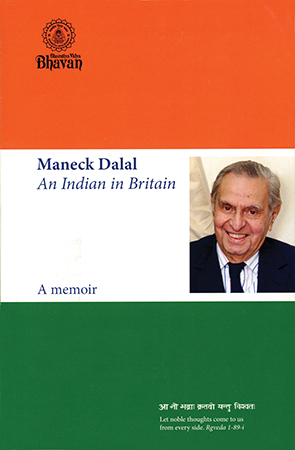
These chapters, reprinted with permission, are edited extracts from Maneck Dalal, an Indian in Britain, collated by Sue Dalal and published by the Bharatiya Vidya Bhavan. Copyright Sue Dalal. Maneck was a former trustee of the Zoroastrian Trust Funds of Europe, managing director of Tata Limited and an Air India stalwart.
Maneck Dalal, above left and right center, with the Duchess of Cornwall and Prince Charles
Meeting the Mahatma
In early 1947 Mahatma Gandhi was staying at G. D. Birla’s lovely house in Delhi. I was asked by my chairman J. R. D. Tata to arrange for the collection of the articles which Gandhi wrote for a paper called The Harijan. As the paper was printed in Ahmedabad, Air India would carry articles from Delhi to Ahmedabad. I sent my office messenger man to pick up articles from Birla House. He came back beaming with pleasure, saying that he had met the Mahatma.
So I asked "kaisé milé (How did you meet him)?” He told me that Gandhi whenever and wherever possible thanked any messenger personally.
Jawaharlal Nehru (l) and Mahatma Gandhi Photo: Wikipedia
I therefore decided to assume the role of messenger to have the privilege of meeting the great man. In those days, I suppose I was a vain young man of 26, wearing silk shirts and bow ties and very tight-fitting trousers which were the fashion of the day.
When I called on Gandhi, he looked this young Indian up and down, taking in the tight trousers and the fact that he clearly fancied himself in western clothes. Gandhi, by contrast, was bare from the waist upwards and wearing a snow white dhoti. He was also sitting on a very low seat. He was quick to notice that I was a Parsi and therefore Gujarati-speaking. He invited me to sit beside him: "Aavo béso (come, sit down).” It is impossible to sit on the floor in extremely tight trousers. I tried. Gandhi cackled with laughter. He told me in Gujarati how silly it was to wear such impractical clothes.
There were two things I noticed about him. The first was that he was extremely observant. The second, that he could concentrate with undivided attention upon every word that you spoke to him. The latter was very flattering, although I was later told that he gave the same undivided attention to Pandit Nehru as to a sweeper woman complaining about having too many children.
I used to see Mahatma Gandhi every week, but after that first meeting I would wear loose trousers and a bush shirt. He had a delightful sense of humor and he gave you the feeling that he was always on your side. He was the kindest of people and yet the sternest of them. He had a great sense of self-discipline.
Pandit Nehru, Lady Mountbatten, Dr Sarvepalli Radhakrishnan and V. K. Krishna Menon
Work was stressful and demanding. Competition in aviation was fierce. My immediate boss in Bombay was Bobby Kooka. He was an extremely hard taskmaster. We shared the same friends in Bombay and of course everyone wanted to come to London and valued my help here. I respected Bobby’s brilliance in advertising.
Since Independence, Indians had come more and more into their own and this was reflected in the airline.
I had been in London only a year or so when, in early 1948, I had to pay a courtesy call on the High Commissioner for India, V. K. Krishna Menon. He was an interesting character, scholarly, and a lawyer by background. He was polite but cool. He was well known for his left-wing views and may have regarded me as a representative of a well-known private sector organization, Tata Sons and, as such, a bastion of capitalism.
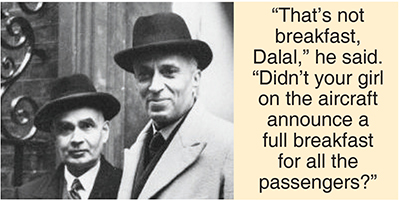
Nehru (r) with Girija Shankar Bajpai at a Commonwealth meeting, 1948 Photo: Wikipedia
Krishna Menon on the cover of Time Photo: Wikipedia
Even at London airport, when people like the Prime Minister (PM) of India Pandit Jawaharlal Nehru came, I was on duty representing the airline, whereas Krishna Menon as high commissioner came with a battery of senior high commission officials.
We would all line up at the passenger steps of the Constellation aircraft. Krishna Menon would greet the PM and introduce his officials. When it came to my turn, he would wave his stick at me and say "that’s Tata’s officer.”
Whilst he was initially hostile, later, once he discovered I was politically inactive, he relaxed. When someone told him I was centrist in political terms, he replied sharply, "Dalal has no politics. His politics and his religion are Air India.”
Quite early on, I was asked by a man called Zaman, who was a travel officer at the high commission to go and discuss student charter flights with the British trade commissioner Arthur Call. Call was sensible and charming and we got on well. We negotiated a price for the first student charter flight from London to Delhi. Soon afterwards I received a telephone call from Capt Sreenivasan to say that Krishna Menon wanted me to reduce the individual cost of a (chartered) plane by £1,000. I said I would have to refer this to my head office.
Sreenivasan said this would infuriate the high commissioner. The students were left in limbo for three weeks.
I was then sent for by Krishna Menon. I was still in my 20s then. After being kept waiting for 50 minutes, I was shown into his large office.
"Dalal, I hear you have been dealing with my officers, instead of discussing this with me,” he said. "If you keep on defying me, I’ll have you out of here in a fortnight.” "Sir,” I said, "You are the high commissioner, and I am only a local airline manager. Of course you could send me back. But would you?”
He was quite taken aback. He walked around his enormous desk, patted me on the back and said, "My dear chap. Don’t take on so. Sit down and have a cup of tea with me.”
In many ways, Air India was the public international face of the emergent country. For example, when the first Indian ambassador to the USSR (Union of Soviet Socialist Republics) Vijaya Lakshmi Pandit (Nehru’s sister) flew to Moscow, the Air India DC-3 in which she travelled flew the Indian flag for the first time.
The inauguration of the weekly Bombay-London Constellation service in June 1948 prompted the issue of a special commemorative stamp by the Indian government.
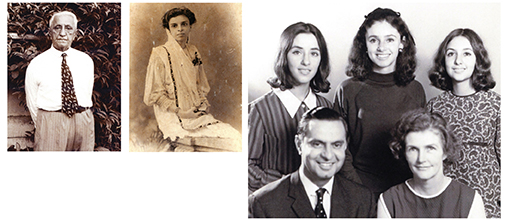
Above: Father Ardeshir (l) and mother Amy Dalal (c);
right, clockwise from top left: Suzy, Tina, Caroline, Kay and Maneck Dalal
The general manager of Air India in India was an Englishman, B. W. Figgins. In the early 1950s, he was sent from India to London. This was politically convenient and also offered him a comfortable situation. A post was created for him as regional manager of Europe. From my perspective, however, this made life more difficult.
I was regional manager, UK. It was very hard to have two bosses, particularly as I knew the ropes and Figgy, as he was known, was essentially a flying instructor who had gradually risen to become the general manager of the airline. The deputy airport manager, Montgomery, once said to him, "Mr Figgins, everybody knows it is Mr Dalal who does all the work.”
Our town offices were on Curzon Street, an area we shared with some rather sophisticated and very elegant "street ladies.” One summer evening, as I was about to get into my car to drive home, the lower window of one of the town houses opened and a friend of mine, Dosoo Karaka, put his head out and yelled "Maneck, come and have a drink.”
Karaka was a hefty extrovert, ex-Oxford Parsi from Bombay. He was also editor of Current weekly. He refused to take no for an answer. He had rented the smallish flat on Curzon Street for a few weeks.
While we had a drink, a very sophisticated and elegantly attired lady went by. Dosoo leaned out of the window and asked, "Had any luck dearie?” She shouted at him with slightly less sophistication, "Shut up you fucking bastard!”
At that time, one of my roles was to escort the prime minister or president of India, when they travelled on the airline. This meant I had the privilege of flying with people like Nehru and Dr Sarvepalli Radhakrishnan, the President.
Nehru was a fast-thinking, mercurial man. He was very mobile in the way he spoke, gesticulating a lot, using his hands all the time. He had a good heart but, as with many bright people, he could be impatient. I used to say that the only time he remembered my name was when something went wrong and he would say, "Dalal, what is happening here?”
I remember one time I met him, when he came into London from New York. At that time none of the current Heathrow terminals had been built, but there was a terminal building at the north of the airport.
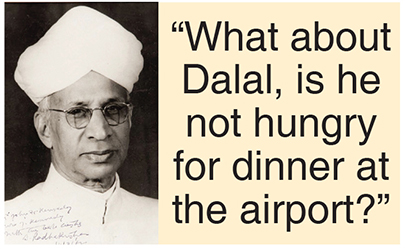
Dr Sarvepalli Radhakrishnan Photo: Wikipedia
The chief of protocol for the British government (Col ‘Gerry’ Hugo), the acting high commissioner for India Azim Hussain, who was a friend of mine, and I met him. Vijaya Lakshmi Pandit was high commissioner, but was in India at the time. I had planned to give the PM breakfast in the airport VIP (very important people) lounge. As the other passengers were having breakfast in the airport restaurant, I thought Nehru would be more comfortable and secure in the lounge. Security in those days was considerably more lax than it is now.
Nehru looked extremely tired and old. He was in a dreadful mood. Azim seemed nervous and jumpy.
I escorted the PM to the VIP lounge and offered him breakfast. We had arranged for tea, coffee, scrambled eggs on toast, etc. He turned to Azim and demanded, "Azim, where’s my breakfast?” Azim turned to me and asked, "Maneck, where’s the Prime Minister’s breakfast?”
In all innocence I said "It’s laid out here sir.” What I didn’t know was that Nehru always had a huge breakfast which was his main meal of the day. "That’s not breakfast, Dalal,” he said. "Didn’t your girl on the aircraft announce a full breakfast for all the passengers?”
I walked Nehru through the fairly lengthy distance to the airport restaurant past the narrow passages of the airport, through bustling queues of passengers who were clearing immigration. So much for attempts at security!
When we got through to the Customs Hall, we saw Duncan Sandys who was then a senior minister in the British government, queuing with the rest. "Good morning, Prime Minister!” he said, "Had a good flight?” "No,” said Nehru and to me, "Where are you taking me, Dalal?”
By this time, I was having visions of being posted to Coimbatore. Hugo and I took turns to appease Nehru and by the time we eventually arrived at the restaurant, one of my staff who had run on ahead had arranged a very full breakfast of cornflakes, bacon and eggs, toast and marmalade, coffee and so on. I sat opposite the PM attending on his every whim with enthusiasm. After he had eaten a very full breakfast, he gave me a really lovely smile and said to Gerry and me, "That was quite a long way!” He then pulled out a long cigarette holder and smoked a cigarette contentedly.
I was to see the PM again a few years later when he came back to London. He was usually accompanied by his private secretary, M. O. Mathai, who wielded a lot of reflected power. Because of arrangements over the years for the PM, I got to know Mathai quite well. In the mid 1950s, Cinerama came to London’s West End for the first time from the United States. This was where a very wide screen was used. As Mathai had a free evening, I asked him if he wanted to join (my wife) Kay and me at the cinema. Mathai was very keen to go. But then he asked whether Nehru could join us. I booked the tickets and, on hearing of our visit, the manager gave us the "royal” seats.
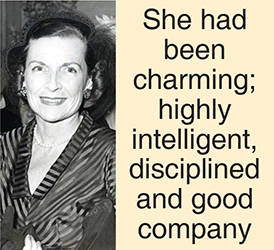
Lady Edwina Mountbatten Photo: Wikipedia
Dalal (l) with J. R. D. Tata (r)
Dalal with Margaret Thatcher
Before the film began, Mathai told us another lady would be joining us. Nehru’s wife had died some years earlier of tuberculosis. The lady in question turned out to be Edwina Mountbatten (wife of Lord Louis Mountbatten, First Sea Lord and Viceroy of India). Even then, there were rumors about an affair. There was an early evening reception at the high commissioner’s residence at Kensington Palace Gardens and the plan was for Kay and me to join them there and then travel in two cars to the cinema. Mathai warned us that the PM may leave the cinema early. Kay rode with the PM and Edwina Mountbatten. I took Mathai in my car.
Later the PM was utterly engrossed in conversation with Lady Mountbatten. He was polite enough, but she was enthusiastic in saying how much she had enjoyed the evening. I had met her briefly once before and she had been charming; highly intelligent, disciplined and good company. She later became chairperson of the India Club of which I was a founder member.
Lord Mountbatten could be very easygoing. As long as he was treated with respect, he was relaxed. I was on the Gandhi Memorial Committee of which he was chairman. Other committee members included the cabinet minister Jennie Lee and Lord Roy Thomson, chairman of The Times. Lord Mountbatten proved himself capable of being rather grand and quite dismissive of even such eminent fellow committee members. I found him otherwise a good man to work with. He was highly intelligent and a good clear decision-maker. If he liked you, he was trusting and generous.
Radhakrishnan had been a professor of theology at Oxford. He became quite a good friend, particularly as his son, Dr Gopal (who like him lectured at Oxford, but in history) would phone me and invite himself to lunch whenever he was in London. Gopal would insist that I always accompany his father on Air India flights. When we lunched, Gopal would make a point of refusing to drink Portuguese wine because of the Portuguese occupation of India.
With supreme imperial arrogance, Portugal had given the city of Bombay to Charles II as a wedding present in 1662, when he married Catherine of Braganza. Even our mangos had assumed a Portuguese name after King Alphonso who enjoyed them so much.
I think it was because of my friendship with Gopal that I was often asked to accompany Radhakrishnan. Flying with him on Air India on one occasion, we were over Moscow when I was asked by the captain to join him in the cockpit. As I was looking after the President, the captain gave me a message for him from the USSR authorities. The message was that President Anastas Mikoyan would like the President of India and his entourage to have dinner at Moscow airport with Mikoyan and his entourage.
I went to tell Radhakrishnan. "Sir, there is a message inviting you to have dinner with the President of the USSR and he wants to know how many there are in your party, and so on.”
He started counting and I said, "I believe there are seven including yourself.” He said, "No there are eight.” I said, "Well sir, I only have seven.” He replied, "What about Dalal, is he not hungry for dinner at the airport?” I said how kind he was to include me in his party and he said: "You are part of my party.”
So it was a great experience on the ground at Moscow Airport to have these two presidents sitting opposite each other flanked by their teams. It was quite a historic dinner in a way because, through interpreters, the two presidents were talking, when the subject of Pakistan arose. It was instructive for me to see how skilfully each president handled the issue of India and Pakistan and Radhakrishnan was superb in his response. It was a lesson for me to see how top diplomacy works.