Chairman and managing director
of Tata Iron and Steel Company,
Russi Mody was an extraordinary leader of men, with many strengths and some foibles
Donn Doongaji
On the occasion of Russi Mody’s birth centenary, in January 2018 Tata Central Archives published a tribute to the man written by Donn Doongaji who had been closely associated with him. Parsiana reproduces here, with permission, an abridged and adapted version of the article.
Travelling with Russi Mody was fun, but it could also be an adventure. I was flying with him from Bombay to Jamshedpur in the company’s King Air. I am not a particularly brave flyer and the small aircraft powered with propellers was not always steady, to put it mildly. It was the aroma of the Parsi pora (omelet) and the exotic food stacked in the plane that helped me put up a brave expression. Mody, who had qualified to be a pilot and had received his licence not too long ago, suddenly decided to take over the controls and asked Jimmy Tapsal, who was a professional and skilled pilot with years of experience, to move aside.
The weather had not been the best that day and as we were nearing Jamshedpur it turned very turbulent. In spite of Tapsal’s request to take charge, conveyed in the most polite manner in a demanding situation which really required the skills of an experienced pilot to negotiate the winds, Mody would not let go of the controls and insisted on landing the plane himself. As a dear friend, Niroop Mahanty, himself a pilot, writes: "There were times when I believed that he (Russi) was certain the Law of Aerodynamics did not apply to him.” I don’t remember how many Gods I prayed to as we swayed and were tossed around, almost scraping past blast furnaces and chimneys of our steel plant, landscapes appearing and vanishing behind screens of clouds and smoke, frequently revving up to climb and dropping speed to descend, as the pilot watched in total disbelief, until we managed to land at Sonari, the Jamshedpur airport, bouncing and bumping to the sounds of thuds as the plane came to a greatly relieving halt!
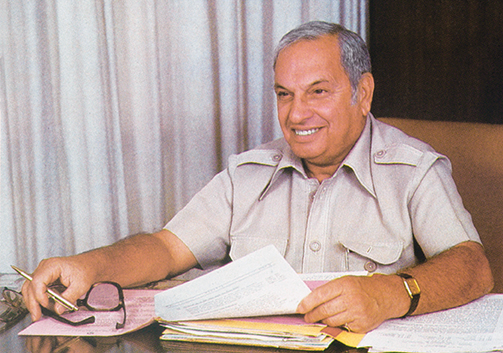
Russi Mody: generous and genial
Caricature of Mody piloting a plane
As we were getting out of the plane and as I once again found my feet firmly on mother terra steadying my trembling self, Mody asked me, "So, how was the landing?” I said: "Sir, in what capacity would you like to know? As one answering his chairman and managing director (CMD), or one speaking to his friend?” He said, "First, as your CMD.’’ I replied, "Smooooth; feather…” "Now as your friend,” asked Mody. All I could then ask in turn was, "Sir, did we descend or did we drop?” I could only hear him mutter "You b…”
Speaking of flying with him, I remember boarding a Bombay-Calcutta non-stop Indian Airlines flight when someone, who wanted to impress the other passengers by showing off how well he knew Mody, shouted from 10 rows behind, "Hello Russi, travelling to Calcutta?” "No, jumping off at Nagpur,” Mody yelled back. Stuck to his seat and stupefied, the poor guy crouched, embarrassed as he was at the burst of laughter that echoed in the plane.
Mody as a host must remain unmatched, for such was his hospitality, generosity and genuine care. I have had the privilege of living with him at two of his homes in Calcutta. Once when Sharokh Sabavala, vice chairman, and I travelled with him to Calcutta, he insisted that I stay with them in his penthouse on the 17th floor of Tata Centre. I was a nonentity and felt awkward to accept his warm invitation and kept making excuses. When our cars arrived at the airport, I quickly picked up my bag and tip-toed my way to the car that had come to receive me. I did not know that every action of mine was being observed. Before I could realize, Mody had walked up to my car, opened the trunk and carried my bag and tossed it into the boot of his car, and the three of us were on our way.
On arriving at his beautiful penthouse overlooking the Victoria Memorial, the staff was asked to show Sabavala his room. As for me, I was escorted to my room by Mody himself with a bearer in tow who was instructed to make sure that there was nothing wanting. I vividly remember him personally ensuring that the bathroom had fresh towels, a toothbrush and toothpaste, soaps, a razor and all that would be required for a guest to enjoy a comfortable stay. After we had stuffed ourselves with a sumptuous lunch, he invited Sabavala and me to his bedroom for coffee. In the bedroom there was this picture of two little boys wearing Parsi caps and jhablas (frocks). Pointing to it he inquired if I could guess who they were. I truly couldn’t but said, "Obviously, Sir, one of them is you or why else would you have the picture in your bedroom?” Mody said, "You guessed right; you see that boy on the left dressed in a gold jhabla, that’s me; and the other fellow dressed in a silver jhabla, that’s Sharokh. And that’s been the difference ever since.”
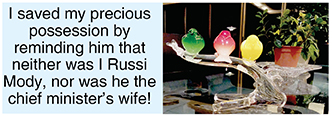
On another occasion when staying at his penthouse, Mody asked me to pick up all the beautiful and precious artifacts, cut glass and other very expensive figurines and curios that adorned his drawing room, and carry them to his bedroom where he began stacking them in the cupboard. After every single piece had been moved, he then gave me some other artifacts and asked me to take them to the drawing room and display them randomly as I might choose to do. Not knowing the reason for this exercise, I inquired as to what was going on. He said, "You wouldn’t know, but the chief minister and his wife are coming over for dinner tonight.” I couldn’t help saying, "If that be so, don’t you wish to display the best from your collection?” He said, "But that, my boy, is the real problem; whenever the lady has visited me with her husband, she has pointed to some piece commenting how beautiful it is, expecting me to immediately present it to her, something I have invariably had to do much against my wish. By doing what we have just done, I have guarded my best.” A few months later, he was at my place in Bombay for dinner and he "liked” the only Murano glass piece that I owned – three colored birds perched on a branch. I saved my precious possession by reminding him that neither was I Russi Mody, nor was he the chief minister’s wife!
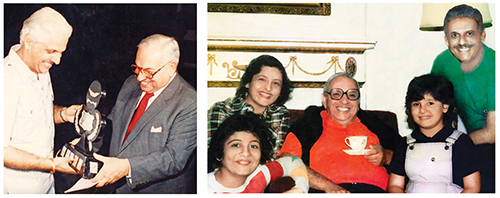
Above l: Donn Doongaji receiving bridge trophy from Russi Mody;
above r: Doongaji family with Mody (center);
below: Murano glass item
There were a few who Mody was genuinely fond of and I would like to believe I was one soul so blessed. After J. R. D. Tata, Sumant Moolgaokar, Sabavala and some other local celebrities had left post a dinner he had hosted at his Jamshedpur bungalow, he asked the three or four of us to wait saying that the "real party” was yet to begin. During the couple of hours that followed we were treated to the best liqueurs, chocolates and desserts and coffee as he puffed on his Hawaiian cigar. As we chatted away and regaled ourselves he looked at each one of us and said: "You know boys, you are the nearest and the dearest to me. I have no family really. I have therefore decided to will away everything that I have, equally divided between you fellows.” And he went on and on saying how precious we were to him, raising our expectations to the skies as we busied ourselves imagining how rich we were all going to be. Hardly did we know then that our dreams of becoming rich were soon to come crashing down. After he had
pumped our expectations to unbelievable heights, he suddenly said: "Unfortunately, there is a snag in what I propose to do.” "Snag, what snag?” someone asked. "The snag, sadly,” said Mody, "is that all of you will die before me.” lt was really late by then and once again at his best he said, "Anyway, I do hope you guys enjoyed yourselves.” "Thoroughly,” we replied as we savored each unforgettable moment that had come to pass. "Don’t you think you should now do me a favor in turn?” he asked. Almost in a chorus we said, "Anything for you, Sir.” Russi bellowed, "Why don’t you all now just f... o...?” And off we went.
It was often said and believed that Mody knew everyone by their first name. This could have been a tad exaggerated, but he did have the knack of spotting a TISCO (Tata Iron and Steel Company) person in any crowd. Once when my family and I were on vacation at a hill station, he also happened to be there and decided to take us out for a walk wishing to buy toys for the children. As we approached the shop he spotted at a distance a couple and their two small kids walking towards us. Turning to me he asked, "Isn’t that fellow coming this way one of our officers? What’s his name?” I said, "Verma.’’ "No. Not his last name. What’s his first name?” I said "Ramesh.’’ "And the names of his wife and kids?” asked Mody, to which I replied, "Rekha, and the kids are Rohit and Poorva.” By then the family was within hearing distance. As if he had known them all their lives, he exclaimed: "Oh! Hello Ramesh, nice to see you. And, you Rekha, how have you been?” Then ruffling the little boy’s hair he enquired of the two kids, "So? Which school do you go to Rohit and Poorva?” Ramesh was swept off his feet, feeling proud of how well and intimately the CMD knew him and his family. For many days thereafter Ramesh floated on cloud nine. (Names changed.)
Mody could swing decisions his way, although not necessarily in a democratic manner. Once when he was chairing the annual meeting of members at the United Club in Jamshedpur, he was keen to have a particular resolution passed. He was aware that the majority would not support the resolution. Tabling the resolution, he said, "First, those against.” Many hands went up and he counted, "1, 2, 3 ... 16 ... 17 ... 23, 24, 25.’’ "Now those in favor” he asked. Barely eight persons raised their hands. So he simply continued counting from where he had stopped for the naysayers, 26, 27 ... 31, 32, 33 ... Carried!” And down came the mallet.
A marketing conference in the sylvan surroundings of Soaltee, Kathmandu, was aborted midway by Mody when he realized that we were there with our spouses. He wanted us to spend quality time with them which pleased the grateful ladies. Mody won the hearts of all whose lives he touched.
Corporate history is replete with stories of succession challenges and battles. In the early 1990s, the succession issue at Tata Steel got mired in controversy. Mody wanted Aditya Kashyap to supersede Dr Jamshed Irani and take charge as managing director (MD). J. R. D. Tata and the board were not in favor, but Mody was no ordinary CMD. The issue stirred corporate India, more so as Tatas with their impeccable record of governance had never been subjected to such public exposure. In the midst of all this bickering, one evening when my wife and I and Aditya and just a couple of other close friends were dining at Mody’s residence, The Cliff, in Bombay, he suddenly turned to me and pointedly asked, "On whose side are you?” My loyalty and friendship of 25 years was being put to test!
I had always believed that what he proposed to do was not in the best interest of the company, bereft as his proposal was of objectivity. I pondered for a minute searching for the right words to convey what I felt and, as if by some divine intervention, I had them. Looking up, I said to him, "Sir, I am on the side of The Tata Iron and Steel Company.” He stared at me and said, "I know what you mean” for he too knew what was right for the company. I must give it to the man that in spite of my response which he did not in the least expect, he never held it against me. Later, Irani took charge as the MD of the company. It is most comforting for me that things had turned friendly again before Mody’s passing on May 16, 2014.
There was a prize distribution function at the Wankhede Stadium, Bombay, sometime in the early 1970s for the Inter Tata Companies Bridge Tournament which TISCO had won and I had the honor of receiving the trophy at Mody’s hands. My friend, who was the chairman of the bridge sub-committee of the Tata Sports Club, had done detailed in-depth research on the life and career of the chief guest as he did not wish to miss a single milestone while introducing him. My friend spoke for almost 10 minutes sharing with the audience the life and times of Mody from birth until that day. In response, Mody’s opening sentence was: "Now I know what my obituary will sound like.”
Mody lived life king size. No, more appropriately, emperor-like. He is not one to rest in peace. My vision of him, as of now, is of him busy playing the harp, promoting camaraderie and making the angels waltz in heaven.
How does one write the obituary of such a man? The sand is inexhaustible in Russi Mody’s hourglass.