While a career in performance is his ultimate goal, Soli Nallaseth
will be happy to teach and compose music for films
Firdaus Gandavia
Play the piano without tightening the arms. This would only be possible if there is complete trust between the brain and the arms. The vital lesson was imparted to 23-year-old Soli Nallaseth by Colin Stone, Professor of Piano at the Royal Academy of Music (RAM) as also the Royal Northern College of Music, under whom he has been studying for four years. On following the recommendation, Nallaseth found his playing greatly improved. Stone views his protege as being "prodigiously gifted at the piano but even more than that he is a wonderfully rounded and erudite young musician. I expect great things of him in the future.”
During the last 18 years of perfecting this art and skill, Nallaseth has been guided by different teachers. While one taught him to economize on the use of the fingers and to play the piano with still hands to produce a more rounded sound, another sought to develop his finger speed and strength and a third focused on technique.
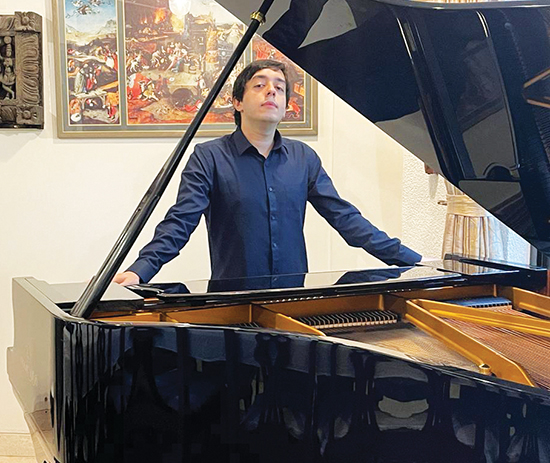
Soli Nallaseth: dedicated and sensitive musician
"I choose a big variety of repertoire because if you want to perform or go for competitions, they want to hear variety,” explained Nallaseth in an interview in January 2022. Currently pursuing his Master’s at RAM, for the first evaluation he played Beethoven’s Emperor Concerto and for his final exam at the end of the first year he will have a 30-minute recital for which he will play Prokofiev’s 6th Sonata. The Ukrainian composer Sergei Prokofiev is one of his favorite 20th century composers. "His music is cool. It puts a spring in your step. He has incredible harmonic diversity and a different rhythmic base which other composers do not always have,” he declares.
Classes with teachers vary between one to two hours a week with the exception of Sulamita Aronovsky who taught him for the first two years of his BA. Looking after him as if he were her own son, she gave him four-hour lessons every two to three days. "She is an incredible person. When I went to study with her, she was 89. She is Lithuanian and had a car accident when she came to England. As she had damaged the nerves in her hand, she could not pursue a performing career but she made a most extraordinary vocation in pedagogy,” related Nallaseth.
Outside the electives and the performances, he also has practical courses on artist development, designing a website, networking, amongst other things. He has additionally opted for courses on piano heritage; the history of recording and performances and developments in pianos; music for silent films; programing module and how to develop engaging sessions for audiences…
Prior to joining RAM, Nallaseth was at the Chetham’s School of Music in Manchester where his "horizons were broadened as a musician. I was taught deeper theory, more chamber music and because I was in that special environment, I was immersed in it.” Since Chetham’s additionally offered A levels (Advanced level subject-based qualifications that can lead to university, training or work), Nallaseth took Music, German and Maths. As compared to RAM in London where he had to cook, clean, learn to run the house, and assume responsibility, life at Chetham’s was relatively easy as it was like living in a boarding school with all the household chores taken care of.
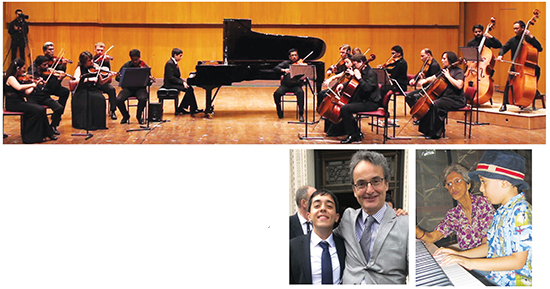
Top: Soli with members of the Symphony Orchestra of India;
above: Soli with Prof Colin Stone; learning the keys at the age of five years
Above (from l): Zahan, Cyrus, Soli and Simi Nallaseth in their younger days
With the support of Dr Murray McLachlan, head of keyboard at Chetham’s who took the youngster under his wing as though he was a member of his own family, Nallaseth not only participated in competitions but also performed in Methodist churches and Manchester Cathedral which gave him confidence to play before audiences. He won full scholarships to Musica Mundi, a famous chamber music festival and he subsequently performed in the Netherlands and in Belgium. He has performed at a chamber music concert at the Wigmore Hall, one of the most prestigious concert halls in London. A semi-finalist at the Manchester International Concerto Competition in 2019, at the age of 22, he won the 23rd International Chopin Piano Competition at Manzovia.
After a consultation with Argentinian pianist and composer Daniel Barenboim confirmed Nallaseth had the propensity to succeed as a musician, the student decided, "I should give it my best shot as I had the talent and the ability.” He sought to avail of every opportunity, attending master classes with the likes of Maria Joao Pires, Steven Hough, Leslie Howard…
Playing the piano since he was five years old, Nallaseth values the foundation laid by his early teachers in Bombay: Roshan Chowna suggested he should partici- pate in MusiQuest, India’s National Piano Competition at Poona merely for the experience and the enjoyment but where he surprised all by standing first. Blossom Mendonca’s tutelage helped him complete the grade 8 exam of the Associated Board of the Royal Schools of Music with an award. Before proceeding to England he studied with Aida Bisengaliev of the School of Music at the National Centre for the Performing Arts (NCPA) and played under the baton of respected directors of the Symphony Orchestra of India. Nallaseth is "a dedicated and sensitive pianist and we are proud of his achievement,” commented NCPA chairman Khushroo Suntook.
While he currently practices six hours a day, Nallaseth believes, "You can’t play the piano all day and then listen to classical music when you come home. That is a sure way to burn out. One has to also pursue interests which are not related to music.” He therefore makes time for sports, reading, theater, visiting art galleries and even playing video games occasionally. He took to weight training in 2019 when he decided to lose weight and take care of his health. "If my body is healthy and my mind is in a better place I can concentrate better,” he observes. When playing football thrice a week he noticed substantial improvement in his performance at the keyboard. An unfortunate leg injury though now prevents him from participating in the game. His interest in Indian classical music, he says, developed in the last few years after attending concerts by Pandit Harishankar and Zakir Hussain. He realized how "extraordinary it was and how much I was neglecting a part of our culture.”
Coming from a multicultural family Soli credits his father Cyrus, a lawyer specializing in immigration, and his Parsi roots for his interest in western classical music and literature. He strongly believes that the Parsi community has "this extraordinary and undying love for life and music. They live life to the fullest… Their enthusiasm and love for music has acted like a catalyst and brought people from other communities into the fold with the result that the audience has certainly got more diversified over recent years.” Jehangir Batiwala and Binaifer Malegam of the Poona Music Society were "truly ecstatic” that Soli "wanted to do music full-time and make it his career… His decision is a brave one which deserves to be encouraged.”
Soli’s appreciation for art and culinary tastes are mainly acquired from his mother Simi’s side. An animator by profession, among her projects was the film Ice Age. Strangely it was his Punjabi nani (maternal grandmother) who made the most delicious dhansak, using 36 to 37 ingredients! Soli’s younger brother Zahan who has just finished schooling will be proceeding to the USA for higher studies!
Soli whose navjote has been performed considers himself spiritually inclined though he does not view himself as religious. Whenever he visits a place of religious worship, it is more to experience the atmosphere, admire the structure and appreciate the art. Once a confirmed atheist, now "I’m more on the fence,” he says. "I’m beginning to feel more than ever that there is a God out there. This could be the influence of plenty of small incidents which have occurred, which could not have been coincidences. It is also the composition and functioning of the human brain and the impossibility of replicating it or explaining how it works which has caused this change.” On issues such as interfaith marriage or the disposal of the dead, he strongly feels people should be allowed to do whatever they think best.
Soli’s ultimate ambition is a career in performance for which a win in an international piano competition would be helpful. He is also considering an advanced diploma and a doctorate in the US as he would like to explore music on a more analytic and deeper level so that when he is performing he is aware of every single nuance. Until now his parents have been investing "a lot of time, love and money in my degree and placing a lot of faith in my capabilities.” He would prefer to be independent hereafter, knowing "there are a lot of conservatories in the US which not only provide tuition waiver but also give generous grants for personal expenses.” To make music a remunerative career, musicians must not limit themselves only to performing, but be prepared to do any work which comes their way. This includes teaching, working with Indian classical music or composing music for films like he did for Sooni Taraporevala’s Yeh Ballet. Images serve as "an interactive, beautiful, visual guide to lead your music… I would be very open to that kind of work.” He also looks forward to composing music for the movie his mother is working on. Teaching is another option. Association with a good university "gives you a base and stability. Giving master classes and lessons to students is something we ought to consider as part of social responsibility,”
Some of Soli’s friends who follow more conventional careers are financially secure but dissatisfied and bored, he has observed. "With music you will never have that feeling. You wake up every day and the one thing which will never desert you is the love for what you do, the passion which keeps you alive, the music you still have to explore and master, and that is what will keep you happy all your life.”