The trial edition of the five model textbooks on Zoroastrianism for Grades 1 to 5 were on display at an event at Avari Towers in Karachi on July 5, 2023.
"Within 10 months we created five books,” announced Kermin Parakh who was the principal of Bai Virbaiji Soparivala (BVS) Parsi Boys High School last year when the project was set in motion. A report on the event along with photographs and a video were carried in the August issue of What’s On, the newsletter of the Karachi Zarthosti Banu Mandal (KZBM).
Under the Government of Pakistan’s "One nation, one curriculum policy,” schools run by minority communities were encouraged to create textbooks so that students of different religions could gain knowledge about their respective faiths just as Islamiat is taught to Muslim students in schools throughout Pakistan. Insights into Zoroastrian prayers and ceremonies, history and festivals, culture and role models have been included in the textbooks to inspire the students to emulate the role models.
The eye-catching, colorful covers, designed by illustrator Farzana Cooper of Bombay, have the words "Zoroastrian Religion” printed in bold with the Grade of the Model Textbook specified. Also featured prominently on the frontispiece of each textbook is "National Curriculum Council (NCC) Secretariat, Ministry of Federal Education and Professional Training, Government of Pakistan.” The test runs of these five books had been sent to the NCC coordinator between August 2022 and February 2023. "The Karachi Zarthosti Banu Mandal has agreed to purchase the text books whenever they are printed and distribute them for free to Zoroastrian children in the diaspora,” announced Parakh.
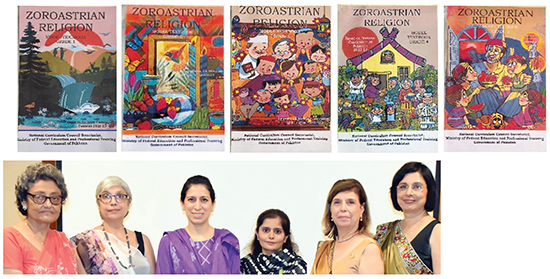
Top: covers of model textbooks; above, from l: Arejoy Khajotia, Furengeez Tampal,
Dr Mariam Chughtai, Madiha Aslam, Kermin Parakh, Perveen Pohwala
Tracing the genesis of this project, Parakh recalled that she and Furengeez Tampal, principal of Mama School, the two Parsi founded schools in Karachi, had signed a memorandum of understanding with the NCC director Dr Mariam Chughtai in March 2022 which read: "We hereby confirm that this document has been developed in consensus with the representatives of the main denominations of Zoroastrianism and there is nothing against any other religion or denomination within…” At the signing of the document Chughtai mentioned that the sense of equality that students of all faiths experienced at the missionary school where she studied had impressed her. Hence, when she was offered the post of director in the NCC six months ago, she was keen to give a similar sense of participation to students of minority religions in Pakistan: Buddhist, Baha’i, Christian, Kalashi, Hindu, Sikh and Zoroastrian.
Taking up the challenge, the headmistress of the BVS Primary Section, Perveen Pohwala was deputed to Islamabad to understand the requirements. Once she had created the curriculum for classes 1 to 10, the "Zoro team,” as they called themselves, set to work on the books. The contents of the books are the joint efforts of Parakh, Tampal, Pohwala, Mama School teacher Arejoy Khajotia along with Farishta Dinshaw of Canada who used to be a volunteer for the Friday School for Little Zarathushtis in Karachi, run by her mother Arnawaz Dinshaw. Besides copious research, the team was required to create activity material and select appropriate photos. The efforts of Madiha Aslam who provided computer expertise and NCC consultant Rana Hussian were also appreciated. The books were then reviewed by additional educationists, Meher Cawasji, Shernaz Darrah and Nilofer Noshirwani, to ensure that the contents were at the appropriate level of comprehension by each grade of students.
"This invaluable series of books on our religion (have)… age-appropriate units of information, followed by activities, to engage the students in learning the concepts. Additionally, a ‘My Learning’ unit refreshes the key take-aways. All this is seamlessly woven to provide opportunities that allow Zoroastrian children to become good human beings and citizens of the world while learning about the visionary teachings of Zarathushtra,” stated Parakh.
"Our journey does not end here,” she mentioned. In the coming weeks the task before them is to work on the answer keys for grades 1 to 5 whilst simultaneously formulating student learning objectives and planning for textbooks for grades 6 to 10. This will be followed by teachers’ training and later an assessment system will be formulated.