The Magnificent Diwan: The Life and Times of Sir Salar Jung I by Bakhtiar K. Dadabhoy. Published in 2020 by Vintage, an imprint of Penguin Random House India Private Limited, 7th Floor, Infinity Tower C, DLF Cyber City, Gurgaon 122002; website: www.penguin.co.in. Pp: lxxxii + 477. Price: Rs 999.
Think "Salar Jung” and the famous museum in Hyderabad immediately comes to mind. The Salar Jung Museum is famed for its rare and valuable collection of art and antiquities assembled by Mir Yousuf Ali Khan, Salar Jung III. While the Museum ensures that the name of the now extinct Salar Jung family lives on, few are aware of the interesting life and contributions of the "original”
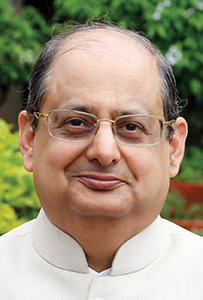
Salar Jung, Mir Turab Ali Khan, popularly known as Salar Jung I and grandfather of Mir Yousuf.
Bakthiar Dadabhoy’s book, The Magnificent Diwan: The Life and Times of Sir Salar Jung I, is a rare biography of one of the most influential men of 19th century Deccan, and one of the makers of modern Hyderabad. Interestingly, as Dadabhoy writes in the book’s introduction, it was while researching an article on the Salar Jung of the museum, that he developed interest in the life of Salar Jung 1.
Bombay based Dadabhoy, who has authored seven books, including the best selling Jeh: A Life of JRD Tata and critically acclaimed Baron so Banking: Glimpses of Indian Banking History, expertly puts the life and achievements of Salar Jung I in their social context, making for a rich and wholesome narrative. He vividly brings alive the snake pit-like feudal court of early 19th century Hyderabad, in which Salar Jung I grew and thrived.
The princely state of Hyderabad is rooted in the 18th century, when Mir Qamaruddin Khan, Asaf Jah I, the Mughal viceroy of the Deccan, took advantage of the weakened Mughal court in Delhi and carved out a principality for himself. While Hyderabad emerged as one of the richest and most powerful regional courts in India, the early Nizams kept up a pretense of Mughal overlordship. This meant that not just customs and traditions but sadly even the administrative set-up followed the now archaic Mughal prototype, quite unsuited to a modern age.
The main pillars of the Asaf Jahi court were the umraos or nobles who controlled vast estates which were larger than most princely states in India. Prominent among the nobility was the Salar Jung family which had played an important role in the history of the Deccan since the 17th century. Originally from Medina in today’s Saudi Arabia, their ancestor, Sheikh Ovais III, had settled in the Adil Shahi court of Bijapur. Later, the family took up service in the Mughal court and moved to Aurangabad. With the establishment of the Asaf Jahi rule, a number of Salar Jung family members served as diwans or prime ministers to the Nizams of Hyderabad.
Little is known of Salar Jung’s early life. His father had died when he was just two and left behind huge debts. To repay them, Salar Jung was forced to surrender all the family estates to the Nizam, except for a small property called Tarbund Bazaar, which yielded an annual income of Rs 700. Equipped with a basic education in Arabic, Persian and English, the young boy had no tools to prepare himself for public life. In a twist of fate, in 1853, when Salar Jung was just 24 years old, he was appointed prime minister of Hyderabad, India’s largest princely state by a coterie who hoped that the young man would be a pliant puppet. It was a gross miscalculation.
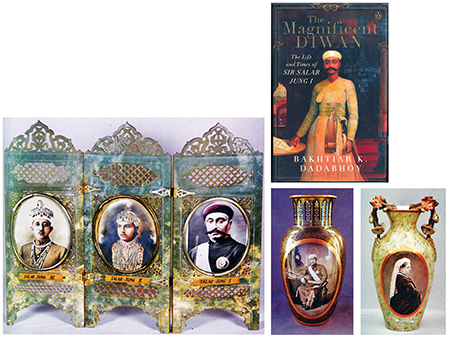
Top: Bakhtiar Dadabhoy; above from left: Jade screen with images of Salar Jungs I, II and III;
vases presented to Salar Jung on his visit to England
From left: Salar Jung with his entourage in England; Diwan Deodi
Despite his young age Salar Jung held his own not only against the courtiers who wished to control him, he even stood up to the British. The Hyderabad that Salar Jung had presided over was in Dadabhoy’s words "a wilderness, one in which anarchy and lawlessness reigned without a check.” Revenue collection was farmed out to the highest bidder who extracted money from the peasantry. Then there was the menace of Arab and Rohilla (Afghan) mercenary bands who roamed the countryside "like hungry wolves” offering their services. Moneylenders hired them to enforce debt collection. Even death was not a release from debt as bodies of the deceased would not be released for burial till debts were paid. Such was the terrible predicament of Hyderabad’s common folk who lived in a cesspool of corruption and oppression.
Salar Jung’s great achievement was replacing this archaic set-up with a "modern” system of administration. His liberal views led him to admire the British model. The system of revenue farming was abolished, and an efficient tax-collection system was put in place. Through police and judicial reforms, the menace of Arab and Rohilla mercenaries was curbed.
As a result, trade and commerce thrived and the finances of the government improved. Salar Jung also built roads and tanks, dug wells and renewed and created irrigation works. He founded schools and introduced railways. Initiating these reforms wasn’t easy but, despite the formidable opposition he endured, Salar Jung persevered.
Salar Jung encouraged Parsis, Kayasthas and Maharashtrians to join the civil service. In later years, prosperous agriculturists came from coastal Andhra to set up businesses. A composite culture of Hyderabad began to flourish. Salar Jung died suddenly on February 8, 1883. While the official cause of death was stated as cholera, there were whispers of poisoning and even suicide. But, by the time of his death, the dawn of a new era had emerged in Hyderabad. Salar Jung’s legacy would be carried forward by his son and grandson, Salar Jung II and Salar Jung III.
Sadly, Diwan Deodi, the great palace of the Salar Jungs in the old city of Hyderabad, was demolished in the 1960s and an unsightly market stands in its place. It was from here that Salar Jung I had presided over the administration and where Salar Jung III assembled his art collection. The loss of this great palace was a monumental tragedy and loss to Indian heritage.
One of the most interesting anecdotes in Dadabhoy’s book relates to Siddi Ambar, the Sudanese housekeeper of Diwan Deodi, who had been with the family since he was a child. He was Salar Jung I’s most trusted aide. After Salar Jung’s death, when his son Laik Ali Khan (Salar Jung II) was worried about finances for his sister’s wedding, Siddi Ambar asked him to take care of the ceremonies while he would produce the jewels. Sure enough, Ambar produced a tray of jewels without a word about where they had come from.
Years later, when Siddi Ambar lay dying and after Laik Ali Khan had passed away, the latter’s son Yousuf Ali was still just a young boy. On his deathbed, Ambar sent for Yousuf Ali, saying he had something to give him. But Yousuf’s mother refused to send him across. So Siddi Ambar sent a set of keys to Yousuf and died soon after. No one knew what the keys were meant for, and the jewels were never seen again!
Dadabhoy’s book is full of fascinating anecdotes like this and is a must read for anyone interested in a detailed history of Hyderabad or princely India.
AKSHAY CHAVAN
Chavan is the co-founder and head of research at Live History India, the country’s largest digital platform on history.