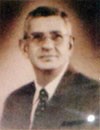
After almost 60 years, jurist Framroz Rustomjee’s (pictured on next page) book Daily Prayers of the Zoroastrians has been reprinted by Jiloo Vakeel Billimoria in memory of her parents Khorshed and Hormasji Vakeel. "They may not have to their credit any exceptional achievements, but leave behind a flow of love and sincerity in the wake of many good deeds done during their lifetime… I strongly feel that Rustomjee’s timelessly relevant words of advice stand good for all of us,” notes Vakeel Billimoria.
The 165-page book comprises "A free translation of each prayer and explanation for teaching the same to children,” wrote Rustomjee who hails from Sri Lanka (then Ceylon) in the 1959 edition. The prayers include the basic ones recited by lay people as well as an explanation of the five gahs. In the first part "I have placed under each word of the text a simple meaning by which a child may easily understand the words in the text, with the assistance of its parents.”
 The second part comprises "brief notes on some of the words translated in daily prayers” such as Khorshed Nyaesh, Atash Nyaesh, the five gahs, etc.
In his foreword Dastur (Dr) Framroze Bode, praised Rustomjee for his efforts, noting: "I can well understand his deep concern for the spiritual well-being of our rising generations. He has planned this prayer book to supply the long felt need of Zoroastrian children, youths as well as elders… Anything done habitually and automatically without an understanding of what is recited, thereby wanting in the essential fervor of the heart, would be considered superfluous and valueless.”
Rustomjee cautions that praying without understanding is "blind faith. The value of such blind faith does not last long. It lasts only so long as we do not come to grief and pain.”
As a tribute to his father Framroz who had a thriving legal practice in Ceylon for nearly six decades, his 85-year-old son Dr Piloo, a surgeon, recalls for Parsiana: My father’s interest in religious studies stemmed soon after my birth (in 1933, the same year when he lost his seven-year-old son Jimmy who was crushed between two cars in January, and I was born in November) when he competed in an essay competition on the life of prophet Muhammed. He did immense research on the topic, and won a gold medal presented by a prominent Muslim businessman, Naina Marrikar.
From this time, Framroz studied the Avestan language, and was guided by scholars from Bombay, like Dr S. H. Kanga, Ervad Behramgor Anklesaria and others. This led to the writing of his first volume of the Daily Prayers, which has so generously been reprinted by Jiloo Billimoria at her own expense for distribution and sale, all proceeds going to Parsi charities. Our family are deeply indebted to her for her generosity.
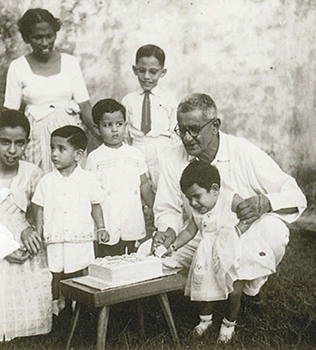
(Top): Framroz Rustomjee (and above) with granddaughter Niloufer cutting her birthday cake
A keen Theosophist, Framroz, was a student of comparative religions, writing books on the life of prophets Zarathushtra, Buddha, Jesus Christ. Most of his spare time went into the writing of the second and third volumes of Translations of our Daily Prayers, the Avesta and a further 19 manuscripts of our religion. He was also a respected co-Freemason, holding the highest rank in the order, and a member of the Rotherfield Psychological Association in Colombo for many years.
My father’s greatest asset was his oratory. Whenever he spoke on any subject there was a deadly silence in the audience, and he could make his subject appealing to scholars, students of our faith, and even little children. He knew his subject so intimately, that he rarely referred to any notes during a speech. If he sensed any lapse of interest in the audience, he would quickly change to a simpler way of expressing his thoughts. Children aged five and over would crowd around him shouting, "Fali Uncle, tell us a story” and he was always happy to oblige, enthralling them with tales of Chinese and Japanese people.
The youngest of six children, Framroz was born in 1896, in Colombo, Ceylon, when it was under the British rule. He was educated at the Wesley College in Colombo where he did extremely well and later at the Law College of Ceylon, from where he graduated as a Notary Public and Proctor. He was appointed a Justice of the Peace, and an Unofficial Magistrate (JP-UM). He set up practice in Hultsdorf, Colombo, close to the Law Courts. Well known for his honesty and superb interpretation of the law, his clients came from all quarters and from various parts of the globe until his death in 1978.
He married my mother, Mary Billimoria in 1922, and soon had a lovely little girl, Jer, followed by a bonny boy, Jimmy, the apple of my father’s eye. I was born seven years later. Mary looked after the family affairs. Our home was decorated with numerous beautiful gifts from China and Japan in the form of glassware, vases and furniture. Jer later married Dr Rusi Rustomjee, Ceylon’s chief ENT surgeon.
Framroz’s generosity abounded. He donated land so that a clubhouse and tennis court could be built for the Parsi Sports Club. This enabled our youngsters to perfect their tennis and table tennis games, a matter of great satisfaction to Framroze who had been declared All-Ceylon Table Tennis Champion at the age of 17. He would take presents for his nieces in Bombay on every visit and write letters to them on a weekly basis, after the loss of their father, his brother, Dr Manecksha.
My father’s life was a tribute to his belief as stated in the book that "no man who genuinely understands the value and importance of each word of our Avestan texts can ever drift from the Path of Righteousness.”