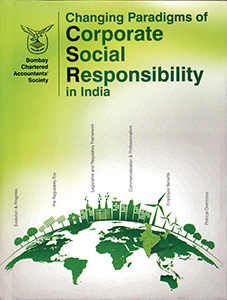
Changing Paradigms of Corporate Social Responsibility in India by Zubin F. Billimoria. Published in 2018 by Bombay Chartered Accountants’ Society, 7, Jolly Bhavan No. 2, Ground Floor, New Marine Lines, Bombay 400020; e-mail: bca@bcaonline.org; website: www.bcasonline.org. Pp: viii + 420. Price: Rs 300.
 Corporate Social Responsibility (CSR) is represented by contributions, both monetary and otherwise, made by companies to society through its business activities and its social investment. In the environment of modern economic development, the corporate sector can no longer function in isolation. Corporations must behave and function as responsible members of society, just like any other individual. Having a social vision is integral for the success of a business mission. Companies desiring to build and sustain brand equity should know that discharging social commitments is essential to generating an image in the minds of the people.
The Indian Companies Act 2013 under section 135 makes CSR compliance mandatory for any company, be it private, public, foreign or for that matter even a nonprofit company registered under section 8, if the company meets certain criteria of profit, turnover or net worth. Reportedly, India is the only country in the world that mandates CSR under law. Chartered accountant Zubin Billimoria’s (pictured) seminal work on this subject is therefore timely and delves deep to uncover various facets of corporate governance and its link to CSR.
The author covers the entire gamut from evolution of CSR in India and the legislative and regulatory framework, to progress on sustainable development and the changing paradigms of CSR in India. There are times when one feels that the author has covered too many issues not directly related to CSR, but this reviewer is glad that he has, because the law in India (section 135 of the Indian Companies Act 2013) has reduced CSR to mere arithmetic.
 As per law, during any previous financial year, if the company has a net worth of Rs 500 crore or more or turnover of Rs 1,000 crore or more or net profit of rupees five crore, it must constitute a CSR committee of the board; have a CSR policy for the company and disclose contents of such policy in its report and also place it on the company’s website, if any; ensure that the company spends, in every financial year, at least two percent of the average net profits of the company made during the three immediately preceding financial years in pursuance of its CSR policy.
Unfortunately, neither section 135 nor the Company CSR rules recognize employee engagement as CSR. All over the world, companies proudly report the number of hours contributed by their employees in community service. However, this is not included even by way of a footnote when it comes to CSR reporting under law. Also, companies are not allowed to spend more than five percent of their CSR expenditure on administrative costs or overheads. How is a company with even a CSR budget of one crore rupees expected to hire capable staff to implement or oversee CSR with just five lakh rupees?
Although the author comes across as very excited and enthusiastic about CSR and its changing paradigms in India, this reviewer is of the view that codifying CSR within the framework of the law has been a disservice to its true essence and spirit because CSR is not just about giving money. It includes compliance of human rights, standards, climate change, sustainable management of natural resources and consumer protection. It is a concept whereby companies decide voluntarily to contribute to a better society and a cleaner environment. The law does not take into account sustainable development, which in our view is the big picture with three components — social, economic and environmental. CSR is merely a component of sustainable development, especially from the social sustainability perspective and this is what the law misses out on.
CSR is a business oriented framework which should cover not merely what a company does with its profits, but also how the company made its profits. Ideally it should go beyond philanthropy and legal compliance and address how the company would manage economic, social and environmental implications, addressing relationships in all key spheres of influence: corporate values, workplace, marketplace, supply chain, community, and public policy realm.
CSR is a coordinated and structured approach for business, government and non-profit transformation. It is not a marketing campaign on a ‘green’ product. It is not merely about philanthropy. It is not only about community involvement like developing a playground for a local park. It is a framework that focuses on tangible benefits that can be garnered from sustainability and how the company can work within the sphere of the community. It is a long-term commitment based on honest, strategic effort, results, best practices and driven by transparency to the public. It is interwoven with business strategies and engages with external organizations. It is about measurable transformation, internally and externally, that extracts tangible business and social benefits.
Thus, in the opinion of the reviewer, the law has taken CSR back to the days of corporate philanthropy. Agreed, that the rules emphasize that CSR is not about one-off donations, but financially supporting projects and programs as per Schedule VII of the Indian Companies Act 2013 which lists CSR related activities. However, the fact remains that the only test of CSR under law is whether the company has a CSR committee, a CSR policy and whether or not it has spent two percent of its net profits on CSR activities as per Schedule VII. All other components of CSR are not even on the back burner where section 135 of the Indian Companies Act 2013 is concerned!
Despite this reviewer’s strong views on the subject, Billimoria’s attempt is laudable and this book will be immensely valuable for every student or practitioner of CSR. The publishers (Bombay Chartered Accountants’ Society) are correct in observing that CSR has its genesis in the inequalities prevalent in society. We particularly agree with their observation that at a broader, macro level, CSR means that people and organizations must behave ethically and with sensitivity towards social, cultural, economic and environmental issues. It involves promoting a proactive stance towards positively influencing and affecting the people and the environment outside of our immediate circle.
The chapter on Legislative and Regulatory Framework of CSR covers a wide range of diverse legislations from the Wildlife (Protection) Act 1972 to labor welfare laws, like the Minimum Wages, Employees’ State Insurance Scheme, Payment of Bonus, Gratuity, etc. There are a few updates which should be added in future editions. For example, although it is an edition of December 2018, it still cites and elaborates on the Maternity Benefit Act 1961 whereas the Maternity Benefit (Amendment) Act 2017 has made major amendments to the Act of 1961. The author does allude to the Labor Ministry proposing amendments to the Act. However, considering that the amendments came into force from April 1, 2017, the update should have been made in this first edition of December 2018.
The chapters on transparency and politicization of CSR are particularly interesting, relevant and of importance. Case studies provided by him add further value to this extremely well researched work.
This book should find a place on the bookshelf of every company secretary, CSR consultant and members of the CSR committee of various companies involved in CSR related programs, projects and activities. At a time when everyone talks about CSR and feels concerned about sustainable development, here is a professional who has documented the history, evolution, process and even what is desirable or not desirable under the broad canvas of CSR.
NOSHIR DADRAWALA
Dadrawala is chief executive officer, Centre for Advancement of Philanthropy through which he offers advice to nonprofit organizations and companies on their corporate social initiatiaves.