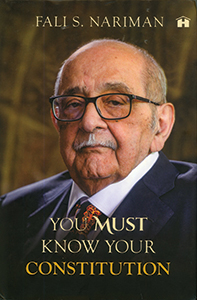
You Must Know Your Constitution by Fali S. Nariman. Published in 2023 by Hay House. Publishers (India) Pvt Ltd, Muskaan Complex, Plot No. 3, B-2 Vasant Kunj, New Delhi 110070; website: www.hayhouse.co.in; e-mail: contact@hayhouse.co.in. Pp: 516. Price: Rs 899.
It should be a matter of considerable gratification for anyone who takes an interest in legal and public affairs in India that, at the ripe old age of 94 (now 95), Fali Nariman, one of the country’s most eminent lawyers, has exerted himself in the cause of public education and awareness-raising about India’s Constitution through this informative book. In it he not only shines a light on many neglected corners of the constitutional edifice, but draws our attention to certain home truths which merit attention:
"Seventy-odd years of experience on this subcontinent has shown that it is easier to frame a constitution than to work it. In the same subcontinent, Pakistan and Bangladesh had crafted written constitutions at different times, but they were interspersed with periods of martial law, and civil and military dictatorships. We will never be able to piece together a new constitution in the present day and age simply because innovative ideas however brilliant and howsoever encouragingly expressed in consultation papers and reports of commissions, can never give us an ideal constitution. In constitution-making there are hidden forces that must not be ignored, viz the spirit of persuasion, of accommodation and of tolerance. In India — as in the rest of the world — all three are at a very low ebb today.”
Depressing though that thought may be, it fails to dampen Nariman’s enthusiasm in explaining the various features and details of the Indian Constitution — a document which has the distinction, dubious or otherwise, of being the longest in the world. He starts, logically, with a dose of history, spanning both the period immediately preceding the country’s independence from British rule and the years immediately following in which a small but dedicated group of (indirectly elected) people toiled for slightly under three years to produce a document which was adopted on November 26, 1949.
Of particular fascination to many readers will be a chapter headed "How India’s Constitution Almost Never Got Finalized,” the reason for which was that the emotive issue of a national language (in a country where dozens of tongues have flourished alongside each other) nearly brought members of the Constituent Assembly to blows! Nariman also makes a salient point which has bothered many an observer, namely that the Indian Constitution is overly prescriptive. There are many matters of detail, argues Nariman, which "could well have been left to ordinary legislation” — this criticism was conceded by the principal architect of the document, Dr Bhimrao Ramji Ambedkar, in the Constituent Assembly itself, but no one seems to have taken much notice of it.
Nariman then goes on to explain the key features of the document, notably the chapters on Fundamental Rights and Directive Principles (and the relationship between them); the parts dealing with the three branches of government; the powers and privileges of parliament and the state legislatures; the "pardoning” power of state governors; the roles, powers, etc of the comptroller and auditor-general and the Election Commission. The discussion is interspersed, as can be expected, with copious references to relevant Articles in the Constitution (which have, slightly jarringly, been printed with underlining) and to appropriate case law, of which there is no dearth in India.
Nariman is not parsimonious with his views, even on contentious issues. A case in point is the Uniform Civil Code, on the desirability of which passions have run high throughout India for many years. Nariman does not think the time is right for this measure. "There is of course logic in favor of the plea for a Uniform Civil Code,” he avers. "We do need a Uniform Civil Code, but only when we ... are all ready for it, and when we have, in thought and deed, put all acrimony behind us.” He calls his position a "non-populist, minority view,” supported by a dictum of Lord Salisbury, the former prime minister of England, that "only uncontentious legislation should be brought before Parliament.”
Another contentious topic on which Nariman has ventured to offer his opinion is reservation for various groups deemed disadvantaged by the legislature from time to time. "The guarantee of equality so proudly proclaimed in Article 14 (of the Constitution),” he avers, "has kept diminishing” because, despite repeated warnings by the Supreme Court in numerous judgments, reservations continue to proliferate and grow. He makes the salient point that the drafters of India’s basic document did not envisage a permanent and perpetual reservations policy:
"It is not because of our Constitution but despite its provisions that we have failed to achieve what were naively assumed in November 1949-January 1950 to be achievable goals. We have abolished untouchability in our Constitution (Article 17), and we had hoped and strived to outlaw social and educational (and even economic) backwardness. But the truth is that ‘We the People’ have yet to eliminate it from our hearts. Only then will the era of backwardness in Indian society begin to be on the way out.”
Slightly disappointingly, Nariman’s prescriptions in the matter of reservations are couched in language which many readers will find confusing:
"My own view is that in order to forestall further (constitutional) amendments prompted by political considerations, and to prevent a spiraling of quotas and reservations in future, the highest court should ensure by its edict that the minimum percentage of seats in educational institutions (including private educational institutions under Article 15) and the minimum percentage of posts in public employment (under Article 16) do not go beyond 50%: otherwise, the goal of equality guaranteed by Article 14 would become totally illusory.”
Does he mean a minimum of 50% reservation for the disadvantaged groups in perpetuity? If so, his recommendation would seem to be going against the tenor of his earlier remarks on the subject.
Unsurprisingly, the book has a section on the constitutional standing of Jammu and Kashmir which has always been in the news but which became the topic of particularly intense and heated debate, firstly in 2019 when the government of Prime Minister Narendra Modi decided to scrap its special status, and again towards the end of 2023 when the Supreme Court of India decreed, controversially, that the government’s measures in relation to that troubled part of India could not be faulted. Nariman has been quite vocal in media interviews in criticizing the court’s verdict, but since that decision came well after the book went to press, his views do not find a mention here.
Regardless of whether Nariman’s views will find universal agreement, his book makes for thought-provoking reading. Many of those who have followed his writings over the decades will hope that, despite his advanced years, he will continue to offer his thoughts on topical issues for the benefit of his fellow-countrymen. The present book could, in presentational terms, be improved — for example, through more meticulous editing and the addition of a back index — but that is a minor quibble.
VENKAT IYER
Iyer is a UK-based barrister and legal academic.