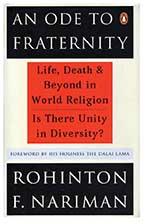
An Ode to Fraternity: Life, Death and Beyond in World Religion. Is There Unity in Diversity? by Rohinton Nariman. Published in 2025 by Vintage, an imprint of Penguin Random House India Pvt Ltd, 4th Floor, Capital Tower 1, M. G. Road, Gurgaon, 122002. Pp: xvi + 316. Price: Rs 799.
Eminent jurist, acclaimed retired Supreme Court judge, scholar of Western classical music, well versed in Avesta and Vedic Sanskrit, Rohinton Nariman (pictured) is an ordained Zoroastrian priest and an expert on comparative religions. Having authored two earlier works on the Gathas and Zoroastrianism, Nariman’s latest book, An Ode to Fraternity, seeks to find a common thread in seemingly diverse faiths which can lead to peaceful coexistence. Though metaphysics may diverge, ethics remain constant, is the message of the author.

Uncluttered by ubiquitous footnotes, the 266-page book is a pleasant read for those interested in the subject. While the material is certainly worthy of a dissertation, the style is neither bombastic nor pedantic. Nariman’s scholarship though is palpable throughout as evidenced by the impressive bibliography for further reading.
His felicity in analyzing the "religions of the book,” from the Bible to the Torah to the Gathas and later Avesta to the Quran, Nariman effortlessly glides through obtuse passages, simplifying them for the lay reader. Theological niceties apart, the moral precepts are universal. All roads lead to Rome and all religions preach the same universal truth. Appreciate this common thread and fanaticism will dissipate.
As you sow, so shall you reap. All faiths give this message in an attempt to unravel the complex principles of karma and reincarnation. When the soul incarnates again on earth it is provided with the vehicles of body and mind according to the karma it has earned and is given a purpose for incarnation. In how it utilizes these vehicles without being attached to them lies the eternal key to nirvana or salvation. Stripped of theological jargon, this cardinal truth resonates with the morally uplifted human.
Although Nariman has devoted most of his adult life in passionately pursuing studies on the religion of his birth, there is not the slightest bias in how he handles other faiths. One has always known him as being an authority on Zoroastrianism, and to a certain extent on Hinduism. This book is, therefore, a revelation of his deep knowledge and insights into other faiths, particularly Jainism and Buddhism.
The author’s inferences derived from exhaustive research leads to some interesting perspectives. For instance, Judaism: "Since there is no central authority in Judaism, it was free to develop in unorthodox ways. Judaism as originally preached did not believe in an afterlife beyond going to the shadowy sheol (abode of the dead). Later writings, especially the Kabbalah, incorporated a doctrine of reincarnation which is not consistent with mainstream Judaism, as practiced today.”
In Islam "a Muslim man is allowed to marry up to four women and is exhorted to treat them equally. He is told that however hard he tries, treating them equally will not be easy. The basic idea was that from an unlimited number of wives, one could marry up to four wives so that outcasts such as widows and orphans are brought back into society.”
With reference to Jainism: "The Jain path to liberation is extreme non-violence to every other sentient being while mortifying oneself. It can truly be stated to be an extremely ascetic and difficult religion to follow. As a matter of fact, in Jain theory, not only is one vegetarian but one cannot take the life of even a plant or a vegetable; therefore one should only survive on what is yielded up by the earth. A morbid side of this faith is sallekhana or the gradual ebbing away of one’s life at the end when one first stops eating food, then drinking water until death finally arrives.”
His analysis of the Hindu Upanishads and their ultimate culmination in the Bhagavad Gita is admirable. With equal scholastic vigor, the author has simplified the concepts of lesser known religions like Confucianism, Taoism and Baha’ism.
This book is a labor of love which obviously entailed assiduous checking and counter checking of references from a plethora of primary and secondary sources. To this reviewer, who can claim to be no more than a humble student of Zoroastrianism, Hinduism and Jainism, not a single contradiction was evident in Nariman’s lucid narration of the philosophy of these faiths.
Finally, there is a chapter on the perennially controversial topic of reincarnation. While reincarnation and karma are the principal pillars of Hinduism, the religions of the book believe that all souls will be judged together on a day of judgment. However, scholars on this subject have exhaustively argued that references to reincarnation abound in the Bible, and the most orthodox of Zoroastrian scholars believe in the concept too. Both Jainism and Buddhism also endorse reincarnation albeit with a slightly different perspective.
Every religious philosophy tries to explain the reasons for human suffering and the way out of it. Ethical living is, of course, the common thread in all of these solutions, which Nariman emphasizes.
The author’s declared objective in writing this book is the hope that people can free themselves from religious bias and extremism and appreciate and understand the religious beliefs of others, leading to peace, harmony and coexistence. Whether this lofty objective will ever be achieved is a moot question. However, Nariman’s efforts have produced an adept primer on comparative religions for the lay reader, without being overwhelmed by theological jargon.
Secularism is not being irreligious or atheist or agnostic. True secularism is viewing all faiths through the same prism without an iota of bias. Nariman has demonstrated through this book what secularism truly entails. BERJIS DESAI
Desai is a lawyer in private practice and a part-time writer.