The alumni of the Happy Home and School for the Blind are excited to plan centennial events
Parinaz Gandhi
On his first day as a new entrant at the Happy Home and School for the Blind, the three-year-old wailing child pleaded with his mother not to leave him in jail. Being small and visually impaired, it may take him a while to realize that far from being a confinement this School would serve to lead him from a world of darkness to a bright future. The airy classrooms on the second floor have specially modified desks for the convenience of students some of whom have no vision and others only partial sight. There are other rooms on the first and second floor that are dedicated to music, carpentry, pottery and ceramics, mosaic glasswork and weaving where not only the students but even some ex-students happily return to be employed in their area of specialization. The tailoring unit is currently occupied creating cloth bags to mark the centenary of this institution. At the ground level is located the well-equipped gymnasium, a garden that boasts an old rain tree as also jackfruit and love apple trees besides other aromatic foliage, and the playground where this new student’s laughter too will soon join the squeals of delight of fellow visually impaired children.
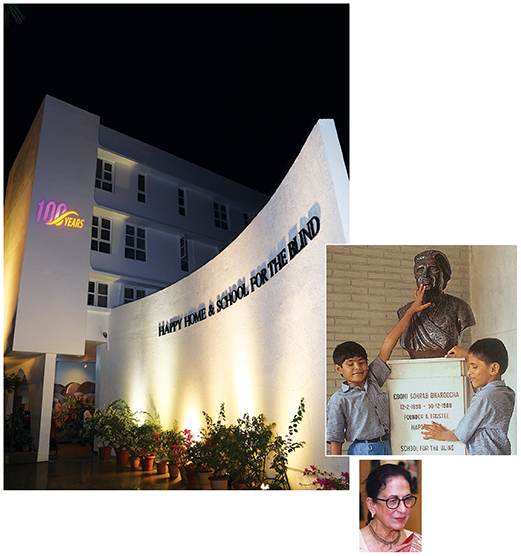
Clockwise from above l: illuminated School building;
bust of Coomi Bharoocha; Meher Banaji
Unperturbed by the loud sobbing, director Meher Banaji who has been with the institution since 1969 when she was appointed principal assured us, "They all come like this. Pampered, undisciplined, without toilet training.” In the first week one parent is permitted to accompany the child until the newcomer has settled in. The teaching staff at the School which has facilities from Montessori to Class 10 help the older ones with their studies and keep the younger ones engaged in activities. Instilling manners, punctuality and values is apparently Banaji’s responsibility. Since they don’t have a matron at present, the 82-year-old director has currently assumed those duties too for Happy Home is a residential school from Monday to Friday, the children being permitted to go home on weekends to spend time with their families.
Currently there are 65 children aged between three and 20 years studying at Happy Home whose motto is "Vision beyond sight.” When Parsiana had carried a feature on this institution over two decades ago (see "With sense and sensibility,” March 2004) there were 197. Is it because children are opting for integrated education in regular schools that accept visually impaired children? "The prevalence of blindness has reduced,” states Banaji.
While earlier they admitted only boys, they now have five girls too on their rolls. Very happy to study at this School that has so many facilities, one of the girls who is a member of the School choir excitedly told Parsiana that she got an opportunity to sit in a plane for the first time last December when their choir was invited to participate in the Serendipity Art Festival in Goa. Yet another rare opportunity for the choir came up last year when they sang for veteran jazz musician Herbie Hancock and vocalist Dianne Reeves who on a trip to India conducted an interactive music session at Happy Home.
Banaji shared an email she received from former student Rahul Gajjal who regretted not being able to join the School’s centennial celebrations for he would be in the UK studying human resource management at Aston University. "This new chapter is a significant milestone for me and I owe so much of my growth and development to the nurturing environment and guidance provided by you and the entire School. One of the highlights of my time at Happy Home was performing with the School choir at prestigious venues. Those moments were… deeply formative experiences… I will always treasure these memories and the invaluable lessons learned under your guidance.”
Top: dignitaries Mother Teresa (l) and Atal Bihari Vajpayee visited the School;
above: B. D. D. Chawls where the School started
School choir and Banaji with Herbie Hancock (2nd from r)
Taking pride in "recognizing and honing the skills and talents of our students,” Banaji mentioned how one of the ex-students, flautist Kiran Vinkar is now an internationally acclaimed musician who travels in a chauffeur driven car. Jaydeep Singh has risen as an international judoka and Shirish Patil as an international chess player. That two of their ex students got opportunities to study in Birmingham and Edinburgh she considers noteworthy as also the accomplishments of those who have made a name for themselves in the banking sphere.
Particularly gratifying for Banaji was to see the enthusiasm of some of the ex-students who have taken on themselves the onus of organizing activities in the centennial year. She referred to the Centennial Reunion circular that was issued by ex-students: "This event is a wonderful opportunity to reconnect with old friends, meet your teachers and share your experiences. We would love to hear your stories, memories and achievements. Some of you may also wish to showcase your talents and speak about your journey since leaving School…”
To learn about the School’s progress, the most knowledgeable on the subject would be Banaji whose association started when they were operating from the cramped third floor premises of the B. D. D. Chawls in Worli where the students had to sit on the floor in the corridor to eat their meals, and the staff and students had to share toilets. When founded by Coomi Sohrab Bharoocha in 1925, it was a ‘home’ where delinquent, court-committed and beggar boys who were visually handicapped were given shelter and rehabilitation facilities. In 1948, a school was started within the home. Describing the founder as a "valiant warrior,” Banaji commended her long-standing dedication to the institution, ultimately breathing her last at the age of 90 on the School premises.
It was on March 28, 1971 that they shifted to the present premises on Dr Annie Besant Road, designed by architect I. M. Kadri, father of the School’s current chairman Rahul Kadri. For the centenary, this building was specially illuminated with number 100 prominently displayed. "The ease of movement and physical safety of visually impaired students was (for the architect) of paramount importance… Here the children can hone their internal antennae in order to gauge where they are and how to move about within the building, and from there, out into the world beyond. Only when a child has the emotional and physical confidence to be unafraid of what they cannot see can they walk down a corridor, across a classroom filled with desks and into a dining room to find their own place at a table,” notes a School brochure.
Ceramics, mosaic, woodwork and pottery on sale at the School’s centenary exhibition;
4th row, from l: Rahul Kadri; Hitendra Dave; Vispi Unwala, Yasmin Curravala, Persis and Cyrus Vachha
When Parsiana entered the dining hall on June 11, 2025, the younger children were already seated at their low tables with fried rice, vegetable Manchurian and minced soya served on their thalis but they dutifully waited to jointly say the prayer "Thank you God for the world so sweet…” before partaking of the meal. Since they were observing the birthday of one of their co-students, they were also made to sing Happy Birthday to him. The same ritual was repeated when the elder students took their assigned seats. After they had finished the food on their plates, those who had raised their hand for a second helping were served more.
Supporting Banaji in the running of the institution are 52 staff members that include teachers, office assistants, hostel attendants and those involved in the upkeep of the property. Accompanying us on a tour of the premises, Banaji enquired of class teachers why a particular pupil was absent, checked with a student what she understood of the globe that was in her arms, asked another whether his hearing aid had been worn for he was among the few students to have multiple disabilities. We later learnt that one of the boys in the choir who had lost his vision due to a cancerous growth in both eyes subsequently developed a tumor in the leg. After surgery, two rounds of chemotherapy and radiation, he is now back on his feet and alongside the other choristers sang for us the School anthem as also a medley of ABBA hits.
In another classroom, one of the senior boys was praised for his neat handwriting and requested to show us his essays. A co-student was asked to read aloud a poem from the Braille book on his desk. When he had finished reading A Teenager’s Prayer, Banaji questioned him on the name of the poet. His fingers quickly went to the end of the passage before answering "J. Morse.”
Alongside the dedicated band of teachers is the committed group of volunteers who have contributed their time and expertise over the years to guide these children in need of special attention. In addition to academics and art skills, they are coached in drama, yoga, sports and swimming. In fact, the children have special permission to use the prestigious Breach Candy Swimming Pool. Their mastery of pottery, ceramics, woodwork, handloom items, cards, etc is annually on display at their well patronized exhibition, "Inner Vision.” The chief guest at the last exhibition was Hitendra Dave, chief executive officer of The Hongkong and Shanghai Banking Corporation (HSBC).
Clockwise from top l: students at choir practice; perfecting a mosaic pattern; enjoying lunch
Banaji considers the institution privileged to have received the blessings of spiritual and political heads like Mother Teresa, Atal Bihari Vajpayee, Dr A. P. J. Abdul Kalam, Bill Clinton among others. At this School where music is always given priority, one of the cherished gifts is the piano earlier owned by maestro Zubin Mehta.
Working alongside the chairman and director in the running of Happy Home are the honorary secretaries Firoze Sethna, Yasmin Curravala and Smriti Bulchandani, and honorary treasurers Vispi Unwala, Cyrus Vachha and Shireen Colah. Being a government aided institution, many are the compliances and requirements that they are expected to adhere to.
"More than the government grant which is only a pittance, the School runs on donations and interest earned on the corpus,” reveals Banaji. While all donations are gratefully accepted, she was most appreciative of the continuous financial support from the chairman of Cipla, Dr Yusuf Hamied, the management of HSBC, and philanthropic Bombay Parsis like Soli Surti and his wife, jurist Navroz Seervai who has also been lending his pro bono services to win legal battles for the School and others from overseas including Noshir Pavri of Hong Kong, Nash Parekh and his Parsi friends from Canada.
Every outstretched hand is gratefully held with humility, for those entrusted to run Happy Home as also the visually impaired in their charge, do not want pity but support to overcome adversity.