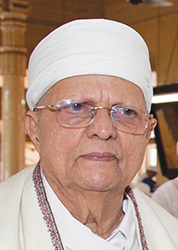
As the longest serving high priest of the Zoroastrian community, Dastur (Dr) Kaikhusroo JamaspAsa continued to be venerated. Not only in Bombay where he had presided over the religious affairs of the Anjumanna Atash Behram for 63 years, but also in London where his son and daughter studied and practiced medicine and where he breathed his last on May 19, 2019 at 85 years of age. His uthamna prayers were thus held at two locations: the Anjumanna Atash Behram before his body could be brought to
Bombay for the paidust at Doongerwadi, as also at the Zoroastrian Centre in London.
Condolence meetings too were held twice over at the Banaji Atash Behram Annexe Hall: on May 30 by the World Alliance of Parsi Irani Zarthoshtis (WAPIZ) that valued the orthodox priest’s support; and then under the auspices of the Bombay Parsi Punchayet (BPP) on the first month anniversary of his demise on June 18 when tributes were also paid to Dastur Kaikhusroo Navroz Meherjirana who passed away on June 4.
"To be at the helm of a religious institution like an atash behram for 63 years is not an easy task… He was a man of very few words, but authoritative and intelligent,” summed up Dastur Khurshed Dastoor of Udvada when paying his tributes to the "humble and noble dastur” at the BPP convened condolence meeting when eight speakers eulogized the High Priest. Remembering him from the time he came to conduct bhantar (prayer recitation) examinations at the Madressa, Dastoor referred to the relief experienced by the neophytes when JamaspAsa would tell them to pray whatever they knew. After Khurshed was ordained as a High Priest, they would exchange views and although "there were lots of differences between us it never interfered in our personal lives. I respected him as my father and he treated me like his son. When there were problems in Udvada, with the priests on one side and I on the other,” difficulties were resolved with the help of JamaspAsa, appreciated Khurshed.
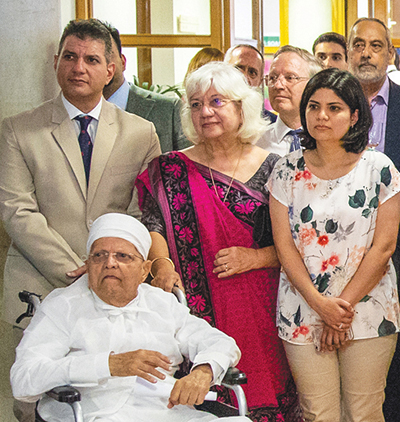
Dastur (Dr) Kaikhusroo JamaspAsa (top and above, from l) with Drs Jamasp,
Bakhtawar and Shirin at the launch of the SOAS-Shapoorji Pallonji
Institute of Zoroastrian Studies in 2018
"Kaikhusroo means royal and famous,” stated Ervad (Dr) Ramiyar Karanjia who was representing the Athornan Mandal (the association of priests) of which JamaspAsa had earlier served as president and trustee. The High Priest being his guide for his doctoral dissertation, Karanjia described his mentor as "very patient and understanding, meticulous and up to the mark in Iranian Studies.” Ervad (Dr) Parvez Bajan, panthaky of Mevawala Agiary who too had done his doctoral research under JamaspAsa, described his guide as "a strict disciplinarian and a hard taskmaster.” Commending the Dastur’s "dignity and decorum,” as also his scholarship, he referred to JamaspAsa’s seminal research work on Aogemadaecha which in ancient Iran used to be recited by priests on chahrum (the fourth day after demise) to stress that more important than the physical sojourn was the spiritual journey that depends on one’s deeds.
As trustee of the Anjumanna Atash Behram since 1980 when he regularly interacted with JamaspAsa and saw him work for the progress of priests, Ervad Burjor Antia was impressed with the "quiet scholar who would daily come to the Atash Behram” until he became immobilized.
At weddings and navjotes performed by him, the kind-hearted JamaspAsa would present a cash gift to the host, recalled Ervad Asphandiar Dadachanji who had officiated at countless auspicious ceremonies with the High Priest. Dadachanji had led the hama anjuman jashan at the Banaji Atash Behram prior to the condolence meet.
Impressed by JamaspAsa’s "honesty, forthrightness and correct opinions on community matters,” Supreme Court senior advocate Firoze Andhyarujina remarked that the High Priest’s "actions spoke more than words.”
BPP chairman Yazdi Desai recounted his first interaction with JamaspAsa in 1987 at the time of his marriage and the next in 2001 after the BPP trustees passed a resolution that one bungli at Doongerwadi be permitted to be used for those choosing cremation. "The greatest tribute to him would be to follow his guidance” as spelt out by JamaspAsa in 2006 when he was felicitated on completing 50 years as a high priest: Whilst following the Zoroastrian path of truth and righteousness, one should visit the fire temples, wear the sudreh-kusti, marry within the community and support dakhmenashini. A condolence resolution for the High Priest was then read out by former BPP public relations officer Godrej Dotivala who was master of ceremonies that evening.
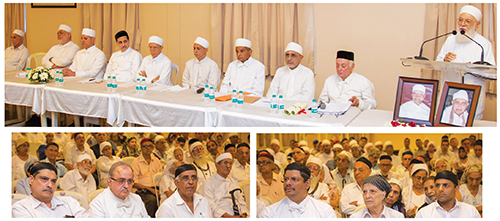
At the BPP convened condolence meet: (top row, from l) Firoze Andhyarujina, Dastur Khurshed Dastoor,
Dastur (Dr) Jamasp, Yazdi Desai, Dastur Kaikhushru Ravji Dastur Meherjirana, Ervads (Dr) Ramiyar Karanjia,
Burjor Antia and (Dr) Parvez Bajan, Godrej Dotivala, Ervad Asphandiar Dadachanji;
2nd row: audience with BPP trustees in the front row Photos: Sarosh and Rehan Daruwalla, Mazda Studios
Acknowledging the tributes, Dastur (Dr) Jamasp, JamaspAsa’s son and successor, referred to his father as "a spiritual guide and a true upholder of the faith.” During his years as a dastur "not all of which were rosy,” he was known for his "fervor, humility, unwavering sense of righteousness… true understanding of right and wrong… fierce determination to stand by what is traditional… Although a strict disciplinarian, he was always supportive and kind.” The most important lesson Jamasp had learnt from his father was to be prepared to tread the path even though "the road ahead may be difficult and strewn with seemingly insurmountable obstacles.”
The fifth child of Dastur Minocher and Najamai’s six offspring, Kaikhusroo was the only one among the four brothers for whom religion was a calling. Whilst his secular education was at the New Infant and Modern School, followed by St Xavier’s School and St Xavier’s College, he was initiated as a navar and maratab at the Vadi Dar-e-Meher in Navsari. At the age of 24, he was installed as the High Priest of the Anjumanna Atash Behram in 1956 when he was required to oversee the functioning of the priests, the performance of ceremonies and cleanliness of the fire temple. In an interview with Parsiana (see "Roots and rigors,” March 21, 2007) JamaspAsa had related that from the time he was a youngster he would help out with the domestic chores by cleaning and dusting the house. To maintain the decorum of a high priest, he would neither eat out at restaurants nor visit cinema halls. He married Dr Bakhtawar (née Mulla), a general surgeon and urologist when he was 45 years old.
Having earned his PhD from the Bombay University, for his thesis on Aogemadaecha, JamaspAsa had worked for four years under Dastur (Dr) Hormazdyar Mirza. Thereafter he pursued advanced studies under Prof Helmut Humbach and Prof Karl Hoffman at the University of Mainz in Germany and was known to be proficient in German and French. In Iran, he worked with Prof Mahyar Nawabi to produce 50 volumes of The Pahlavi Codices and Iranian Researches that were published by the Asia Institute of Pahlavi University. In England, he had collaborated with Prof John Hinnells. For over three decades he served as honorary professor of Iranian Studies at Xavier’s and concurrently as principal of the Sir J. J. Z. Madressa for 10 years and as senior lecturer at the Mulla Firoz Madressa too. At the condolence meeting convened by WAPIZ, Dastur (Dr) Firoze Kotwal confirmed that overseas scholars used to respect JamaspAsa’s knowledge on the Zoroastrian religion.
A picture of poise and piety, his youthful countenance and merry eyes belying an aging body, even when confined to a wheelchair in later years, he continued to hold religious sway. Elected Honorary Life Member of the Zoroastrian Trust Funds of Europe (ZTFE) during its sesquicentennial in 2011, two years later he attended and blessed the launch of the Zoroastrian All Party Parliamentary Group (ZAPPG) in the Houses of Parliament. At the behest of the ZTFE, JamaspAsa attended the inauguration of the SOAS (School of Oriental and African Studies) Shapoorji Pallonji Institute of Zoroastrian Studies last June. "This was the last time that many of us saw Vada Dasturji on a public occasion in the UK,” noted ZTFE president Malcolm Deboo. Dr Ardeshir Khorshidian, president, Anjoman e Mobedan e Iran, conveyed through Deboo condolences on behalf of the members of the Council of Iranian Mobeds and Zarathushti community of Iran.
Having authored several articles on the religion, JamaspAsa had extended his scholarship to this magazine too and had assisted us when we published the Parsiana Book of Iranian Names. A firm traditionalist, he had expressed in an article in Parsiana (see "The collective good,” August 21, 2007), "If today, under the guise of modernity or the common perception of moving with the times or because of the erroneous use of ‘free choice,’ the religion is torn apart by the many controversies raised, one will not be able to carry the faith for the next generation to follow. Religion is not like music or technology, for there is a sanctity and sacredness of the unseen spiritual world attached to it which should not be altered or discarded at will. A religion has an internal integrity which, if disturbed, breaks down under the weight of indiscriminate changes brought about by its members… Religion is for the collective good of the community… More than half the problems in our community stem from an abysmal lack of religious education and a poor understanding of the theology of the faith.”
The dedicated Dastur is survived by his wife Bakhtawar, son Jamasp and daughter Dr Shirin.