The trials and tribulations of the founding of the The Sir
Jamsetjee Jejeebhoy Hospital and the Grant Medical
College show the colonial authorities and the Indians
working towards the common weal
Dr Sunil K. Pandya
"As a trading company, the chief goal of the East India Company was to generate profit for its shareholders in Britain. The education of the natives of India was not a priority,” wrote the late medical researcher Dr Sunil K. Pandya in the first in the two-part series detailing the founding of the Sir J. J. Hospital and the Grant Medical College in Bombay. Medical care and education were not priorities for the colonial authorities. It was left to individual socially conscious Englishmen and philanthropic natives to found medical and educational institutions. The 180-year-old J. J. Hospital spread over 44 acres is undergoing a partial makeover.
Charles Grant, chairman of the East India Company, initially visited Bengal in 1768 and made other visits over the next 50 years. In 1813, he wrote to the Marquis of Hastings in Calcutta: "If we can maintain our possessions in peace, the people will enjoy under our rule a greater measure of security and prosperity than they would under any government of their own… I wish to believe that this may continue to be the lot of at least a large portion of the many myriads who now constitute the population of British India. And the prospect of gradual improvement under the influence of British auspices in so important and peculiar a division of the human race is indeed delightful…
Bombay Native Hospital
Sir Jamsetjee Jeejeebhoy
Photos: Wikipedia
"I most cordially agree in your views of ameliorating the moral and intellectual state of that people… I am happy to see that you enter with so much interest and just discrimination into the great subject of education, and that it is so much an object of attention both to Lady Hastings and yourself.”
Grant earmarked Rs 100,000 (USD 1,193) annually "for the promotion of the sciences among the inhabitants of the British territories of India” which led Lord William Bentinck, Governor-General, to set up a medical school in Calcutta in 1822.
Governor Mountstuart Elphinstone was quick to follow suit and proposed an institution in Bombay to enable Indians to serve their countrymen as physicians and surgeons. Alas, owing to several problems well beyond the control of the very able teacher Dr John McLennan, the secretary of the Medical Board wrote on March 19, 1932: "Medical knowledge is not communicable to the natives of this country.” The school was closed on June 20, 1832.
This would have sounded the death knell of medical education in Bombay had not Sir Robert Grant succeeded Elphinstone as Governor of Bombay. Together with his able medical advisor, Dr Charles Morehead, he successfully revived the project against great odds and with considerable personal effort.
An insuperable hurdle to the success of McLennan’s efforts had been the failure of the government to provide a hospital where medical students could study clinical medicine. This difficulty was faced once again by Sir Robert and Morehead.
Fortunately, this time they had Sir Jamsetjee Jejeebhoy as their ally. When he learnt of the plans being considered by the government to establish a new medical college in Bombay, on March 16, 1838 Jamsetjee pledged a donation to set up a hospital attached to the college.
"I am willing to make an immediate donation of one lakh of rupees (USD 1,193) in furtherance of the establishment of a Native Hospital and Dispensary in Bombay on an extended and efficient scale provided the government will give an equal amount of capital… and will allow interest at 6% on my donation — or, in other words, will appropriate Rs 6,000 (USD 72) per annum to be paid to the committee of management as the hospital may require as the produce of Jejeebhoy’s fund in aid of the new establishment, the principal to remain untouched forever.” He added that in addition to his own fund, the money obtained from government and contributions from other charitably inclined individuals, he was prepared to offer an additional Rs 10,000 (USD 1,197) towards the construction of the hospital.
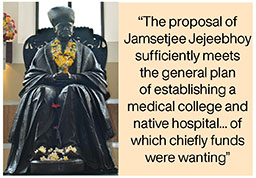
The response from Governor Grant was enthusiastic. He wrote a minute: "The proposal of Jamsetjee Jejeebhoy sufficiently meets the general plan of establishing a medical college and native hospital which has, for some time, engaged the earnest attention of government and for the accomplishment of which chiefly funds were wanting and that we entertain a sanguine hope that with the liberal and unlooked for aid now tendered the authorities to whom the plan must now be submitted will honor it with their full sanction and encouragement.”
As the prospect of creating the institute appeared feasible, he grew strangely impatient. In a minute dated April 20, 1838 Governor Grant urged the secretary to the Governor’s Council to communicate with Jejeebhoy and obtain a detailed proposal regarding his donation. Realizing his abruptness, he explained in what must be one of the most premonitory statements on record: "I should be sorry to seem impatient or precipitate. But all is full of casualty in this country and I own I am very anxious to bring it quickly to the test whether the Government will or will not be pleased to sanction our design, as in the latter event we must encounter the further delay and hazard of a reference to England. Let us once be empowered to proceed and we can then take all due time to mature details.” The proposal for the creation of a medical college was submitted to Governor-General Auckland in Calcutta.
On July 9, 1838, Sir Robert succumbed to cerebral apoplexy at Dapooree, near Poona. The citizens of Bombay convened a meeting at the Town Hall on July 28 to honor him and consider the best means of erecting a memorial unto him. Nana Shankarseth proposed that a medical college be built in memory of this great friend of Bombay and named after him, as he had so ably and enthusiastically planned it and zealously advocated its cause.
The Court of Directors in London replied to the Government in Bombay on May 22, 1839: "Under these circumstances and in compliance to your strong recommendation we cordially adopt your views and sanction a sum to be disbursed by your government equal to the amount of public subscription. We trust this contribution will be sufficient but if the aggregate costs should materially exceed the sum of one lac of rupees, you will refer the estimates for our previous sanction.
"You will communicate to Jamsetjee Jejeebhoy our high appreciation of his conduct and our desire to cooperate with him to the utmost in carrying his benevolent designs into effect. We shall, of course, sanction any designation you may think it desirable to give to the fund for the purpose of doing honor to this very meritorious individual. We accede to the proposal for an advance of one lac of rupees.”
The Committee to plan the Grant Medical College and Sir Jamsetjee Jejeebhoy Hospital comprised Sir John Awdry, the Chief Justice of the Supreme Court of Bombay, President; The Lord Bishop of Bombay; Dr Macadam, Member of the Medical Board; Col Dickinson, Chief Engineer and Jejeebhoy.
The initial proposal to construct the college and hospital at the site of the Native General Hospital (near the Dhobee’s Tank at Marine Lines) was turned down as the proposed site "was interfering with the defences of the Fort.”
A few private local dispensaries existed in different parts of Bombay which catered to patients able to pay for services rendered. Before the Native General Hospital was set up, there was no dispensary where free treatment based on Western medicine could be availed of. The dispensary attached to this hospital, however, did not respect differences in caste and creed and was thus not used by the poor from the higher castes.
The arrival of Dr Mackie changed the situation.
In a retrospective note, Mackie described his initial experiences: "Shortly after my arrival in Bombay, my house was beset by numbers of persons in all stages of disease who were desirous of obtaining medical relief. All that I could do for them as far as advice was concerned I did, but I observed with much regret my assistance, such as it was, nullified in most instances by the extreme poverty of the applicants, preventing them from purchasing the medicines prescribed...
"This at once accounts for my being constantly beseeched both at my house and while going my rounds, for medicines by a great number of evidently poor people.
"The scenes thus continually presented to my view naturally turned my attention to a consideration of the means by which so much distress and suffering might be alleviated or remedied... Under this impression I drew up a prospectus of the proposed institution, with which I waited upon the principal native gentlemen, personally explaining to them the benefits that would result from the establishment of a dispensary both in its immediate and ultimate consequences... Few seemed disposed by money contributions or otherwise to lend their aid towards such an object. Some honorable exceptions there were but they were too few to influence the general body of citizens on a subject so foreign to their notions as that of a public institution for such a purpose.
"Thus, after four years of labor and struggle with a variety of difficulties... the dispensary was established in 1835.
"After two years passed in an endeavor to overcome these difficulties and after repeated solicitations and explanations I at last ... realized a subscription of nearly Rs 3,000 (USD 36).”
The government was then approached for further help. After negotiations, it offered rent free premises and Rs 300 (USD 3.5) monthly towards the expenditure incurred by the dispensary. This building was opposite the Native Education Society’s rooms on the Esplanade.
Being an uncovenanted Englishman without any official ties to the government, Mackie was initially opposed by locals and Europeans alike. Motives of personal advancement and enrichment were attributed to him. Endowed with hindsight, we can only applaud his labors.
Following a public meeting in October 1835, several subscribers and donors came forward to help the Bombay Native Dispensary. Jejeebhoy donated Rs 500 (USD 6) and promised an annual subscription of Rs 100 (USD 2). Shankarseth donated Rs 250 (USD 3) and offered Rs 50 (USD 0.60) per month. The total donation on October 7, 1835 amounted to Rs 9,000 (USD 107). In addition, Rs 5,000 (US 60) was promised as annual subscriptions.
When the Grant Medical College was in the making, Mackie expected a role in it as a teacher. This did not happen. We have no evidence to know why. Mackie resigned as Medical Attendant to the Dispensary saying: "I for one cannot submit to a passive cooperation in a plan entirely subversive of what was originally contemplated. I withdraw from a positive impression of the death blow being given to the Dispensary from the day that the Government allowance ceases.”
He decided to return to England to recoup his health.
Gradually, attendance at this dispensary dwindled and an institution that had served indigent locals in one of the most crowded localities for so long waned.
Two handsome tributes were paid to Mackie when he left India. The first was an address written on behalf of the poor residents who had benefited from his endeavors. The second tribute read: "It is to Dr Mackie that we are exclusively indebted for the native dispensary — the germ, as it has proved, of the Sir Jamsetjee Hospital; and of the value of the former by those who are aware of the amount of native prejudice required to overcome in its establishment — of native suffering which has been gratuitously relieved by its operations — a list of no fewer than 40,000 patients who within eight years have been treated in it, now standing on its books speaks for itself. The address of the poor natives appears to us more touching by far than any testimonial, however valuable, or eulogy, however high-flown, which Mackie could carry along with him to his native country. They had no more to offer than the grateful expression of their feelings and this they tendered freely, and in the most simple terms which heartfelt gratitude could supply... He leaves Bombay with the hearty good wishes of the whole community, amidst the regrets of a wide circle of friends sincerely attached to him, and anxious for his happiness and welfare wherever his lot may be cast.”
To be continued