Coffee Days, Champagne Nights and Other Secrets by Kainaz Jussawalla. Published in 2017 by The Write Place, a publishing initiative by Crossword Bookstores Limited, Umang Tower, 2nd Floor, Mindspace, Off Link Road, Malad (W), Bombay 400064, India. Pp: 275. Price: Rs 295.
Kainaz Jussawalla’s Coffee Days, Champagne Nights and Other Secrets shows skill and competence for a first collection of short stories. Her experience with Savvy, The Times of India, Debonair and Bandra Buzz have certainly given her a breezy and colloquial style and her career as an international flight attendant must have given her an insight into the characters she describes in her stories.
It is women who dominate the stories; the men are shadowy figures, by and large, hovering in the background. It is the women who have been cast in a mold through which they need to break out to become themselves.
"Coffee Days, Champagne Nights” concentrates more on the champagne nights. Chandni Kaur from Chandigarh has a "coffee day” side to her character. She is all that a husband could wish for: she is a reasonably good cook, excels in tennis and is a brilliant student of economics. Moreover, she has the required traditional side to her character showing respect for her elders. But 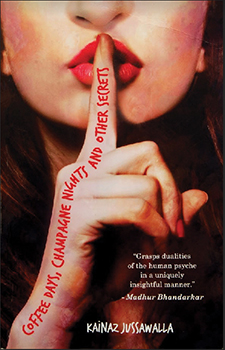 she also has a more interesting "champagne nights” aspect to her personality where she becomes a highly paid and successful prostitute by night merely because she "needs some pocket money.”
In "Carpe Diem: Seize the Day,” five women of different faiths travel on a local train from Virar to Churchgate in a ladies first class compartment. At 38, Alia is the youngest, works for an important fashion magazine as an assistant editor. Her magazine is planning to send her to Goa on a "press junket” and she is insistent that her train friends who seem to be tied down with traditional responsibilities of home and job accompany her. Will Alia manage to convince them that women are more than wives and employees and that they should seize the day and make the most of this not-to-be-missed opportunity?
It is Divya who is "Papa’s Little Girl” and who has always been discriminated against because she was born a girl in a family of cardiac surgeons. Her father always looks down on her despite the fact that she becomes an outstanding gynecologist. He despises her even further when Divya decides to settle down with Harish Tripathi, "just a professor and that too a divorcee.” Divya yearns above all to be accepted by her family and to present them with a grandchild. But sadly, Divya is unable to conceive. Then she meets a patient, a Muslim girl, who has met a Hindu flight lieutenant online and has started a liaison with him. Though marriage is promised, he is killed in action and she is left pregnant. She comes to Divya. The situation is an explosive one: one woman has a child she is not sure she wants and the other is unable to have the child she craves for. To what extent will Divya go to please her father and conform to the role of a dutiful daughter?
In "Sister Act,” Jussawalla presents Meera Shah, who had studied at Mount Carmel High School, knew the Bible chapter and verse and who is so drawn to Catholicism that she decides to join the Church. Jussawalla handles the situation in an extremely skillful manner. Though Meera is unaware of her true sexuality, the reader soon suspects that there is something suspicious on account of the several casual and gentle hints which Jussawalla drops in the course of the story: Meera throws up when she sees a pinup of a nude man and is horrified when her cousin marries an ugly man. But her true nature and sexual struggle come to light when she meets Lara DuPont from Paris who has just turned 40 and who visits Divinity Hands, an organization which Sister Meera works for. Tension mounts when Lara suggests that the lovers should elope. Where does Meera’s future lie? With the Church or with Lara?
The stories are very enjoyable. The collection is followed by a glossary for all the Indian words and phrases Jussawalla uses in her stories. It would have been better if the meanings could have been subtly incorporated in the text. It would be interesting to see how well Jussawalla can write from a male perspective. Perhaps, in her next collection of short stories?