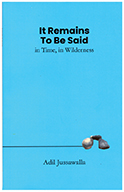
It Remains To Be Said in Time, in Wilderness by Adil Jussawalla. Published in 2025 by POETRYWALA, an imprint of Paperwall Publishing, A/103-Krishna Residences, 379, Cardinal Gracious Road, Chakala, Andheri (E), Bombay 400099; website: www.paperwall.in; email: info@paperwall.in. Pp: viii + 34. Price: Rs 200.
Adil Jussawalla has published several volumes of prose but he is a poet at heart. After all, he has been honored with the Sahitya Akademi Award for his collection of poems, Trying to Say Goodbye, as well as declared the Poet Laureate at the Tata Literary Festival in 2021.
Adil Jussawalla: seeing things anew
Many of the poems in Jussawalla’s It Remains To Be Said in Time, in Wilderness were probably written during and post the Covid pandemic. The rather grim epigraph speaks of:
"Our unsheltered domain
of conflict and plague
has stopped voice and breath.”
But though some poems are dark and deal with the virus, one certainly cannot claim that Jussawalla’s vision is without hope. Very often the human spirit emerges and proclaims what "remains to be said.”
In the very first poem, "Our Convict,” the virus is seen as a predator which "feeds” on us and "has us now for bread.” Like an all-consuming fire it spread, and like a chameleon:
"as it altered disguise,
to enter us undetected,
kill the surprised.”
The ignorance of the government in the face of this pandemic is starkly described in "Kindly Accept.” Jussawalla stresses the government’s inability to demarcate the Covid free zones, or inform people how many individuals will "succumb” to the virus. When the government tells one to "go about business / as usual but with precaution,” what they imply is that they do not really know what would happen if people did not make the attempt to isolate. The poem ends on a chilling note:
"…Kindly accept there’ll be sacrifice
for the greater good, for the health of the nation.
Why fear it’s going to be you or your loved ones?
But if it happens, kindly accept.”
Equally tragic is "Exodus,” which describes the sorry plight of migrants in search of a home which appears to be at the end of the road. Probably, as we have seen again and again, when they reach the apparent destination they are told:
"... Not here.
After so many
dead on the road, or dying
to get there, we are told
this isn’t your home.”
The only solution, he seems to imply, is to "Keep moving… Move on.”
In "A Piano Teacher’s Flat Empties,” Jussawalla writes with great pathos about the emptying of a piano teacher’s flat. He describes in vivid terms the upright piano being transported down the stairs. One can almost imagine "its keys running scales up, / down, / then down and up in fright” while the neighbors silently watch the "show.”
In "Body Building,” Jussawalla describes the frenzy in a gymnasium, "the sounds of weights crashing…the grunts and groans of lifters and pressers” under the supervision of the masters of days gone by "turning bicep and thigh to Himalayas of muscle.” Jussawalla, in contrast, compares himself sitting silently like the dog on an HMV record label, waiting to hear from his long gone master:
"muscle resolving into pain, lips numb,
waiting to hear what never comes.”
Jussawalla uses metaphors of food in "Running Out.” What is actually running out is time and beauty; but he advises the reader to ration these to those who need them and who are closest to them. The ravages of time cause "the food of the sight of the one you love” to disappear and "the shelves of your heart/ are almost empty.” One should
"…take stock.
There’s no knowing when refills arrive
of time, of beauty.”
Though they may seem bleak and desolate, many of the poems in the anthology are filled with hope, even when the tone may be somewhat subdued, even elegiac. Marsyas, the satyr in Greek mythology, was supposed to have challenged Apollo to a contest of music and lost not only his hide but also his life. In Jussawalla’s "Marsyas Continues,” the protagonist thanks the audience for waiting "when the concert ended in a rip tide of blades.” But even though Marsyas has been flayed, his heart has several layers and continues to beat. The poem, though filled with graphic and cruel imagery, seems to suggest that art and poetry may continue to exist even in extreme and adverse situations.
In "Turning Seventy” (2010) Jussawalla’s description of the body is disturbing. He compares it to an abandoned "pile of papers left behind on a bench” or a "metal tube / of paste, wire, clips.” He feels he is a plant in a garden where he stands all day confused, "splodged with blooms like Pierrot (classic clown of French pantomime).” Though Iranian poet Sa’adi Shirazi’s gift comes late in life there is some consolation that at least his achievements, like "roses, will stay fully open.”
The poem that follows, "Turning One,” was written in 2020 when Jussawalla turned 80. He seems to imply that even at this age one can see things anew as if for the first time, the images falling on a blank page "annulling everything in this book,” and realize "I haven’t turned 80, but one.”
"Hope” is also written on an optimistic note albeit an elegiac one. He describes the portrait of a blindfolded woman with all but one of her lyre strings broken. This painting hung near the lift which brought the patients, hoping to be cured, to his father’s naturopathic clinic. The woman is depicted on the "top of a globe” and Jussawalla’s father explained to him that this was the picture of Hope:
"All but one of her strings are broken,
all but one, and she continues to play.”
It is with hope that we wait for another collection of poems from Jussawalla.
FIRDAUS GANDAVIA
Gandavia holds a doctorate in English literature and is a retired chartered accountant. He is a compulsive reader of fiction.