A life dedcated to socialism earned
respect from police officers
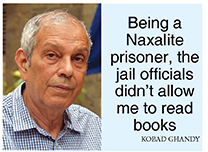
Kobad Ghandy
These abbreviated and slightly edited excerpts of an interview with Kobad Ghandy from The Feared: Conversations With Eleven Political Prisoners by Neeta Kolhatkar, have been reprinted with permission from the author. The first instalment is carried in this issue.
I was wondering whether I would ever come out alive.
My last jail term was in Surat and I knew nobody in Gujarat. I got bail because the others were granted bail. The people handling my case and those of the others were mostly human rights lawyers. Actually, my sister (Mahrouk Vevaina) has been there for me and she paid my bail. She brought me to her house once I was released. In Surat I knew I would be out soon, but my biggest worry was once I come out where would I go? I had sold all my properties and I didn’t have any place (to stay). I was wondering who would keep me. Not a single one of my Left associates offered me their place. They all have big flats, extra flats but not one of them offered me a place. Till today, not one of them has asked about my well-being.
The Parsi community, and especially Parsiana magazine, and some individuals have been extremely supportive (of me). Like I have mentioned in my book Fractured Freedom, I have raised questions on the philosophical aspects of the Communist movement regarding values, freedom and happiness. I found I am getting support, which has been refreshing. One didn’t realize that ordinary, old, Parsis wanted to meet me. I never expected that.
When I was arrested in Surat, I began to think of writing a memoir. Initially, I didn’t have the intention because nothing was certain regarding my release, bail and all such issues. When I saw the possibility of getting bail, I began to conceptualize it. Around January 2020, I began looking for a publisher because I know nothing about the publishing industry. A few friends put me in touch with some publishers and soon the lockdown was declared. This was a boon for me as I could focus on my book and there were no distractions. In fact, my book came out around March 2021 which gave me a lot of confidence as it has done well.
A person who comes from an elite background is given support when he/she sacrifices everything for the poor and oppressed. But a poor person who joins the cause has nothing to sacrifice. It is another matter that most do not sacrifice but keep their wealth while also following communism. I found this even among the police officers; they all respected me for this sacrifice which they said is rare these days. Maybe because I have been living by the ideals and because the Intelligence Bureau (IB) and other authorities knew that I had given away all my property and had nothing in my name. From that point of view, I got support from all jail authorities except those in Tihar. The officials expressed surprise and respected me; in this day and age few individuals live by ideals for the poor. Now I’ve found this respect even among my Doon School alumni.
As far as the Parsi community is concerned, well that is also divided. Many years ago, when we used to live in Colaba, my neighbor, who is a Parsi, told me that while some people are against me, many are sympathetic. I have personally sold 150 copies of my book, mostly within the Parsi community. There is a section of the Parsi community which is anti-Muslim and pro-Narendra Modi — some of my relatives too are like that. But there are a large number of Parsis who are ethical. My father was sympathetic towards us. The Parsis are sympathetic because of their ethical values and honesty. These are still prevalent among the general Parsi community. During my incarceration also I got a lot of support.
I was expecting to be arrested for the kind of work I was involved in. It was a possibility; it was collateral damage that one expects in this kind of work. We (my wife Anuradha and I) were in Nagpur for many years and we didn’t face much trouble then. But after that, things began to get tense. Anu went to stay in the forest for three to four years. It affected her health a lot. She returned to Jharkhand which is where she suffered a dangerous bout of malaria. That apart, the pressure was getting to all of us. We could see people being arrested. The Andhra IB people were overly active. People all over the country were being arrested. The Andhra IB officials, who detained me illegally for three days, said they were waiting to arrest me and thought they could do so when Anu died.
Author Neeta Kolhatkar
No one actually dealt with me badly. They all had some sort of underlying respect. I was kept in a special cell, but otherwise it wasn’t that bad. When I was taken for interrogation, the senior officer said he was looking up what "Urban Naxals” meant on the Internet (laughs). I had been sharing a room in Delhi before my arrest with a Hindi speaking man who was an avid reader. There were books by Premchand and other authors lying around which they got from my room. There were many literary people in the interrogation team and they told me they were reading those books (smiles). They were mostly Hindi books. I got decent treatment in most jails, except by the jail authorities in Tihar who were rough. I even had good judges. My lawyer, Rebecca John, is an excellent lawyer. She is a tough person who did everything for my cause, extremely warm and nice. And still, it took 10 years for me to get out on bail.
The way things were dragging on, I was wondering whether I would ever come out alive. Only when I reached Surat did I have some inkling that there could be a chance of my being released. But then I was re-arrested at the gate. I first came out in 2017 and was re-arrested after three days and put in Jharkhand jail. Here too the superintendent was decent. I got a lot of time to write articles in that jail.
I tried to keep myself mentally fit and not get depressed.
At one time, Tihar was terrible; it has come a long way. Yet, it is no patch on the jails in Hyderabad, Visakhapatnam, Kerala or, I believe, even in Bengal. The rest are still run mafia-style, especially in Delhi. Everything in Delhi is like that, I suppose, even the politics. When Arvind Kejriwal came to power, I wrote two or three letters to him regarding jail reforms. He didn’t bother to respond. Everyone thought he (Kejriwal) would do something different because prior to him (Delhi chief minister) Sheila Dixit was a terror. I believe she never released anyone.
To be concluded