Improving the quality of life for Parsi villagers in Gujarat is
one of The WZO Trusts Funds’ major thrusts
Farrokh Jijina
Till a few years ago, agriculturist Dinshaw Wadia lived with his family in a hut made from bamboo and cow dung just off the highway that leads to Dapada. The village, near Silvassa, the capital of Dadra and Nagar Haveli (DNH), a union territory in western India, had a population of 5,713 as per the 2011 census. His wife Shirin and he now live in a simple but permanent house where he welcomed Parsiana, unable to get up from the chair he sat in on the otla (verandah) of his house, due to severe rheumatism. Neatly dressed in a bush shirt and trousers, he encouraged us to look through his home. The spartan main room is decorated with a large picture of Hindu goddesses. Tea is rustled up by a neighbor’s child from a somewhat bare kitchen furnished with basics required for cooking. Shirin is away at a neighbor’s house. The Wadias’ 24-year-old daughter was married last year.
There are four Parsi homes in Dapada, all Wadias, all cousins, states Dinshaw Tamboly, chairman of The WZO (World Zoroastrian Organisation) Trust Funds (WZOTF). With his team members Aspi Ambapardiwala and Sarosh Gazdar, Tamboly, at Parsiana’s request, showed us around on November 17, 2018. DNH is one of the many geographical areas in which the trust assists needy Parsis. The rural housing project of WZOTF has converted 275 huts like the Wadias’ into cottages, mainly in Gujarat and Maharashtra, since the inception of the project in 2001, stated Tamboly. Twenty-nine beneficiaries were assisted in 2017-18 alone.
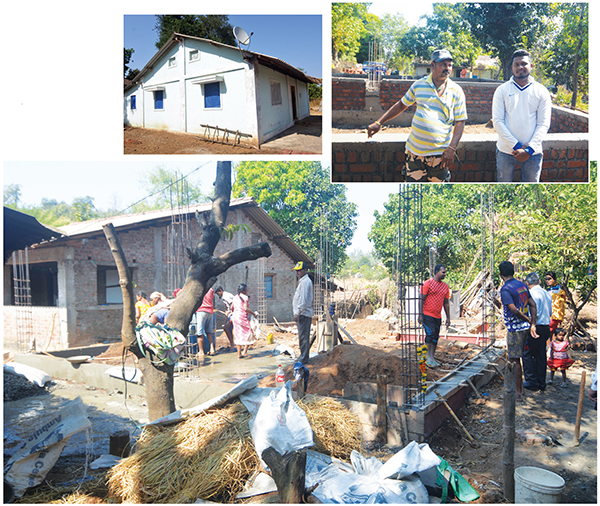
Clockwise from top l: A home funded by WZOTF; Jivanji and Aspi Wadia;
Naval Jal Vaid’s (center, red tee shirt) home being built
Above: Rustom Govadia at his engine oil shop; alongside, Jivanji Wadia’s grocery store
1) Dinshaw Vaid, seated checked shirt, Noshir Vaid, standing, foreground, striped tee shirt, with visitors; 2) Dinshaw Tamboly,
Neville Wadia, Aspi Ambapardiwala, Sarosh Gazdar (1st, 2nd, 4th and 5th from l); 3) Photoframes around main door of Rusi
Vaid’s home: repeating motif; 4) Dinshaw Vaid (Dapada); 5) Naaz Vaid; 6) Naval Moti Vaid; 7) Burjor Vaid; 8) Dinshaw Vaid
(Karchond); 9) Pallonji Vaid with daughter Pinaz (seated) and a family member; 10) A WZOTF funded home
Twenty-four Zoroastrian homes in Karchond (total population 4,688) have been transformed by WZOTF from hutments to permanent structures. "For each renovation project, we give five lakh rupees. We stipulate basic requirements for flooring and material to be used and then leave the layout of the house to the beneficiaries,” stated Ambapardiwala. Ninety percent of the disbursements are non-repayable grants. Interest free loans are given only to those who have the capability to repay.
Aspi Wadia has been disbursed a grant this year. He is on leave from his job as a chasniwala in Bombay’s Hormasji Saher Agiary to oversee the building of his home. "Agiary ma kaam karva haaru (saaru) laagé (It feels good to work in an agiary),” he informed us, taking a break from watering the freshly laid cement floor. While Aspi is in Karchond, he has arranged for Dinyar Patel, a cousin from Savta near Dahanu to substitute for him at Saher. Aspi was navjoted by Ervad Jal Bhesadia of Karajgaam, also in south Gujarat when he was a young adult, said Ambapardiwala. Tamboly stated that Aspi could earn Rs 8,000 per month doing a factory job nearer home but the working hours could be much longer. The Saher job pays him Rs 5,500 per month plus tips of about Rs 2,000.
Jivanji, Aspi’s father was not navjoted. Lack of opportunity, lack of knowledge and the relative isolation of the community from mainstream Parsis could be likely reasons, Tamboly explained. "By and large, a lot of the previous generation has not been navjoted. Most are getting their children navjoted now,” he stated.
Aspi’s neighbor Naval Vaid is also constructing a home for himself and his family with WZOTF’s assistance. In between shoveling cement with the help of friendly neighbors and workers, Naval told us that he is a chasniwala at Bombay’s Boyce Dhunapatel Agiary. Since there are already two other workers at Boyce Dhunapatel, he was not pressured to find a substitute worker while in Karchond. His home will be complete in about four months.
While the spoken Gujarati of most of the beneficiaries Parsiana met is heavily flavored with a rural accent and words, elderly Burjor Vaid was not able to comprehend even simple Gujarati. He looked at Tamboly blankly when he was asked about an earlier promise of disbursement of trust monies for his permanent home. "Mè maaru vachan puru kidhu, né? (I fulfilled my promise, did I not?),” queried Tamboly. A woman standing nearby explained Tamboly’s question to him, using a mix of Gujarati and the local dialect. The senior citizen then nodded solemnly. While their home is under construction, Burjor’s family lives under tarpaulins surrounded by their meager belongings.
Noshir Vaid of Dapada serves in the 51st India Reserve battalion that protects India’s union territories, having been posted in the Lakshadweep islands. A beneficiary of the WZOTF’s grain distribution scheme, his pert 19-year-old daughter Naaz wants to study medicine, "haara (saara) marks aavhé (aavsé) tau (if I gets good marks),” she told us. Tamboly has a few words of encouragement for her: "Aagal sikhvanu (you must study further).” Naaz has a better chance of admission to a postgraduate course if she describes herself as a Warli (indigenous tribe living in the mountainous region on the border of Maharashtra and Gujarat) rather than a Parsi while seeking admission to a college. There are special seats with liberal admission criteria for tribal people in educational institutions, none for Parsis, Tamboly noted.
Noshir was navjoted in Navsari. His father Ardeshir was not. Noshir’s wife Behroze was earlier called Bharati, he informs us. "Aè par-kom ni chhé (she is from another community),” he whispered to us, almost apologetically. "At WZOTF, we do not concern ourselves with whether a beneficiary’s spouse is a Parsi or not,” Tamboly informed us.
A yellow one-storied somewhat grand house which stands out from the huts and the modest WZOTF-provided housing in Dapada, is home to Neville Wadia. The verandah has framed pictures of Zarathushtra with other Hindu deities, a repeating motif in many of the homes Parsiana visited. The admiration that this onetime principal at the Sir J. J. School in Surat has for the work done by the trust is evident when he asks his daughter to touch Tamboly’s feet in the traditional Hindu expression of respect. Embarrassed, Tamboly graciously accepts the gesture. Neville’s wife was a recent recipient of a grant of Rs 1,00,000 for treatment of throat cancer.
While we walked through the narrow lanes of Karchond, a worried looking Pallonji Vaid informed Tamboly that his daughter is sick, with some kind of growth near her jaw. Stopping by at their home-cum-shop, Tamboly comforted the father, the distraught and slightly sullen looking daughter Pinaz, and their extended family. Take her to a good doctor in Navsari or Surat for treatment, he said. Some family members suggest Ahmedabad. "Wherever you feel she can be examined in detail, a diagnosis arrived, and treatment provided…We will help,” said Tamboly. Over 400 beneficiaries were the recipients of funds from WZOTF for medical purposes last year.
One would estimate Rattansa Govadia’s age as about 70. Many do not keep track of age in the area. Navjoted at "15 or 16,” his kusti was "cut into half by his masi (maternal aunt),” and he has not worn one since. Probing for reasons did not yield much from the hard of hearing Rattansa. His middle-aged son Rustom has not been navjoted. Will Rustom’s children be navjoted? Kermin is 20 and Sorab, 15. Rustom shrugged and looks at the ground.
Assisted with a loan of Rs 1,00,000, Rustom bought an existing automobile engine oil retail shop three kilometers from his home in Karchond, in Dudhani. Ambapardiwala explained that while the average disbursement under their self employment scheme is Rs 3.5 lakhs, WZOTF sometimes disburses a lower amount. When the office bearers gain confidence in the beneficiary’s capability to run their business, more amounts are given. Rustom started small with a shop to repair cycle tire punctures and later expanded with the seed money. "He is a hard worker,” said the hands-on Ambapardiwala who visits DNH once a quarter to keep an overall eye on how the funds are being utilized. Rustom is one of 1,090 community members in 116 locations to whom WZOTF has have disbursed interest free loans totaling Rs 18.97 crores from 1995 till March 2018 under their self employment project, stated Tamboly.
Dinshaw Vaid grows rice in his small holding in Karchond. Daughter Jennifer could be a potential beneficiary for education aid. She aspires to be a dental hygienist. Tamboly told her, "Aagal sikhvanu, hahn ké? (You must study further, right?)” The pretty lass says that she will get herself a job wherever the opportunity arises. She is helping her younger half-siblings Farhad and Ferzin to learn the Yatha Ahu Vairyo. Does the family go to a nearby Hindu temple or a Zoroastrian place of worship? The farmer looks at the floor. The nearest fire temple is in Sanjan, 52 km away, explained Ambapardiwala, a long commute for the residents of Karchond.
One hundred and sixty-one individuals were supported with interest free educational loans in the year ended March 2018. "We support only those who are pursuing graduate and postgraduate courses (with interest free loans),” said Tamboly. School fees are generally affordable in these areas.
"Mind opening”
It is now time for lunch, thoughtfully brought by Ambapardiwala and Gazdar from Navsari where they are based. The venue is the wayside shop of Jivanji Wadia. With WZOTF’s assistance, Jivanji has set up a small store selling provisions needed in the area, inaugurated on Hindu New Year Day, November 8, 2018. Soaps, detergents, eggs and inexpensive sweets are crammed into the modest showcase. Packets of savory snacks are strung up on lines. A small cooler stores soft drinks. In a side hutment chicken are reared for slaughter and sale.
Tamboly revealed the motives that prompted him to take up the cause of indigent Parsis living in rural areas. An employee at one of the textile showrooms he owned and ran in Navsari in the early 1990s, Sam Dharampuriwala, took him to meet his family in a nearby village. "I blurted out, ‘Sam, tu tau jhopra ma réhch (You live in a hut).’” Though embarrassed at his utterance, it was a "mind opening experience,” Tamboly recalled.
"Connecting the community, one family at a time,” says a 2017 brochure, listing its 10 key activities that range from medical and educational support, assistance to the clergy, economic housing, care for senior citizens, to rehabilitating farmers, and providing permanent housing by converting huts to permanent structures. "The vast volume of multifarious welfare activities that WZOTF performs would not have been possible without the regular and ongoing support received from the trustees of the Zoroastrian Charity Funds of Hongkong, Canton and Macao (ZCFHCM),” Tamboly told Parsiana. Nearly 40% of the donations received by WZOTF in the last financial year came from ZCFHCM, he stated.
Sitting in front of Jivanji’s shop on plastic chairs provided by the agriculturist turned shopkeeper, Tamboly stated, "My biggest satisfaction comes from seeing incremental progress in the lives of our beneficiaries.”