Two “life memoirs” of Parsis in Burma
narrate their diverse struggles and successes
Mitra Sharafi
"‘Life writing’ includes memoirs, autobiographies, letters, diaries and family histories that recount the story of the author’s life or that of his or her family,” notes Mitra Sharafi, associate professor of law at the University of Wisconsin Law School in Madison.
"In the Parsi context, life writing encompasses a rich collection of texts by men and women in British India and beyond... The authors may not frame their texts as Parsi community history, but their works also contribute to the preservation of Zoroastrian heritage,” states the legal scholar.
Flags of British Burma as a part of British India (1824-1937)
and as a separate colony (1934-41, 1945-48)
Family portrait of the Mistry family of Mandalay, circa 1911,
including Burjor Mistry as an infant sitting on his mother’s lap
Image courtesy: Jehangir B. Mistry
"The Parsi population of Burma was small — just a few hundred at its peak in the early 20th century.” The two accounts examined by Sharafi provide us with narratives of everyday life in colonial and post colonial Burma that are immensely valuable contributions to the archive of Parsi-authored primary sources, the author notes.
Sharafi thanks Semine Patel (Poona, India), Rubina Patel (Silver Spring, Maryland, USA), the late Cyrus Ruttonsha (Poona, India), Zareer Ruttonsha (Toronto, Canada), and Firdaus Ruttonshaw (London, UK) for making P. D. Patel’s memoirs available to her and for sharing the history of their family. She thanks Jehangir B. Mistry (Bombay, India) for sharing with her the memoirs of his father, Burjor M. Mistry.
Parsiana carries extracts from the article "Parsi Life Writing: Memoirs and Family Histories of Modern Zoroastrians” in Holy Wealth: Accounting for This World and The Next in Religious Belief and Practice. Festschrift for John R. Hinnells (Wiesbaden: Harrassowitz, 2017), 251-77 with permission from the author, the editors Almut Hintze and Alan Williams and the publisher.
Burjor Maneck Mistry’s memoirs described his own childhood. His family was living in Burma, and he recalled being taken by his mother into the city of Mandalay, "full of gold topped Buddhist pagodas.” He was once saved by a Burmese man at the outbreak of a stampede during a religious ceremony. When he was four, Mistry remembered watching an elephant walk on a "strong man’s chest” at the "Rama Muti Circus,” when he was also bitten by a monkey. The young Mistry, his father Maneck and their ayah (maid) would pack ham sandwiches and have picnics in the countryside with their landau, an "aristocratic, four-wheeled open carriage, drawn by a fine horse.”
These recollections of Mandalay were strikingly visual and memorable — whether because they were particularly beautiful or upsetting for a small child. However, a much larger trauma would color Burjor’s memoirs after his family moved to Maymyo, a Burmese hill station outside of Mandalay. The tragic death of his mother when he was six prompted Maneck to move back to Bombay from Burma with the author and his younger sister, Thrity. The father never recovered from the loss. Burjor’s mother was Daulat Ookerjee-Vakil, and she had grown up in Hyderabad. Seventeen years younger than her "stern” and "exacting” husband, she was his opposite — "ebullient and bubbling,” and always smiling. Her photo reflected an elegant young mother in her embroidered silk sari. Daulat was charming and fun-loving, a favorite with the English wives who regularly invited her to their parties. She entertained with her family regularly. Burjor remembered one occasion when his mother put on her husband’s office coat after dinner and impersonated him, to everyone’s delight.
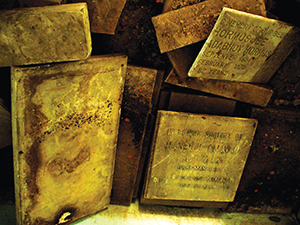
Tombstones bearing Parsi names: Hormusjee Dadabhoy Hormusjee,
1891-1978, 82 years (above right); and Manekji Pallonji Daruvalla, died 5/8/1918
Daulat’s sudden death left her husband stunned. "He never wept — just sat silently.” Her son’s account suggested that he himself was too young to comprehend her death in the same way. At her funeral, a "long winding cortege of carriages” wound through the countryside. She was buried in a "very fine English cemetery.” Presumably, Maymyo was too small to have a Zoroastrian Tower of Silence (dakhma) or even a Parsi cemetery. After the Mistry family returned to India, Maneck arranged to have an English priest continue to leave flowers at Daulat’s grave. Japanese bombing during World War II probably destroyed the cemetery. Maneck lived a lonely and austere life after the loss of his wife. By Burjor’s account, he lived like a sanyasi or recluse. He never attended social functions or the cinema, but spent his time alone, working or reading.
Burjor’s childhood in Bombay looked more like a conventional Parsi child’s than did his earlier time in Burma. He was educated by Jesuits at St Xavier’s School, where he excelled at debating. His family lived in a flat in Rustom Baug, then a newly built Parsi colony. His aunt and uncle lived nearby and played a major role in his upbringing. "Tehmi Auntie” supervised Burjor’s homework every night, for instance. After completing his studies at St Xavier’s, he studied law in Bombay, despite his father’s wish that he go to London to become a barrister at the Inns of Court. Burjor went on to have an illustrious career as a Bombay advocate. He initially worked with P. B. Vachha, a prominent advocate and memorialist of the Bombay High Court, and then began his own solo practice, specializing in criminal law.
Burjor’s career included some highly publicized murder trials. In 1946, he represented a 19-year-old female spiritual leader named Godharibai who was being tried as an accomplice to murder and for "black magic.” In a 1956 case, he acted as prosecutor in the trial of a beautiful Kashmiri prostitute named Kishori who was accused of killing Nadkarni, an airline official who was infatuated with her. In 1970, Burjor defended a Parsi named Daruwalla who had killed four people, "inflicting a ghastly total of 286 wounds.” Later, he represented four young art students from Poona who strangled ten people in imitation of Alfred Hitchcock’s books and movies. In other words, Burjor took on difficult cases, particularly for the defense, and did his best to ensure a fair trial and sentencing in the face of extreme violence and tragedy.
Against the traumatic aspects of his criminal caseload, Burjor came home to a happy family life as an adult. In 1936, he married Jer Presswalla, whom he had met at St Xavier’s College, and together they had four children (Nari, Ronnie, Jangoo and Gulnar). Thirty years later (from 1966 on), his children had their own children. Burjor’s account ends with a paean to his grandchildren, and to his love of times "when my children are at home with us with their children, especially those times when the whole family is together all at the same time under one roof — never mind the pandemonium and the noise!” Burjor’s life story began with tragedy and loss early in life, but moved toward happiness and security as an adult, despite the unsettling content of his professional life. His account is relatively short. The main text is just 11 pages long, and appears to have been put into writing for the family at the urging of younger relatives.
P. D. Patel’s life story is 35 pages long and dramatically different in tone. It seems to have been born out of the urge to describe a single traumatic experience: surviving in Burma during World War II. It ends not with a sense of retired grandfatherly contentment, but with outrage at the failure of governments to compensate individuals (particularly non-Europeans) for their wartime losses in Burma. Like Maneck Mistry, Patel was married. Like Mistry, Patel had adult children and at least one grandchild when he wrote his memoir at age 80. But there is no mention of his wife, children or grandchildren during the latter half of his memoir. Patel sent his immediate family members to India as the Japanese were advancing on Burma. The Patel family lived in Bombay from that point onwards, and his son went to Britain to study accountancy. Patel mentions one visit to Bombay after the end of World War II. He found the climate unpleasant ("I did not like Bombay. I felt very hot.”) His family urged him to move to Bombay, but he refused, returning to Burma with new energy to remake a life for himself there: "I felt extremely happy that I had returned to the country of my adoption though I did not know what would be the future.” Patel seems to have lived apart from his wife and children for the rest of his life, and they receive no mention after his Bombay trip.
Unlike Mistry’s memoirs, those of Patel do not start at the beginning of his life or with the lives of his parents and grandparents. Patel’s account is entirely focused on his 50 years in Burma, and on survival. He is unapologetic about his formula for survival: he stayed alive through knowledge of how state power structures worked and by forging strategic alliances with highly placed officials, whether British, Japanese, Indian or Burmese. Patel himself was a prominent player in civic life. In his student days in Britain, he was an active debater and vocal supporter of Gandhi. In colonial Burma, he occupied prominent positions in municipal government. He was elected president of Insein Municipal Council (just outside of Rangoon) and became a member of the Rangoon Municipal Committee, defeating a British candidate in a heated contest. His memoirs recount fierce election struggles, political maneuvering within the horse-racing Turf Club, and Patel’s role as mediator in labor disputes (between a hospital administration and nurses) and in Hindu-Muslim conflicts over the ceremonial slaughter of cows. Patel was not a man to shy away from confrontation. Indeed, in some cases, he may have invited it. On occasion, Patel worked to have people he considered misguided or incompetent removed from their positions — including highly placed Britons like the commissioner of Rangoon Division, one Mr Robertson ("poor man died in a mental asylum in Scotland”) and a Turf Club judge, "a Britisher who had only one eye and whose decisions were invariably wrong in close finishes.” He had six true enemies during his life. Among them was his unidentified nemesis, ‘my life long bitter enemy—so-called leader of the Bar’ in Rangoon. Patel hoped that God would punish such people by taking them away from "this beautiful world: None can avoid providential justice.”
An occasional opponent scuppered Patel’s political ambitions in British Burma. Patel would lose far more, though, to the forces of chaos. His misfortune was to be sitting in the path of two advancing and retreating armies — the Japanese and the British — during World War II. In both contexts, he survived through knowledge and good relations with the right people. Patel spent time in Japanese custody on one occasion when an unscrupulous neighbor reported him for espionage. Patel was tortured by the Japanese military. As he described it, "I spent 21 days in captivity. I was classed as a British spy and a most dangerous man. I received terrible thrashings, 75 slaps without a break on both cheeks, merciless beatings with a bamboo on legs and back resulting in terrible swellings and finally was tied up to the ceiling, dangling in the air for 45 minutes. There was a lack of food. I had no bath. It was winter. I slept on a bare floor, no mattress, no pillows and no blanket. It was frosty and bitterly cold as I was in an open cage with bars all round.”
But he noted that he "had an iron constitution” and survived "through the mercy of providence.” On other occasions, Patel avoided detention (for himself and others) by calling upon highly placed Japanese officers with whom he had become friendly.
When the Japanese retreated and the British re-occupied Burma around 1945, Patel became a member of the Army House Committee. In this role, he helped identify the original owners of houses: "I was a useful asset to the Army.” However, under the Japanese occupation he had also hosted and supported the Indian independence leader Subhas Chandra Bose during a visit to Kalaw, the hill station where Patel owned a house and spent most of the occupation. As head of the Indian National Army, Bose sought independence from British rule by allying with the Japanese. Patel supported Bose’s larger political project, but also used his relationship with Bose to protect his own immediate interests:
"I took a letter from him that my residence belonged to him and I was his manager with a view to prevent Japanese occupation of the house. I might here say that he was well respected by Japanese forces. In fact, his stay did me a lot of good. Japanese Kempeitai treated me with great respect. I walked with my chin up and chest expanded. They used to ask me ‘is Subhas Chandra your friend?’ My reply was ‘he is my uncle.’”
Patel did not seem to see any contradictions between his alliances with Bose and the Japanese, on the one hand, and later with the British, on the other. He would surely have explained his actions as essential to his survival.
In addition to avoiding further imprisonment and execution, Patel used strategic networking to protect his property during wartime. Presumably, Patel stayed on in Burma to protect his material assets, refusing to flee to India with his family. These included several houses in Rangoon and Kalaw, at least one car, furniture, revolvers, a gramophone, silver, a private library, and a liquor collection. (Patel liked his drinks, and described the particular kinds of alcohol that accompanied key moments of his life.) He lost a vast amount of property during the course of the war, and the twinned themes of trauma and loss dominated his memoirs. In 1943, Patel made a trip from Kalaw to Rangoon to check on his houses there: "I was shocked to see that state of my houses — the contents with lovely furniture made by Rowe & Co, expensive piano, His Master’s Voice gramophone, two radios, valuable pictures by Dutch artists, silver wares, etc had been sent away to Tokyo.” When the Japanese retreated from Burma, they again "robbed me right and left,” while he sought shelter from British bombing in a trench. This time, the Japanese army robbed me of my plum jam, a very useful item of food, my cash, my clothes and my automatic revolver which I had since 1912.” The clothes were quickly sold, but the Indian street vendor who bought them recognized them and sold them back to Patel — an "amusing thing.” Shortly before the Japanese retreat, a group of Japanese soldiers also came to Patel’s door in the middle of the night, convinced that he was a "Britisher” because his house had a main gate. Despite his protests "the brutes poured petrol on (the gate) and burnt it. I could do nothing. I grinned and cursed them.”
As the Allies advanced back on Burma, they bombed Kalaw for 13 weeks. The glass panes of the doors and windows in Patel’s house were "completely smashed up through blast and machine gunning.” The monsoon then came early, making "life more unbearable” especially in the trench where he sought shelter. The return of the British army to Burma only brought a new round of rampant theft. Patel noticed that his collection of "220 Standard Books” and some valuable furniture had been removed by the army without his permission. He complained to the colonel in charge, who promised to return it all before leaving Kalaw. However, within a week, the unit had departed "taking away my property.” On another occasion, a British soldier pocketed a photo of Patel’s wife and daughter from the mantelpiece, while another pulled down a hanging lamp and left with it. He caught a Sikh soldier trying to break open the locked bedroom wardrobe with a weapon: "The bayonet’s marks are still on my almirah.”
Patel prevented more serious confiscations through his connections. While he was being detained and tortured during the Japanese occupation, the "Kempeitai chief” and his US-educated Japanese interpreter moved into Patel’s house. The chief "made himself comfortable,” wearing Patel’s clothes and using his motor car. However, once released (through the influence of the interpreter), Patel returned to his house and shared it with the chief. This interaction became another opportunity for strategic alliance-building. Every day, Patel provided dinner "and so became friendly with the chief.” The chief asked Patel for a list of all the Anglo-Indians, Anglo-Burmans and Europeans in Kalaw. Patel did so, giving each person "a clear report” so they all lived in Kalaw "without molestation” for the rest of the occupation.
Similarly, he avoided the confiscation of his Kalaw house by the British military later thanks to his knowledge of military authority structures. One day, a military group led by a "bulky officer” named Capt Buckingham appeared at Patel’s house and told Patel to vacate. The officer’s explanation was audacious: "We like your place, it is well furnished, it is commodious, the floor is beautifully polished and we can have dances.” Patel replied: "I am well connected with officers of the Indian Army.” He requested that these officers fly him to Rangoon to meet with "the Supremo. If Supremo says I must give, I shall give.” The officers then relented, telling Patel that he "knew too much.” Patel’s reply epitomized his survival technique throughout: "Yes that is why I am alive and I am here.” Patel was well aware of the Supreme Commander’s order not to harass local residents who were living in their own houses. The British army was entitled to occupy absentee owners’ houses only. The officers then shook Patel’s hand and asked for some furniture instead. He loaned them some tables and chairs from his bazaar office, rather than from the house. This furniture was never returned, nor did the officers give back the large collection of spoons, forks and knives (many engraved with his wife’s initials) that they had borrowed for Christmas dinner.
These items of property held sentimental value for Patel. What he most resented about the British re-occupation, though, was the destruction of the currency value held by many residents of Burma after the Japanese occupation. The British administration was "vindictive.” Louis Mountbatten, who was Supreme Allied Commander for Southeast Asia (and who would oversee India’s independence a few years later), turned a large part of the population into paupers by demonetizing the Japanese currency. "It was the most cruel and unreasonable act.” In the early 1950s when Patel wrote his memoirs, he still had 25 lakhs (2.5 million) of Japanese currency notes. The very poor turned to robbery and dacoity, and entered into grossly exploitative loans. Outrage was a dominant emotion in Patel’s memoirs: "From the bottom of my heart I blame the then administration which rightly received curses from the sufferers.” This policy expedited the arrival of Burmese independence.
At the end of the war, Patel worked tirelessly to seek compensation for the losses suffered by his fellow residents in Burma. He wrote to the then Governor of Burma asking him to declare a moratorium on interest due on all pre-war loans. This request resulted in the passage of the Accrual of Interest (War Time Adjustment) Act of 1947, and aided many desperate debtors in Burma. He also wrote over 100 letters to the Press arguing that the British government should pay compensation for wartime damage suffered in Burma. The British government set up a War Damage Commission and invited claims. Patel filed a large number of claims for several individuals (himself included) and firms. The Commission prepared a report assessing the loss at 200 million pounds. But when Burma achieved independence, "the question of compensation was clean forgotten.” Patel wrote to (British Prime Minister) Winston Churchill, but to no avail. He received a reply from the British embassy "repudiating the claim” and breaking the "solemn promises” made during the war. There were some successes, but these were mainly for British firms (Patel represented them in war risk insurance claims) and individuals (for chattels lost during war). "All Burmans, Indians and Chinese unfortunately received nothing” as chattel compensation.
Patel also lamented the lack of compensation from Japan for wartime losses in Burma. Burma was not a party to the San Francisco Peace Treaty of 1951, and could therefore secure reparations from Japan subsequently. However, the paying out of reparations was deeply flawed. Patel complained that "individuals got nothing as Government collared all.” Reparations were to be paid in ways that would industrialize Burma — and through trade in Japanese goods. But industrialization had not advanced as planned, and Japan was dumping its poor-quality electrical goods on the Burmese market. "In other words,” fumed Patel, "Burma is paying reparations to Japan.”
Patel described himself as an optimist and attributed his survival to his temperament, along with the help of God. His memoirs also dwelt on his friendships more than his family. These relationships were cosmopolitan and included close bonds with Britons, Burmese, Hindus, and Muslims. Four friends in particular — two Britons and two Burmans — were "towers of strength to me.” [With the exception of his immediate family and several friendly Parsi officers in the British colonial military, there were few references to members of the Parsi community in his account, although Patel was a lawyer in litigation relating to the famous Rangoon navjote case of Saklat vs Bella. At one point during a libel suit related to the case, a British lawyer named Connell was asked to describe typical Parsi (physical) features. He pointed to Patel and a Parsi court official, J. Hormasji. To the delight of everyone in the courtroom, the magistrate responded that these two men could not be put in "as exhibits.”] Nonetheless, in the facts of his narrative the ability to forge strategic alliances played as important a role in his survival.
Trauma in Burma thus united both the Mistry and the Patel memoirs, although Mistry found deep happiness in his family while Patel sought out satisfaction through his friendships and leadership roles in politics. Patel’s anger over loss also distinguished his account from Mistry’s memoir.
To be continued
.JPG) Mitra Sharafi is an associate professor of Law and Legal Studies (with History affiliation) at the University of Wisconsin–Madison in the USA. A Canadian scholar of part-Iranian descent, she is the author of Law and Identity in Colonial South Asia: Parsi Legal Culture, 1772-1947, published by Cambridge University Press (US/UK ed, 2014) and Permanent Black (South Asian ed, 2017). The book won the Law and Society Association’s 2015 L. Willard Hurst Award for best book in socio-legal history.
Mitra Sharafi is an associate professor of Law and Legal Studies (with History affiliation) at the University of Wisconsin–Madison in the USA. A Canadian scholar of part-Iranian descent, she is the author of Law and Identity in Colonial South Asia: Parsi Legal Culture, 1772-1947, published by Cambridge University Press (US/UK ed, 2014) and Permanent Black (South Asian ed, 2017). The book won the Law and Society Association’s 2015 L. Willard Hurst Award for best book in socio-legal history.