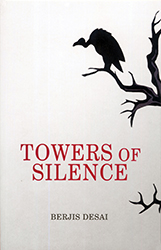
Towers of Slience by Berjis Desai. Published in 2021 by Zero Degree Publishing, No.55(7), Second Floor, R Block, 6th Avenue, Anna Nagar, Madras, 600040. Pp: 407. Price: Rs 400.
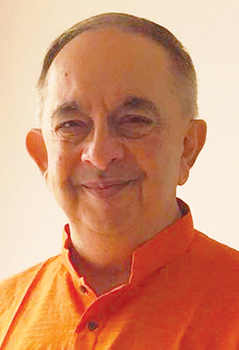
If the reader thinks that Berjis Desai’s (pictured) Towers of Silence, as the title suggests, will be full of doom and gloom, he/she is mistaken. As we witnessed in his earlier books Oh! Those Parsis — A to Z of the Parsi Way of Life and The Bawaji: Chronicles of a Vanishing Community, Desai is very perceptive about describing the nature and the idiosyncrasies of the Parsi community. The author’s debut novel is full of interesting characters who have been fleshed out and given a life of their own. It chronicles the lives of the Bhamgara family members for several generations and the reader would be quite lost without the family tree which Desai provides at the beginning of the novel.
 That Desai’s powers of observation are very acute, one notices in the very first paragraph of the novel with his careful and observant description of the mourners who accompany the corpse of Rusi Bhamgara at the Towers of Silence: they walk in pairs "limply holding a white handkerchief.” The corpse bearers are dressed in "yellowing white cottons” and the priests are in their "starched white gowns and conical white caps.” Rusi’s landlady had ill-fitting dentures which "caused her to have suffocating bad breath as if a pigeon had died and got entrapped in the outer cover of an air-con.”
Soon after Rusi’s funeral we move backward in time to when he is a young man living in Bombay as a paying guest in Cusrow Baug. We meet him as he is on his way to meet his spiritual Baba. During the journey, Rusi thinks about his mumma who, incidentally, is never named. Desai uses this opportunity to take us back to the 1890s when mumma’s father, Rustom, leaves for Singapore. At this point, Desai skilfully weaves the story of Rustom (who dies of the plague), mumma’s childhood and introduces us to members of her family. Subsequently, for a paragraph, we are once again in the present with the visit to Baba after which Desai plunges us back into the past to Rusi’s arrival in Bombay and his search for a job. This is all very confusing. It would have been great had Desai used these flashbacks more judiciously. However, we are constantly thrown backward and forward in time and it is quite possible to lose our focus as the story oscillates between past and present.
Whereas Desai’s strength lies in the sleight of hand with which he can portray a character in a few deft strokes, he describes relatively minor ones and those who do not have a critical role in the story at great length. As a result, the book becomes unwieldy and the reader is assailed by a host of characters, many of whom it is difficult to keep track of. Though Baba has a fairly major role in the novel, is it really necessary to know his entire life story in great detail?
Frequently there are long digressions in the novel which, interesting and educational though they are, result in distracting the reader from the plot of the novel. At the very beginning, we are subjected to a long account of the Parsi system of disposal of the dead at Doongerwadi. This elaborate description — from the bathing of the corpse, the tying of the kusti, the arrival of the mourners, the funeral ceremony, till the ultimate journey to the Towers of Silence — would be familiar to Parsis readers. Is such great detail of interest to non-Parsis or would they find it unnecessarily long-drawn? Once again, there is a fairly elaborate description of the magical properties of the nirang and the description of the varasyaji. The reader gets the impression that Desai has forgotten he is writing a novel and not a tract on the rites and rituals of the Parsis. It is true that Desai enlivens this austere account with moments of humor: when the "bored” dog is brought to see the face of the deceased for the last time, it has to be dragged away before he "could lift its hind legs.”
The novel is infiltrated by ghosts and supernatural beings. Though these add to the atmosphere of the novel, they seem to be a bit of an indulgence.
 Mumma’s father, Pappa, has the strange gift of curing scorpion bites with a prayer which had been given to him by a Muslim priest. Fali Panthaky, the managing priest of Bombay’s oldest fire temple, spoke about "his fire temple’s guardian angel, a very tall, bearded handsome figure in white…who tended to the holy fire in the night.” A medium, Tehmul, was able to identify the exact spot where the body of the young lawyer who was a mountaineer and had fallen into a crevice in the Himalayas could be found. The bathroom on the first floor of the Sentinel office is not used as the ghost of Mrs Rodrigues, the telephone operator, haunts it. Black magic is used when there is a tussle for the editorship of the daily Sentinel. Automatic writing and planchette are commonplace.
Desai shows that he can write with great tenderness when the situation demands. The relationship between Burjor and Sangeeta, his non-Parsi wife, is convincingly portrayed with the right touch of romance and emotional depth ensuring that it never descends into melodrama even when tragic events occur. He adds a lovely touch when both mumma, as well as his own mother shower affection on Sangeeta. Even though they may be from a relatively traditional city like Navsari they wholeheartedly and lovingly welcome her into the family.
The title of the novel refers to a land-grab situation at the Towers of Silence. There is a secret road behind an unused dakhma which could only be opened by a locket and a certain prayer known solely to Danesh, the supervisor of the nassessalars. This road emerges in the backyard of an immense bungalow. When Danesh died, the locket would be passed on to Burjor, Rusi’s son. However, an evil nassessalar, Noshir, substitutes it with a fake locket which he sends to Burjor. Noshir is in league with a powerful Parsi Punchayet trustee, Tehmton, and an evil real estate developer, Ramesh Lakhani, who is interested in acquiring a part of the Doongerwadi land which was connected to Danesh’s secret pathway. In the last quarter of the book, Desai shows his skills as a lawyer and takes us through a mire of deception, lies and forged documents during multiple appearances in court. Once again, this seems to be a separate event and an add-on and does not flow naturally as part of or as a result of the plot.
The incident at the Towers of Silence, the practices and the history of the Parsis, the elements of the supernatural may all be of interest in themselves, but one wonders what part they really play in the story. With so many different characters and themes, one gets the impression that Desai is getting lost in his own story.
The novel is extremely well written; Desai has an easy style and a wonderful sense of humor which make it very readable. The novel is replete with Parsi Gujarati words — often swear words — and customs. The readability for the non-Parsi would have certainly improved if the glossary could have been avoided and the meanings of the words included in the text itself. Once again if only he had left out several minor characters which weigh the book down, as well as Parsi customs, history and rituals, the book would have been a delight to read. As a first time novelist it would have been best if Desai had limited the canvas. I’m sure his next novel will be a success if he is less ambitious and concentrates on the depiction of his characters, in which his strength lies. FIRDAUS GANDAVIA
Gandavia holds a doctorate in English literature and is a retired chartered accountant. He is a compulsive reader of fiction.