Born Cawas Khatow, tenor saxophonist Rudy Cotton and his Swing Band popularized jazz music in India
Parinaz Gandhi
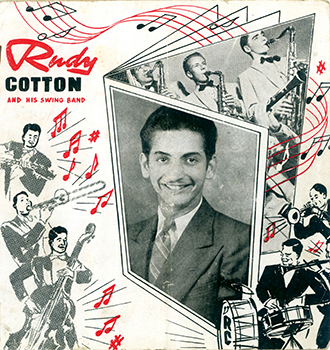
Everybody knows Rudy!” announced the 1946 quarterly brochure of Piccadilly, "your rendezvous where you can listen to sweet music at tea time, cocktail hour or 8.30… As a maestro he’s a leader! This season Rudy Cotton and his Swing Band are going to give you works if you know what we mean.” While band leader, composer, arranger and saxophonist Rudy Cotton was a popular jazz musician in the middle of the last century, today even in the Parsi community few may have heard of him or be aware that born Cawas Khatow, he was the eldest of Jehangir and Roshanbanoo’s seven sons.
The prominent RC monogram on the music podiums proclaimed Cotton’s presence on stage. Tall and exuberant, his fans found him enigmatic. Reputed to be one of the most disciplined artistes, he would always arrive on time for his performance. Immaculately dressed, he expected his fellow musicians to be well turned out too.
When speaking from community platforms, the former attorney general of India, Soli Sorabjee who was the president of the Delhi chapter of Jazz India would often reiterate that the late Cotton should be included in the list of distinguished Parsis because his "improvisations and legendary solos on his tenor-sax could rank with the best in the world.” According to Sorabjee who was quoted in The Asian Age, Cotton’s band "spiced up and enlivened ballrooms” whether it was at the Taj in Bombay or at Mussoorie’s Hakman’s Hotel during World War II. He earned a living by playing in jam sessions mainly in hotels till his death in 1985. "In one of the jam sessions at the restaurant Laguna in Delhi, when the musicians played Undecided, Rudy took a succession of choruses which lasted for 40 minutes,” added Sorabjee. Regretting that there was no recording of such great jazz moments, he added that "Rudy had a natural talent for busking (playing music in public places for voluntary donations).”
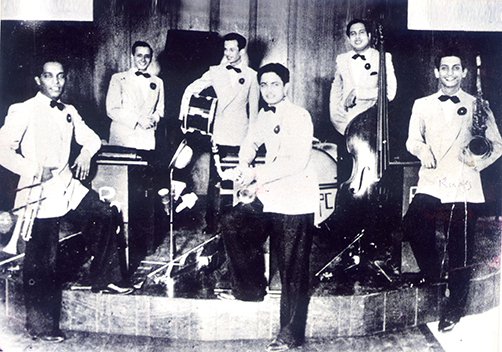
(Top) Brochure published by Piccadilly; (Above) Rudy Cotton (far r) and his band
Above (from l) Frank Fernand, Cotton and Chic Chocolate Photo: Taj Mahal Foxtrot
Clockwise from above: Nergish Khatow (center) with band members;
Percy Khatow; Zena Khatow with Indira Gandhi
Cawas Khatow’s grave at the Delhi Parsi aramgah Photos: Ervad Cawas Bagli
Having attended a couple of his concerts, nephew Khushroo Khatow remembered his father’s elder brother in the company of the world’s best jazz musicians and his favorite expression, "By Jove,” that sounded alien to his family. Khushroo shared with Parsiana some of the news clippings, memorabilia and images of Cotton during his heydays, including one announcement of his uncle’s performance at the Taj Hotel in Bombay on April 10, 1953 where a ticket was priced at five rupees and four annas: "Blue Rhythm presents Rudy Cotton (specially flown in from Calcutta) with top all-star accompaniment” noted the poster prominently printed in red by Vakil and Sons Limited. A report of the event carried in the Blue Rhythm magazine was titled "Rudy Cotton Charges Bombay Musicians with a High Voltage Jazz Current.” The write-up added, "The happiness on the stand was radiated to the audience and they were enjoying the music as much as the musicians themselves.” A hazy photo of Cotton and his Swing Band playing at the Taj also featured in a specially created Christmas and New Year card from the RC banner.
Rather than complete his studies from the Master Tutorial School, Cawas opted to take his first lessons in music from Behram Irani. At 15 years of age, he started his musical career playing the trumpet with the touring theater companies like Alfred with which his Khatow family was associated. Once he decided that the tenor saxophone suited him better, his first major assignment was with Tony Nunes’s band as a sideman. In 1935 he played in Vincent Cummine’s band in Poona and accompanied the same band which included trumpeter Chic Chocolate to Rangoon.
By 1939 Cotton had formed his own band that included Ken Cummine on the violin, Johny Baptist on the saxophone, Frank Fernand on the second trumpet, Sollo Jacobs on the piano, Fernando (Bimbo) D’Costa on the bass and Leslie Weeks on the drums. "Bookings poured in from the Taj, the Majestic and the Ritz, among other establishments... Each summer, the band traveled to Mussoorie...(where) Cotton’s performances at the Savoy were among the main attractions of the season,” noted Naresh Fernandes in his book Taj Mahal Foxtrot: The Story of Bombay’s Jazz Age. The book further quoted critic Ali Rajabally, "Cotton was astounding. He had an extraordinary tone, impeccable taste in choosing phrases, flaming imagination and a technique that few could equal.” In addition to regaling audiences in different cities of India, over the next three decades he took his band to Lahore, Ceylon, Bangkok, Nepal. Failing health compelled him to slow down. In the last years of his life that he spent in Delhi he played as a sideman in Mosin Menezes’s band.
Seven years before his demise Cotton was given the honor of starting the program at the first Jazz Yatra organized at Bombay’s Rang Bhavan on February 12, 1978 when he had blown the first note of his composition which was an adaptation of the Hindustani classical Sohni Raag, at one time a signature tune of All India Radio. This festival of Indo-Afro-American music organized by Jazz India in collaboration with Air India and other patrons was reportedly the only jazz festival in the world where the participating foreign artists from Denmark, Germany, Poland, Great Britain, Sweden, and Japan performed gratis, according to a report in Magic Carpet, the Air India periodical.
Two decades after his passing away, the Rudy Cotton Memorial Concert as a tribute to the tenor saxophonist was organized by Jazz India’s Delhi chapter in 2005. The Concert that included performances by Braz Gonsalves, Menezes and Sorabjee himself was meant "to keep the memory of a great musician alive as he did not get the recognition he deserved when he was alive,” as reported on zeenews.india.com.
On his demise at 67 years of age, Sorabjee arranged for his prayers and burial at the Parsi aramgah in Delhi. According to Delhi head priest Ervad Cawas Bagli, Cotton’s was the second funeral he had performed in Delhi. Diogo Rodrigues’s eulogy described Cotton as "an ace Indian jazzman and one of the most successful band leaders during the British Raj and post Independence era… His fame spread far and wide not only in the country but even in Europe without his ever performing (there). This was mainly due to British army regiments and civilians stationed here before Independence who heard his music and carried sweet memories with them…”
The famed saxophonist shared his first name with his grandfather Kavasji Pallonji Khatow, the popular thespian who was linked to the Alfred Theatre of yore. His grandmother Mary Fenton of Irish descent had become a familiar face on the Urdu/Hindi/Gujarati stage with her felicity for Indian languages and was popularly addressed as Mehrbai after her marriage to Kavasji. The couple had a son Jehangir who too was engaged with theater. Besides Cawas, Jehangir’s other sons were Jal, Kekoo, Phiroze, Percy, Sammy and Noshir. Jal, a cameraman adept with the 35 mm shoots, was known to train assistants who garnered fame for working on films like Mother India and Sholay. Percy and Sammy earned recognition as national level boxers (their accomplishments will be featured in a future issue of Parsiana). The youngest Noshir was an actor.
While Cawas Jehangir Khatow was married to Nergish Balaporia, his brother Jal had married Nergish’s sister Freny. Cawas and Nergish had two children, the first born Zena was an airhostess with Indian Airlines and frequently accompanied then Prime Minister Indira Gandhi on her official travels, and son Percy who suffered from cerebral palsy. Both the children had relocated to the UK before their demise.
Like those in India who cultivated a taste for jazz music after hearing Cotton play, Sorabjee’s son Hormazd, publisher and editor of Autocar India, has fond memories of accompanying his father to the Tavern, at the then Oberoi Imperial Hotel in Delhi, and later to Hotel Mansingh. Able to strike a rapport with fans of all ages, the musician cum raconteur could banter easily. Hormazd enjoyed listening to Cotton’s "lame jokes, what we Parsis would call koila jokes. One of his favorites was ‘God asked Moses to come forth but he came fifth and lost the race.’ Unassuming, content and very happy in his space,” the absence of wealth did not bother him nor his failing health on account of his excessive smoking. His demeanor showed "no apologies, no qualms,” observed Hormazd. He remembered his mother Zena once asking Cotton what kind of a life he would have liked, given another chance, and his nonchalant response, "I would live it exactly the same way.”