The Global Working Group will formulate guidelines to assist
the hosts of future congresses
Parinaz M. Gandhi
The youth of today are talking a different language (which) most people in this room don’t understand. Theirs is the make or break generation that may go with everyone or go on their own. Change will happen. We have to be cognizant,” stated Arzan Wadia, vice president of the Federation of Zoroastrian Associations of North America (FEZANA), coordinator for the annual Return to Roots (RTR) program and program chair for the Seventh World Zoroastrian Youth Congress (WZYC). Wadia was alerting the senior members attending the Global Working Group (GWG) meeting at the Banaji Atash Behram Annexe Hall on January 7, 2020 to recent developments based on his regular interactions with the youth.
The Youth Congress in Los Angeles last July saw participation from 400 attendees, including from areas like Kenya and United Arab Emirates (see "We cannot stand still,” Parsiana, August 21-September 6, 2019). The meet "had many firsts,” stated Wadia: Of the 64 speakers, the majority, 36, were women. The sessions were completely live streamed. Two earthquakes were experienced during the California Congress. An entire day was set aside for events planned by the World Zarathushti Chamber of Commerce (WZCC) Youth Wing. An experiential session was created when the lights were switched off and the auditorium was filled with the fragrance of incense while an image of a burning flame was flashed on the screen. The question-answer session on Skype with Dastur Khurshed Dastoor of Udvada resulted in many youngsters expressing an eagerness to visit the Iranshah.
Wadia conveyed the views of the Congress chair Parshan Khosravi: The Congress guidelines are outdated and insufficient. An age limit for the speakers may not be the best; a ban on alcohol may not be practical when the youth find alternate ways to consume liquor; of the 455 registered for the Congress, 55 from Iran could not attend as they were denied a visa; the Youth Congress should not avoid hard topics because of the prevailing politics as the youth are looking for free and candid discussions; since traditionalists threatened to boycott the Congress as a woman mobedyar and a converted Zoroastrian were invited as speakers, attempts at intimidation and reining in of free discussion should be countered.
"The youth are open to other opinions and don’t come with the same baggage,” pointed out Wadia. The youth, especially the co-chairs of the Congress, need a seat at the table. The two co-chairs of the 2023 Eighth WZYC in London could be sponsored by the Zoroastrian Trust Funds of Europe (ZTFE) to attend global community events, suggested Wadia.
With rising costs, money is always a problem for the organizers as well as those seeking to attend. Fortunately sponsorships from Hong Kong and FEZANA, with donations from 150 individuals helped the Congress make a profit. The surplus generated from the preceding Youth Congress in New Zealand (NZ) was used by the NZ team to sponsor their youth attending the Los Angeles meet.
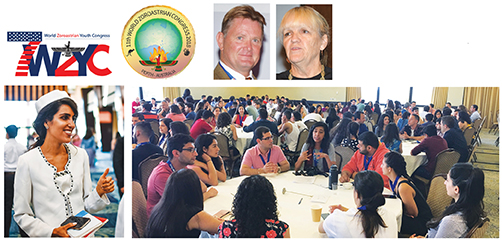
Clockwise from top l: logos of the Congresses; David Adams and Alison Betts at the 11th World Zoroastrian Congress
in Perth Photos: Jasmine D. Driver; interaction among youth Photo: Parenda Foroghiand Mobedyar Mahshad Khosraviani
at the Seventh World Zoroastrian Youth Congress in California Photo: Ana Verahrami
From l, top row: Arzan Wadia, Firoz Pestonji, Viaf Mehta, Dorab Mistry, Rusi Dalal;
2nd row: Dr Behram Pastakia, Homi Gandhi; Farrokh Mistree, Farrokh Rustomji,
Kersy Bhesania Photos: Jasmine D. Driver
When Bombay Parsi Punchayet (BPP) trustee Viraf Mehta enquired whether the costs could be brought down for Indians desirous of attending the next Youth Congress in London, Dorab Mistry, erstwhile ZTFE president responded, "Maybe the BPP can subsidize the air cost.” Jested Yazdi Tantra, WZCC vice president, "I have an answer. Ask Tamboly [Dinshaw Tamboly is chair of the WZO (World Zoroastrian Organisation) Trust Fund that supports many community welfare and cultural activities].” ZTFE trustee Rusi Dalal shared their experience of hosting the 1997 Youth Congress where "nearly 100 families in London hosted youngsters in their own homes. Some unions came out of that. We can replicate that effort.”
Chair of the 11th World Zoroastrian Congress (WZC) held in Perth, Australia in 2018, Firoz Pestonji corroborated the views of the Youth Congress chair stating proper guidelines need to be formulated. "The guidelines are only for the Youth Congress, ratified by the GWG a decade ago,” Wadia informed Pestonji. "We need to decide and rewrite the guidelines,” stated Meher Bhesania of Dubai.
Since most of the 11 WZC co-organizers had no prior experience of hosting or even attending a Zoroastrian congress, planning for this meet was a challenge, noted Pestonji, adding, "In a way they were able to come up with new ideas because they had no preconceived notions.” He further remarked that they are working on a final draft for the proposed Federation of Australian Zoroastrian Associations. "We hope to legally formalize. We do not want to rush into anything… We communicate every 15/20 days.”
The surplus money from the 11WZC will be used for their new Federation or youth activities. Raising funds was a challenge and if sponsorship had not come from Hong Kong, "I would have been bankrupt,” disclosed Pestonji. Not a single speaker was sponsored by the organizers. For the 11WZC, 48 delegates could not come from Iran. "I was told that a letter from Yaz Mubarakai, the Zoroastrian Member of the Legislative Assembly of Western Australia, would have helped the Iranian delegation.”
Dr Behram Pastakia, chair of FEZANA’s Information Receiving and Coordinating (Publications) committee, referred to the 11WZC session that saw participation from Alison Betts, an archeologist from the Sydney University studying Zoroastrian sites, and David Adams, a photojournalist from Australia, that resulted in "a lot of interest in central Asia.” For a prevailing research study in Russian on this subject, they are hoping to find a translator. FEZANA president Homi Gandhi referred to his trip to Uzbekistan when he was taken around by Betts and realized that she and her team members had to commute 20 km each day to reach the ancient sites. When he asked them why they did it, he was told, "We want to give back to the Zoroastrian community.”
The heritage of the Zoroastrian community, especially the excavation findings on the southeastern part of Uzbekistan that proved there was a fire temple in the region, will be on view at the Hermitage Museum in St Petersburg. Kersi Shroff who is the FEZANA co-chair for research and preservation is very interested in this study. "If anyone is interested in going on these trips, please let us know,” stated Gandhi. Pestonji mentioned that tours to Georgia and Azerbaijan are now commonly advertised.
Lauding the support the RTR program gets from different Zoroastrian associations, Wadia mentioned that the next trip has been planned for March 2020 for which youth from the diaspora in the 22 to 35 age group interested in learning about their roots in India are welcome to get in touch with the organizers. He noted that the RTR coordinates with the WZCC Youth Wing, Xtremely Young Zoroastrians and the reconstituted Zoroastrian Youth for the Next Generation.
The Zoroastrian Faculty Network (ZFN) program is reaching out to senior academics "who have a heart and can provide a nurturing environment… those who are interested in giving back to the community” by nurturing students interested in higher studies overseas, stated Prof Farrokh Mistree from the University of Oklahoma. "My own models are Dr Cyrus Poonawalla, Edul Daver, Dinshaw Tamboly, Rohinton and Roshan Rivetna,” stated Mistree. This year ZFN has been able to identify one student who would benefit from such mentoring and next year they hope to bring together four students and motivated faculty members. ZFN core team member Farrokh Rustomji urged more students to log onto their website (
http://zoroastrianfacultynetwork.org) that will give updates on education/finance/internship and other opportunities available. Gandhi enquired whether ZFN could help students from the US seeking internship opportunities in India. "Yes, why not?” responded Rustomji who advocated the need for a month long youth exchange program to be initiated, along the lines of similar programs conducted by organizations like the Rotary and Lions, "to widen the horizon of the youth.”
Kersy Bhesania of Dubai remarked that programs should be organized to draw community youth to the Indian Administrative Service, Indian Foreign Service or the armed forces. Rustomji explained that such efforts had been made since the time of Lt Gen Adi Sethna (retd), erstwhile president of the Delhi Parsi Anjuman (and Rustom Anklesaria, a former Indian Administrative Service officer and chief executive officer of the BPP — editors). Currently the BPP sponsored Holiday Programme for Youth (HPY) for students who have completed their schooling includes a session addressed by Cmde Medioma Bhada (retd) or Cmde Aspi Marker (retd) but they have "not been able to make much headway” in enticing youngsters to the armed forces. It has only resulted in a few enquiries regarding beneficial coaching classes. To be concluded