Mumbaino Bahar by Ratanji Farami Vatcha. Translated by Homi D. Patel. Edited by Dr Zenobia Dumasia, Aban Mukherji and Rashna Poncha. Published in 2024 by The K. R. Cama Oriental Institute, 136, Bombay Samachar Marg, Bombay 400023; website: www.krcame.org; email: krcamaoi123@gmail.com/the krcamaoi@gmail.com. Pp: xxviii+618. Price: Rs 5,000.
Did you know that the first Parsi known to have settled in Bombay in 1640 was Dorabji Nanabhai? He came from a poor Parsi family of Mora Sumari in Surat district, and did very well in the administrative affairs of the then ruling Portuguese. This nugget from Mumbaino Bahaar shows how meticulously and scrupulously the events occurring in Bombay were compiled by Ratanji Faramji Vatcha. In his own words, the book is "a description of the history of this island, its inhabitance by people of various communities, life sketches of many benevolent personages. And other memorable incidents.”
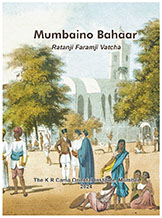
The original work, in archaic Gujarati language, was printed in 1874 by Union Press, then owned by Nanabhai Rustomji Ranina. It was first translated with some difficulty by Homi D. Patel, and further refined by others, including the late Farrokh Jijina, an independent researcher and erstwhile senior editor of Parsiana. This 646-page, 4.5 cm-thick book was finally edited by Zenobia Dumasia, Aban Mukherji and Rashna Poncha. It was published in 2024 by The K. R. Cama Oriental Institute, and is dedicated to Banoo N. Cama and Muncherji N. M. Cama who very generously funded its publication.
A distinctive feature of the original book was the verses that enhanced the prose in many chapters, to "create a garden of words.” These have been translated into English by Mukherji and retained in the current book. The first part of the book begins with a reference to the Greek philosopher Ptolemy who in 171 AD had stated that Bombay consisted of seven different islands, which are today known as Colaba, Walkeshwar, Worli, Mahim, Sewree, Mazgaon and Pydhonie-Fort. Right up to 1837, during high tides, Colaba could be reached only by sea.
In 1530, when a local chieftain of Thana gave Bombay away to the Portuguese (who had already conquered and possessed Goa), it had a population of barely 5,000, and yielded a revenue to the government of a meager Rs 700. An interesting triviality is that before the Portuguese took over what was then Mumbai, tailoring as a profession was unknown. The first tailor of Bombay was Atmaram Balaji of the Shimpi community from the South.
In 1661, Portugal bequeathed Bombay to the British crown by way of dowry, when their monarch’s sister, Infanta Catherine, married Charles II of England. The author recounts how Bombay’s governance was mismanaged by the British, leading to the invasion on February 22, 1689 by the Siddis of Janjira led by their chieftain, Yakub Khan. This was followed by the Great Plague in 1690, after which the British appointed Rustom Dorabji (son of the first settler) as governor and army general. With almost all British soldiers dead, Dorabji raised and trained an army of local Kolis who in 1692 successfully repulsed a second — and last — raid by the Siddis. Dorabji was bestowed title of Patel and continued to assist the British with his Koli supporters.
The first mention of a Parsi dakhma was by a traveler, Dr John Fryer who reported in a book in 1698 that "on top of the hills of Babulnath, a single dakhma of the Parsis was seen.” At that time, the entire population of Bombay numbered 60,000.
In 1735, the make-shift docks made by the Portuguese were reconstructed to build battleships and commercial vessels. For this, skilled workers from the Wadia family were called from Surat. Led by Lowjee Nusserwanjee Wadia, they soon established themselves as the pioneers of shipbuilding in India. Their work was so good that the administration soon withdrew the British supervisors initially appointed to oversee their performance. Wadia’s descendants continued with the trade until 1881.
The authentic information in the book includes complete chapters on individuals of various communities, and also gives the family trees of over 65 prominent Parsi families. The Index created by the editors adds convenience of reference.
To conclude the review of the book, this reviewer finds it pertinent to quote the first lines of its opening chapter: "It is an undisputed fact, universally accepted, that people of all castes — coming over from everywhere — have inhabited this prosperous city.” PHIROZE B. JAVERI
An architect by profession, Javeri is also president of the Indian National Kennel Club and an avid collector of books, pens and watches.