A Parsi name and reference were sufficient
criteria for railway recruitment in the early 20th century
Parinaz Gandhi
From the vanguard they moved ahead. For a toehold on the trains they changed their name and destination. Over a hundred years ago, to be recruited by the British for a job in the railways was considered prestigious, as attested Parsi sexagenarians/septuagenarians/octogenarians and nonagenarians who deemed themselves members of the "railway family.” They had witnessed their fathers/grandfathers flash their bronze/silver/gold cards that entitled them to privileges. There have been several instances of two generations from the same family or siblings being recruited by the British for railway service on the recommendation of a senior. Parsiana will feature those who served on the senior echelons of the Indian Railways over two instalments. The current issue focuses on those who served in the administrative sector and the next issue will include those who made a mark in the engineering sector. Three decades ago we had covered the engine drivers (see "Romance with the railways,” Parsiana, December 1990).
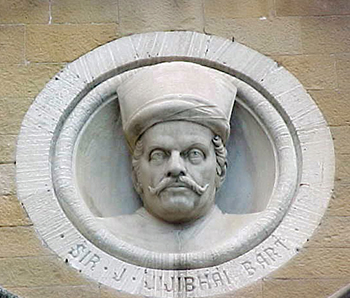
Architectural medallion of Sir Jamsetjee Jejeebhoy, second baronet
at the heritage building at Bombay’s Victoria Terminus
The community takes pride that one of the 10 architectural medallions at Bombay’s Victoria Terminus (VT) features Sir Jamsetjee Jejeebhoy, second baronet, who was among the first directors of Great Indian Peninsula Railway (now Central Railway) Company that was set up in 1849. According to one of the rail legends, he had booked an entire train once for family and friends.
Four of Jehangir Jhaveri’s eight sons joined the BB&CI (Bombay, Baroda and Central India) Railway (now Western Railway) like their father who was possibly the first Parsi station superintendent based in Ahmedabad. They came to be known as the Junior Jehangirs and forsook their original surname Jhaveri in favor of Jehangir, recalled Dr Rumi Jehangir whose father Pesi and uncle Rusi started as guards and rose to be senior commercial officers. The eldest brother Cawas had a brief stint in the railways before he contracted tuberculosis of the spine that required him to lie flat in a plaster cast for two years at the J. J. Hospital. His job was assigned to his brother Dara who eventually became the chief commercial superintendent (akin to a deputy general manager). Cawas though "never lost his love of the railways. Till late in life, he would visit the station daily to say ‘hello’ to passengers traveling by the Gujarat Mail and had made many friends in the process,” stated Rumi.
Also in the BB&CI Railway was Dhunjishah Sethna who was better known as Dhunjishah Master having risen from a station master to general manager of Bilimora. His two sons Meherji and Darashah, and Meherji’s son-in-law Nozar Satarawala had excelled in the railways too. Meherji, who became the district traffic superintendent at Abu Road, Ratlam, Bulsar and Ahmedabad "earned the title of ‘most efficient district manager in the whole British Empire,’ for which he was given a Winston Churchill statue,” recalled his granddaughter Dr Shernaz Cama. He went on to join the Railway Board, the highest decision making body in the Indian Railways. Darashah had served as chief operating officer, Central Railway, from 1958 to 1961.
In the North Western Railway two outstanding divisional engineers were Meherwan Irani, and his younger brother Rustom who was educated in England. "These young engineers had the responsibility of ensuring the safety of operation and improvements… of awe-inspiring wonders, many of them the first of their kind in the world,” wrote Rusi Sorabji who remembered his father Ruttonshaw, then a guard, regaling the family with tales of these engineering marvels like the suspension bridge at Sukkur, the Khojak tunnel, the Kalka Simla rail track that reached beyond 7,000 feet with its 103 tunnels, the Khyber and Bolan Pass railway lines… and of the brothers whom he hero worshipped. Ruttonshaw had two elder brothers, Ardeshir and Dossabhoy Batiwalla, who had also joined the Railways.
Starting as assistant engineer with the North Western Railway in Bhatinda in 1942, Pesi Mehta ended his 32-year career with the Indian Railways as chief engineer (survey and construction) with the Western Railway in Bombay. The most eventful period of his career was the three years he spent on the Kalka-Simla section when a tunnel collapse had kept him rooted to one spot for several days.
In the East India Railway that covered the Gangetic region from Calcutta to Agra, a prominent figure was Jal Muncherjee who in the mid 1920s was selected for the newly established mechanical engineering sector. He was posted in six different divisions, served as director on the Railway Board and eventually retired in 1967 as general manager, Western Railway, reported his son Dinshaw.
Two other brothers who had served on the higher echelons of the Railways were Dr Rusi Vevaina who was chief medical officer with Central Railway and his brother Dinshaw who retired as senior deputy general manager.
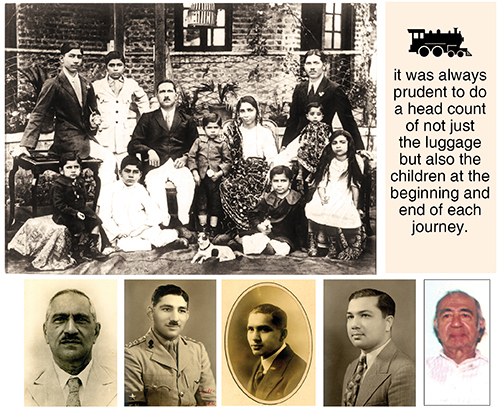
Top: Gulbai and Jehangir Jhaveri (seated, center) with their nine children (standing, from l): Eruch, Cawas,
Dara; (sitting, from l) Pesi, Minoo, Noshir, Pheroz, Rusi, Naju; 2nd row (from l): Jehangir, Dara, Cawas, Pesi, Rusi
Jhaveri ‘jewels’
As soon as the gongs announced the arrival of a train, Jehangir Jhaveri’s wife Gulbai had trained her naughty children to rush to a petara — huge wooden trunk where grain for the whole year was stored — to which they would be handcuffed until the train had departed. Terrified that one of her 10 children whom she considered her real jhaverat — jewels — would be run over by a passing train, she had devised this ingenious strategy to keep them out of harm’s way!
She had also learnt that it was always prudent to do a head count of not just the luggage but also the children at the beginning and end of each journey. In those days passengers traveled with huge and heavy metal trunks and beddings for overnight journeys and some finicky Parsis even carried their own buckets and personal commodes. The bogeys were kept cool by laadis (slabs of ice) kept in metal tubs in the middle of the compartment. This also served to keep sweet drinks cold.
When her son Pesi started his career as a guard in a goods train that only provided an open cabin at the rear end, the halting of a train in the jungles at night was a harrowing experience. In the dark, eerie stillness he would ward off inquisitive, wild animals by flashing a lantern or frantically waving his green and red flags.
Sethna snippets
As railway controller, Meherji Sethna was one of the first Indian Railway officers, a rare distinction in the 1920s. When he became the district traffic superintendent (head of the western section), it fell to his lot to supervise the Gandhi Special at Abu Road. His wife Dollmai was given the honor of inaugurating the Flying Ranee, then the fastest BB&CI train from Bombay to Surat in 1937. On June 6, 1942, Meherji was conferred the Khan Bahadur title with a gold medal and sanad (deed) at the annual Kings Honours. It was presented in Ahmedabad by the governor of Bombay State.
In 1948 he was appointed director on the Railway Board. Post retirement, he was re-employed from 1948 to 1951 as chief controller railway priorities and also had an office at VT as chief operating officer, Western Railway.
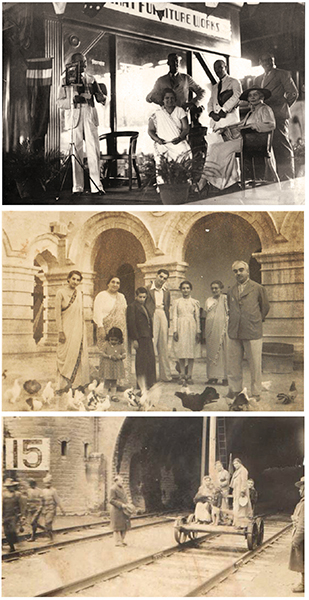
Dollmai Sethna (seated l) at the inauguration of the Flying Ranee; members of the Batiwalla
and Irani families at Sukkur; Parsi ladies and guests on the hand-pushed inspection trolley at Khojak tunnel
Stationed in Delhi
On completion of his schooling in Karachi at the age of 17, Ruttonshaw Batiwalla applied for a job in the Railways in 1915. Though underage, he was offered the position of a guard if he used his father’s name Sorabji as his surname. Since Ruttonshaw’s elder brothers Ardeshir and Dossabhoy had also sought jobs with the Railways, the recruiting officer was not willing to employ three Batiwallas. Being orphaned by the Bombay plague of 1896, the brothers were willing to accept the terms of the recruiting officer. Thus Ruttonshaw and Dossabhoy were appointed guards in Karachi with the North Western Railway and Ardeshir was posted to a desk job with the BB&CI in Bombay at the imposing Victorian building at Churchgate.
Ruttonshaw was occasionally given duties from Quetta, Sukkur, Jacobabad and Peshawar. When the Irani brothers supervised the construction and maintenance of the Railway engineering projects, with his Kodak camera Ruttonshaw would take photographs from his guard post at the rear end.
After 10 years as a guard, Ruttonshaw was promoted as assistant station master and transferred to Delhi Main Station. In 1928 he was appointed the first non-European station master of Delhi Main and assigned a large bungalow, west of the Dufferin Bridge. The Delhi Main Station had two railway retiring rooms on the first floor in front of the station, one on the right for first class ticket holders and Europeans, the one on the left for second/inter class. When important European personalities were expected to use the first class retiring rooms, the station master had to pre-inspect the facilities. On one occasion, while coming down the large mahogany and brass passenger elevator that served the first class passengers, Ruttonshaw saw some suspicious bundle in the corner of the lift and kicking it towards the front, instructed the operator to get rid of it before stepping out of the elevator. It was apparently a bomb targeting some dignitary for, a few seconds later, a big bang in the elevator killed the operator. During his tenure there were also two other bomb blasts in the cargo lifts connecting platforms under the tracks’ tunnels.
When visiting Parsi businessmen, traders, engineers and other professionals and candidates for job interviews could not be accommodated at the Railway Retiring Rooms in Delhi, they would be invited as guests to the station master’s residence where they were offered a hot Parsi meal and a comfortable bed.
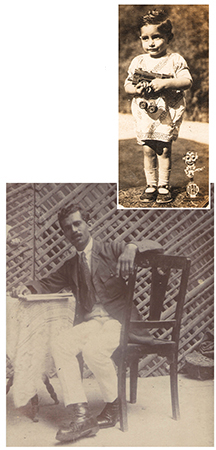
Ruttonshaw Sorabji as assistant station master
in 1925; Rusi Sorabji with his toy engine (inset)
Clock supplied by Cursetjee Cowasjee
For the on-time running of the trains, proper coordination and timely operations by the staff and convenience of the passengers, accurate watches and clocks were crucial for the Railways. At the Delhi Junction Broad Gauge Station in 1925, spaced out along the length of the three platforms, overhanging from the roof were circular, large-dialed electric clocks bearing the name Cursetjee Cowasjee with Bombay written below that and Sussex in the lower half of the dial. It appears that Cursetjee Cowasjee were the suppliers/contractors to the Railways for their timepieces at the ticket offices, waiting rooms, dining rooms, etc. The Sorabji family retains one nearly 100-year-old model of a circular, seven-day spring wound clock, about 24 inches in diameter. There are two keyholes on the face of the dials, one for the winding of the hours and the other for the chimes. Even the Westend branded silver or stainless steel pocket watches that the Railway staff like station masters, guards, engine drivers, ticket collectors were provided with had the Cursetjee Cowasjee name etched on the backside of the watch. Ruttonshaw had a silver and gold one with long chains.
In the 1930s when New Delhi was being built, the Railways had already constructed a row of 10 red brick bungalows and other facilities on the half mile long Chelmsford Road. Of these, three were occupied by Parsis. Residing there were the Batiwallas, Kapadias and Bankwallas. The first bungalow was occupied by the Batiwalla family, the head of the family being a comptroller with the North Western Railway. Eruch Kapadia was a senior in the comptroller’s office who after Independence opted for Pakistan. Within a few weeks of his posting in Rawalpindi, he, his wife, servant and German Shepherd dog were murdered.
Edul Bankwalla was a superintendent station master in the 1930s, rose to the rank of divisional superintendent before being transferred to Lahore in Pakistan at the time of Independence. During his tenure at the New Delhi station he initiated extensive expansions and introduced amenities, adding the Viceroy’s Platform at the southern end of the station that was later referred to as the Ceremonial Platform. Their family was more English than the Brits. Not only was the food from an upper class English cookery book but the multiplicity of glasses, shining silverware and nine plus cutlery surrounding the three sides of the dining plate always left novices baffled.
Another Parsi posted to Delhi was Dhanjishaw Mavalwala who served as deputy station superintendent and was in charge of VIP and troop movements.
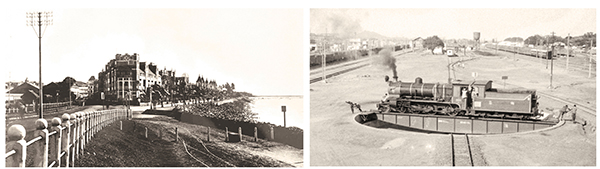
Above (l): Imperial Mansion at Cuffe Parade; (r) turntable to reverse the engine
North Western Railway steam engine, 1920
Above l: Baluchi family awaiting train to collect water and mail;
r: in Jacobabad, big earthen vessel to cool water
Rail reverie
Initially trains ran on coal engines, later diesel and thereafter electricity. The coal engines had two firemen who shoveled huge amounts of coal into the furnace. At small stations, locals would approach the obliging engine driver and request him for some boiling water which they could use for their baths. The firemen often suffered from early cataracts because of constant exposure to heat. To avoid foreign bodies getting into the eye, experienced passengers would always opt for seats backing the engine.
The railway officers on duty traveled with or without their families in a saloon which had a living room, bedroom, kitchenette and balcony that offered a fantastic view. This was usually the last bogey which could be detached from the train at the necessary halt. The last coach of the train always bore a big red cross (X) and a light. If this was missing it denoted the distal portion of the train had decoupled along the way.
Communication was by Morse code, lanterns, red and green flags. When a fast train would pass a small station where the train did not halt, a large loop to which a docket (resembling a signet ring) was attached would be held in the outstretched hand of the engine driver and slipped onto the hand of the person at the platform assigned to receive it.
Line inspection was done by a trolley — a bench on a wooden platform with wheels. This was pushed manually by linesmen running barefoot on the tracks. Detonators (looking like small discs) were clamped onto the rails to warn approaching train drivers that a trolley was checking the lines. The loud burst of a detonator when the engine passed over it was a warning to bring the train to a halt. Floods often washed off the bed of the tracks and the metal rails with wooden sleepers would hang in mid-air resembling a DNA loop.
Trains were classified as broad gauge (5’6” space between the rails), meter gauge (3’3” space) and narrow gauge (2’6” space). Toy trains headed to hill stations like Matheran, Ooty and Darjeeling. At the destination two puny men would rotate the engines by 180° on a turntable with gears and ballbearings in preparation for the return journey. The first and second class coaches had cushioned seats while third class travelers had to make do with a wooden plank. Those seeking privacy could opt for a coupe.
Local trains in Bombay terminated at Colaba after traversing the present day Oval Maidan and going under a bridge where now stands Wellington Mews. There was no Marine Drive, Backbay Reclamation or Nariman Point. Badhwar Park that currently offers accommodation to senior railway officials earlier served as a rail yard; Imperial Mansion at Cuffe Parade was one of the oldest residential quarters for railway officers.
Stations were associated with their specialty food items that passengers looked forward to: Vasai — bananas; Palghar — mint; Dahanu — coconut water; Gholvad — chikoos; Karjat — batata vadas; Fatehabad — hot gulab jamuns; Agra — pethas; Allahabad — guavas.
Rail journeys provided such excitement that children would dream of becoming engine drivers.
Erstwhile Mhow resident Pervin Jehangir maintains that there were no monkeys in that town but the first migrants arrived by train. According to a story that is in circulation, a goods train transporting mahua for making liquor had come to a halt with the doors mistakenly left ajar. A group of monkeys climbed inside the wagons, feasted on mahua and heavily intoxicated, fell asleep. When the train reached Mhow, the monkeys who had considerably sobered by then leapt out and made it their permanent abode.
Parsiana is grateful to Pervin and Dr Rumi Jehangir for insights on the Jhaveri family and rail reverie; to Dr Shernaz Cama for inputs on the Sethna family; to Rusi Sorabji and Rukshana Shroff for information on the senior railway personnel in Delhi and the North Western Railway. The images that they have shared capture a bygone era.
The second instalment will appear in our November 21-December 6 issue.