Behram’s Boat by Adi Pocha. Published in 2022 by Leadstart Inkstate, a brand of One Point Six Technologies Pvt Ltd, 123, Building J2, Shram Seva Premises, Wadala Truck Terminal, Bombay 400022. Pp: 436. Price: Rs 499.
For a first novel, Adi Pocha’s (pictured) Behram’s Boat is a remarkable work. Few first time authors can create a character that is so human and lovable in both his weaknesses and his strengths. He was at one time the youngest creative head at Lintas in its Calcutta office in 1987. Currently he runs his own corporate and documentary filmmaking company, Squirkle Productions. The author has created a host of other credibly vivid characters who live on long after we have closed the book.

The central character of the novel, as the title suggests, is Behram Rustomjee. We first encounter him in an Irani restaurant through the eyes of Pesi, a lad of 10, who has come to run some errands for his mother and who is scandalized to notice that Behram’s primary interest in the "Jam-e” is to read the obituaries and "gleefully” inform the restaurant’s manager about the demise of a common friend or acquaintance.
In a short time, Pocha effectively establishes Behram’s isolation and loneliness. He does not seem to have any relationship with the residents of his colony and no friends apart from the manager of the restaurant who replies to him occasionally in a surly, monosyllabic manner. Hence, it is no wonder that we encounter him dressed shabbily, travelling up and down all day from Churchgate to Virar and back again "properly drunk” and singing lustily. At 10.30 p.m., he returns to his empty flat — his wife has passed away and his daughter Persis lives separately with her family and seldom visits him. His drinking has become chronic; the neighbors complain that he returns drunk every night, vomits, loses control of his bowels and finally has to be institutionalized in a de-addiction center.
Pocha describes how Behram’s alcoholism and loneliness make him cantankerous and quarrelsome. He vents his anger on innocent children. One day, he purposely stamps on the paper boats that Pesi and his friends were playing with in a puddle of water. When the boys get angry and tell Behram off, he merely replies that they should sail their paper boats in their bathtubs, should study, learn, achieve something and do something worthwhile with their lives. Pesi retorts, "Why don’t you do something worthwhile? What have you ever achieved in your life? What is the purpose of your living still?”
Behram is the son of a rich father who has been cheated out of his inheritance after his father passed away. He becomes an insurance agent but spends much of the time using his charm not only to sell policies but also to seduce his female clients. The pointless and dissolute life which he has led so far and which Pocha portrays so effectively, makes him wonder if what Pesi said was, in fact, the truth.
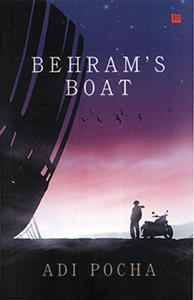
In his eagerness to do something, he gets the brainwave to build a boat, not of iron and steel but of wood, similar to the ones which the Parsis supposedly had used when they travelled from Iran to Sanjan. Only now, the journey will be made in the opposite direction with 50 couples who would be encouraged to procreate and help solve the problem of the dwindling number of Parsis in the world. Whereas Jamshedji Dorabji, the boss of the newspaper where Persis works, views it as a mad scheme which would help to boost the dwindling sales of his newspaper and acquire a large corpus from generous Parsis who would support the concept, the larger section of the Parsis think that the idea is abhorrent and call it the "sex boat.” Behram suffers insults from his colony members; he is assaulted and assailed by rotten eggs, but his spirits do not dampen.
Pocha depicts Behram’s single-mindedness of purpose and his commitment to building the boat. He gives up alcohol completely as he now has a motive to live and a goal to work towards. He travels to Salaya in Gujarat and shortlists Salim Bhai and his team to build the boat. Whereas the newspaper looks at the event merely as a publicity stunt, Pocha establishes that Behram’s motives are honest. He stays on in Salaya not merely to supervise the construction of the boat but this elderly 65-year-old man actually wades through black swampy soil and lifts heavy wooden beams himself.
He is frequently called back to Bombay, not for any work, but as a stooge for a publicity stunt to garner more funds. Everyone is impressed by this shabby and disreputable elderly man who has become suntanned, lost 22 kgs and who sports a scruffy long beard. He is interviewed on television and as a result becomes notorious (to his enemies). The villagers see this program, realize that the boat they are making is in fact a "sex boat” and consequently Salim Bhai ceases all work on the construction of the vessel. Pocha ensures that Behram still doesn’t lose hope and continues to persevere till his goal is reached.
It is not only Behram who is portrayed with great depth and understanding. Even the minor characters come to life in Pocha’s hands. Salim Bhai is Behram’s staunch friend but withdraws his support on moral grounds. Though Salim Bhai’s son makes his appearance only in the last few chapters of the novel, Pocha ensures that his manner of speaking is refined and his vocabulary well developed as he is studying for his MBA (Master of Business Administration) in Bangalore. Salim Bhai’s daughter, an innocent young girl in a burkha, falls in love with Behram, further complicating the situation. Most endearing are two characters: Maneck Aunty in the colony who comes to Behram’s rescue when he is covered with egg yolk; but the moment her job is done joins the others shouting slogans against him. And then there is Pilloo, the oldest and most ineffectual reporter of the newspaper, who is sent along with Behram on this preliminary visit and whose nature as compared to Behram’s is like chalk and cheese.
The novel is uproariously funny at times but has a very serious theme as well. Pocha handles this in a very dexterous manner ensuring that the novel never becomes sensational or melodramatic. To present other points of view, there are extracts from Persis’s conversation with her doctor, a newspaper report written by Pilloo, and several interviews with different characters. After such a delightful read, one hopes that Pocha continues to entertain us with further novels. FIRDAUS GANDAVIA
Gandavia holds a doctorate in English literature and is a retired chartered accountant. He is a compulsive reader of fiction.