In the face of competition from banquet halls, baugs are gearing to enhance their appeal
Parinaz Gandhi
Are the fairy lights dimming at the open-air baugs, the one-time popular venues for wedding/navjote celebrations? If the per head cost of organizing a function at the Eduljee Allbless Baug or Jeejeebhoy Dadabhoy Agiary is almost similar to a grand event at The Taj Palace or Trident, what would hosts choose? Is cost the deciding factor when choosing a venue to host a reception? To gauge community trends and preferences, Parsiana approached baug trustees and event planners to determine whether post pandemic celebrations will be with greater fanfare or frugal.
Cost is proving a deciding factor in the choice of venue, asserted all the event planners who responded to questions posed by Parsiana. The price of a baug booking may vary from Rs 1,25,400 for Jeejeebhoy Dadabhoy Agiary to Rs 6,500 for the Cama Baug big otla and Rs 2,500 for the small otla. To that should be added the cost of electricity, décor, rented furniture and, of course, the patru and drinks which means the rates keep mounting. The price of a basic patru catered by reputed caterers starts at Rs 1,500; for every extra dish that the host includes, the cost keeps multiplying.
In a banquet hall, the cost of a buffet plate may vary between Rs 1,500 to 3,500. There are few venues though that would offer an exclusive Parsi menu including fish, meat, chicken and egg dishes that Parsis and non Parsis so look forward to in their patru. The cost would vary depending on the number of invitees and the choice of menu at a function.
Currently the rates of organizing an event in a baug and a banquet hall appear to be comparable. While there is a joy in attending an open air function there is also the fear that inclement weather may suddenly dampen the festive spirit. Further, when venues like Cama Baug have a 9.30 p.m. deadline for music to be switched off to stop disturbance to the neighbors, youths who come late and would like to party longer feel their enjoyment has been cut short before they could even start. "Youths like to work hard and party harder. They want to have a good time. Since 10 p.m. is the official deadline as per the court ruling, baug trustees need to resolve this issue with the police,” recommends Sarosh Daruwalla of Mazda Events.
At present, baugs continue to be in favor "with 60% of the community members” although banquet events are gradually gaining in popularity, believes Daruwalla. He fears that the balance may tilt any time and the community should not allow this to happen as "so many Parsi families are sustained with the continuation of baugs.” Additionally, event planners may not patronize Parsi vendors thereby further depleting their income.
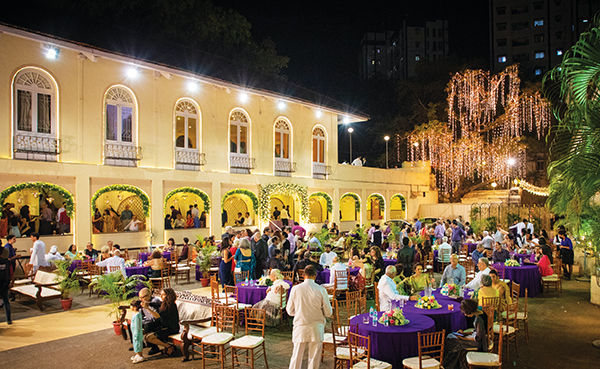
Celebrating at the Jeejeebhoy Dadabhoy Agiary
At The St. Regis Photos: Rehan S. Daruwalla
Traditional venues
There is clearly a baug divide when it comes to hosting celebrations. Those who are cost conscious would prefer Cama Baug, while those who wish to spend may opt for Allbless Baug and Jeejeebhoy Dadabhoy Agiary.
For the upcoming wedding season from November 2022 to March 2023, the Jeejeebhoy Dadabhoy Agiary at Colaba has been booked for 65-66 days, conveyed assistant secretary Parizad Avari Diventri. While they would like the baug to be used for 80 to 90 days in a year, the trust is willing to face the reality that with a dwindling population, this target may not be met. "How are we to manage? We have to maintain the baug, plus the 189-year-old agiary plus there are so many families supported by the trust. We will have to look into options. We might change the baug booking policy,” said Avari Diventri.
They assure their patrons "the best of services, customer friendly relations with bookings done at any time of the day on mobile since our landline has not been functioning for the last few years. Good hygiene, cleanliness, housekeeping” is also important to them. "We have not changed our rates for the last five years,” reminded Avari Diventri.
"Bookings are slow, but they seem to be picking up,” responded the Allbless Baug trustees. "We are in the constant process of upgrading existing amenities to meet present day demands,” they added, referring to Allbless Hall, an air-conditioned room on their premises that can be booked for small functions with free parking facility. The trustees have not been required to dig into their reserves or seek donations although they need to "continuously endeavor” to meet their annual maintenance costs.
For the upcoming season, Cama Baug has received bookings for 32 days, stated managing trustee Khushroo Press. "We expect to have an average of about 100 bookings or more a year for the next five years. Our baug is best suited to functions during the monsoons as we have an airconditioned hall, ample covered dining area, kitchen facilities and lots of parking space within our walls. Baug booking is a mere Rs 6,500 for the big otla and Rs 2,500 for the small otla as the objective of our trust is to offer an affordable venue. Hence we augment our revenue by off-season parking and letting out just the kitchen for off-site catering.
"Income from bookings barely cover our day-to-day expenses in a good season. The lockdown has forced us to dip into the corpus. Nonetheless we were the only ones to refund booking amounts for cancellations due to the lockdown,” added Press. Among the facilities introduced are 24x7 CCTV (closed circuit TV camera surveillance), airconditioned halls on both otlas, enhanced LED lighting, fire safetly compliance... Currently, toilets are in the process of being renovated. Roof repairs are a major expense too.
Banaji Atash Behram Hall has received bookings for 20 days. "We offer the best amenities and are reasonably priced,” responded manager Pakzad Katpitia. Trust income is sufficient to cover the maintenance costs and they do not need to dig into their reserves or seek donations. For the next five years they expect the hall to be used for less than 10% of the capacity (under 36 days).
In the four years preceding the 2020 pandemic, the average count of marriages in Bombay, involving one or both Zoroastrian partners, was 190. (There were 222 marriages in 2019, 189 in 2018, 182 in 2017 and 166 in 2016.) While 2020 understandably had the lowest count of 85 marriages, 2021 saw 154 marriages solemnized. In 2022 there have been 68 marriages from January to September. How then can the baugs sustain themselves?
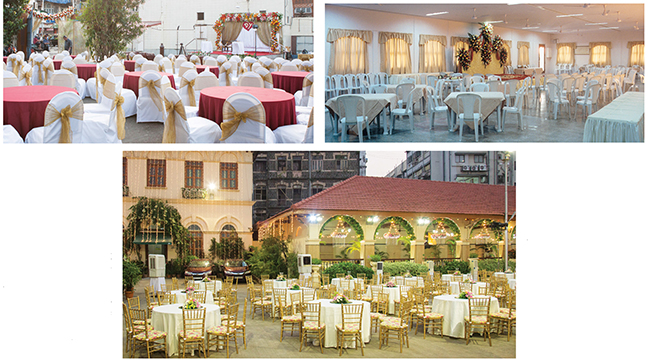
Above: Eduljee Allbless Baug Photo: Rehan S. Daruwalla;
top Cama Baug (l) and Banaji Atash Behram Hall
Baug boosters
"Youngsters may like a smaller selective crowd but the elders feel obliged to call many guests. The seniors in the community are happy doing things the traditional way and are willing to meet the photographer/videographer and other service providers two or three times to convey their personal preferences. They do not see the need for event managers,” explained Daruwalla. More than community functions, Mazda Events is busy planning corporate events and organizing non-Parsi functions, working on the logistics — from bringing the bride or groom to the venue until the couple returns home after the honeymoon.
"The pandemic has made people realize it is better to do small functions in banquet halls,” observed Daruwalla referring to the new trend of celebrating the engagement on the first day, with the sangeet (where the bride’s and groom’s family entertain each other with music and dance) on the next day, and finally the wedding. He nevertheless made a plea to members of the community: "Please use the baugs. The tradition should not discontinue. Even non Parsis are happy to come to baugs.”
"Post the pandemic, it is back to usual, bigger crowds. Parsis prefer the traditional baug venues for their functions. It was only during the pandemic that banquet halls were preferred to baugs,” stated Jimmy Bhesania of Kling Hospitality who specified "we are not event planners, We are specific service providers in the food and beverage segment.”
Celebration fervor "is almost getting back to the same level as before the pandemic,” stated Pervez Sidhwa of EMPL. Parsis do not tend to avail of services by event planners. "For a lagan/navjote, the seniors in the family want to observe the reet-reevaj and follow the customs and traditions. The family’s primary focus is on food.” As event planners, he offers a range of services from concept to design, execution and planning, and charges 15% agency fees on the total billing. While earlier hotels would offer a range of incentives to draw customers, that is not the case anymore, added Sidhwa.
Event planners are not often used by Parsis because frequently there are elders in the family with preconceived notions on how they would like to celebrate an event, plus baugs have tie-ups with service providers who enjoy a monopoly, stated Firdosh Khambatta of Unicorn. The services they offer include music, sound, lights with production and technical expertise, photography-videography, and travel arrangements including honeymoon bookings.
In Surat, there is a trend to host one major function and two or three smaller events, noted Pearl Contractor of Glitterati who organizes events in both Bombay and Surat. While they may host the pre-wedding haldi event (when turmeric is applied to the bride and groom) with yellow as the color theme, wedding at the Taamna Dharamshala with lavender as the color preference, the reception with greater glitz and glamor is held at venues like the Marriott in Surat. Post-pandemic, "clients are choosy about what they want. They come up with their own designs for the décor instead of asking us to show them.”
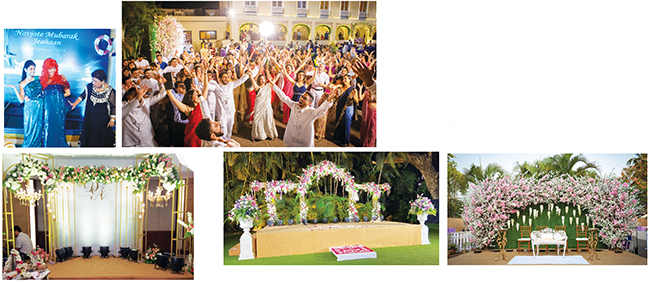
Top l : event hosted by Jennifer Dinshaw; r: merriment at Jeejeebhoy Dadabhoy Agiary Photo: Rehan S. Daruwalla;
above, l and center: decor offered by Glitterati; r: by Mazda Events
Budgeting for an event
Some event planners like Daruwalla believe that around 30% of the spend at weddings/navjotes goes into food and another 30% into drinks. In earlier days Chivas Regal would only be opened for the most exclusive guest. In current times, the youth want to serve the best drinks to everyone. The balance 40% could be divided between the venue, with lights, flowers, music, photography and videography. Since valet services cost not more than Rs 7,000 he felt it was too inconsequential to mention.
According to Sidhwa, 50% of the costs borne by the hosts are towards food, with venue being 20%, lights, flowers and music another 15%,10% on drinks and almost five percent on photography and videography. Likewise Bhesania believes that 50% of the expenditure is on food and 10% on drinks. He assigned five percent as venue costs with lights and flowers costing 10% each, and music, photography/videography and valet around five percent each. Khambatta assigned 55% to food and drinks, 30% to venue, flowers and lights, and the balance 15% to music, photography/videography and valet services.
Contractor assigned 30% to venue costs including therein the décor like lights and flowers. Another 30% each she would allow for food and drinks. The balance she would divide between music, photography and videograpy and other service providers. Enjoying her role as an "anchor where she has to keep the crowd engaged,” Contractor mentioned that she charges Rs 20,000 for anchoring with music, Rs 30,000 to 35,000 for music with décor.
"Infinite options,” is the catchline event planner Jennifer Dinshaw repeats to her guests. A popular master of ceremonies at children’s functions, she likes to make the events "dramatic” offering a variety of options like an audiovisual screen, a photo booth, cold fire, cake entry… She feels "it is a pleasure to deal with Parsis though some ladies are very particular and may insist on black balloons, a color not generally considered auspicious. But I try and please them. After all, the customer is king,” she believes.
"People want to celebrate”
Post the pandemic, the wedding market in India has risen nearly 200%, guesstimates Pooja Vir who serves as a consultant in the hospitality industry. Everyone has been waiting for the wedding season starting November 2022. "There is a general excitement. People want to celebrate. They have saved up for this special one day event. That is good for the hospitality industry that has been hit really badly with no help from the government. We are back to big celebrations for sure.” While people are happily celebrating at venues like the Taj Ballroom, there are gymkhanas too that have come up with smaller rooms, catering to a limited guest list. She referred to the open area next to Gallops restaurant at the Race Course where the lawns and special lighting have been creatively used to encourage optimal use of the space. "There is something about weddings and Indians. Nothing stops us. The luxury fashion market is thriving. For a Sabyasachi bridal outfit, there is a waiting list for months,” she revealed.
She referred to her Hindu neighbors of modest means who were willing to spend one crore on a wedding at the Taj Land’s End with 300 guests in attendance. When organizing functions at five star properties, the per head costs average Rs 6,000. The food costs are high as also the vendor costs since hotels insist on working with service providers empaneled by them.
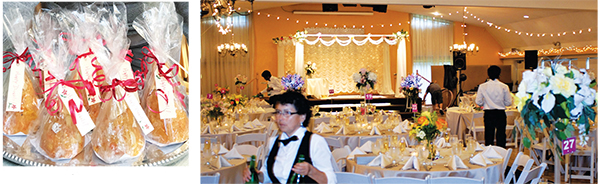
Above l: Agharni na larva gain popularity; r: decor for a navjote celebration
at the Zoroastrian Association of Metropolitan Chicago hall
Subdued abroad
"During the Covid closedown, navjotes and weddings here were small gatherings at home, with a tent set up in the backyard, albeit with all the fancy flower decorations and table settings,” stated Roshan Rivetna of Chicago, erstwhile editor of FEZANA (Federation of Zoroastrian Associations of North America) Journal. "In the last few months, as Covid restrictions are being lifted, we have had several large navjote gatherings, some at our Zoroastrian Association of Metropolitan Chicago hall. Of course, by large I mean by US standards (about 200 or so guests) which would be a small gathering at Allbless Baug or Colaba Agiary,” she clarified.
"In my Parsi Mithai Shop business which is really more of a hobby, my orders for agharni na larva (special sweetmeat distributed in the seventh month of pregnancy) have soared (wonder if it has anything to do with last year’s lockdowns!). And last week, a Hindu friend ordered these larvas for her Diwali party! I tried to explain that these larvas are for celebrating pregnancy and to order my signature badam ni boi marzipan sweets instead, but she insisted.”
"There have been no celebrations in Montreal since the pandemic. We have had several gahanbar jashans on Zoom. The first in person event we had was on Shahenshahi Navroz in August and the Ayathrem gahanbar on October 24,” mentioned Dolly Dastoor of Canada, editor of FEZANA Journal. Our community is aging so people are reluctant to meet in person, and avoid it as well. Even for private gatherings for dinner or lunch, we restrict to our bubble of about eight couples and try to do it in an open space. There have been large events in Houston, weddings, etc but it became a super spreader! Not worth it. There was the inauguration of the prayer room of the Kamran DarbeMehr, an in-person meet. Everything is on a smaller scale.”
In The Religious Ceremonies and Customs of the Parsees, Sir Jivanji Modi writes, "The following six toasts were generally proposed at Parsi marriage feasts: Yazdan-ni yad (in remembrance of God); the married couple; the sacred fire temples (may their sacred fires burn forever, may they be the means of helping all); the guests; the host; His Majesty the King. Occasionally another toast is added, Asho Farohar ni yad in remembrance of the pious departed ones… At large gatherings, there are professional toast proposers. Loud and clear voice is their only qualification for the work. When the dining parties are very large, they go round the tables, repeating the toasts several times so that all may hear.”
Perhaps one more toast should now be added: To the baugs…