Zareer Masani, who passed away peacefully in Switzerland on August 9, 2024, clearly subscribed to German philosopher and critic Friedrich Nietzsche’s view that "one should die proudly when it is no longer possible to live proudly.” His death has the potential to rekindle the debate on a contentious cause which his distinguished late father, Minoo Masani, had espoused, without much success, in the 1980s and 1990s, and which still remains taboo in many societies, namely, voluntary assisted dying (or euthanasia, as it is more commonly called). There is a certain poignancy to the fact that the city where Zareer chose to end his life, Basel, was also the city with which Nietzsche had a strong and enduring connection.
Zareer Masani:
prickly and charming
Though only 75 at the time of his death, Zareer had, for some years, expressed growing fears about being overwhelmed by debilitating illness. The basis for those fears was a progressive weakening of his lungs which manifested itself in chronic obstructive pulmonary disease (COPD) brought on by heavy smoking over four decades. In recent years he had also developed minor mobility problems which contributed to his growing pessimism about being able to cope with old age. He frequently told his friends that he wanted to avoid the fate of his late father who experienced considerable suffering for some years before breathing his last in 1998. Consequently, when he took the decision to end his life in a clinic in Basel, all pleas from his friends to reconsider were politely rebuffed. Zareer even wrote an extraordinarily candid article outlining his thoughts on the subject of dying for Open magazine in November 2023 (reprinted in Parsiana, March 7-20, 2024, titled "Chronicle of my death foretold”).
Much has been written about Zareer’s illustrious career as a current affairs producer for the British Broadcasting Corporation (BBC), a historian and an essayist — a career which spanned half a century. Along the way, he also wrote a number of books — including Indian Tales of the Raj, a biography of former Prime Minister Indira Gandhi, an assessment of the legacy of Lord Macaulay, and slightly more controversially, a memoir entitled And All Is Said in which he described in searing detail the stormy marriage of his parents which ended in an acrimonious divorce in 1989. That book also brought out the sharp differences in his parents’ approaches to the upbringing of the young Zareer, with one of them (mother Shakuntala) doting on him and the other being markedly austere and unsentimental.
The dysfunctional situation at home, coupled with a growing unease over his sexuality (he is reported to have experienced homophobic bullying at his school in Bombay) led him to move to England in the early 1970s where, among other things, he completed a doctoral thesis on Radical Nationalism and the All India Congress Socialist Party at Oxford University before joining the BBC as a current affairs producer — a position he held for some two decades and which allowed him to retire on a sumptuous pension. He then embarked on scholarly pursuits, becoming an independent historian; this period also saw the beginnings of an ideological transformation in the course of which, like his father before him, he progressively shed his leftist worldview and embraced conservatism of a kind which manifested in, among other things, a strong appreciation — and robust defence — of the benefits of imperialism and stinging criticism of wokery (progressive or left wing attitudes or practices, especially those opposing social injustice or discrimination, that are viewed as doctrinaire, self-righteous, pernicious or insincere) and political correctness that have been sweeping over many cherished British institutions in recent years.
Zareer’s latter-day political views were not calculated to win him friends; indeed, they led to the fracturing of many personal and professional relationships over the years. In the Indian context, he developed an intense antipathy towards the Bharatiya Janata Party (BJP) and to Hindu nationalism which some compatriots who shared his conservative outlook found difficult to understand. As for the other political parties, his disillusionment with the 1975-77 state of emergency ended his earlier enthusiasm for Indira Gandhi and the Indian National Congress (which, to the chagrin and embarrassment of his father, he and his mother had joined even as Masani père had, as the leader of the Swatantra Party, been vigorously fighting that party in successive parliamentary elections until 1971). Zareer publicly admitted that, had his mother not nailed her political colors so firmly to the Congress mast in 1971, his parents’ marriage might have been saved. Since at least the 1990s, he began warming up to the idea of a revival of the Swatantra Party (or something equivalent), telling one interviewer: "Where does one turn if you are like me and don’t like the BJP?”
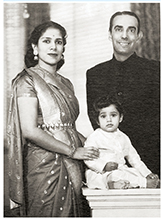
Infant Zareer with parents Shakuntala and Minoo Masani
Zareer was never close to Minoo, but the hostility which he entertained towards his father gave way to a guarded affection in later years. After Minoo passed away, he began visiting India more frequently, not least to lay claim to the elegant rent-controlled flat which Minoo had acquired through requisition from the government in a highly desirable part of Bombay in the 1940s. Faced with a repossession suit from the owner of the property, Zareer had to run the gauntlet of the Indian courts for a while before the owner threw in the towel and entered into a compromise under which Zareer was allowed, along with his two servants, to enjoy possession of the flat for the rest of his life. At the time of writing, it is not known if news of his death has reached either the landlord or the servants; it is not inconceivable to anyone familiar with the labyrinthine Indian legal system that another round of legal proceedings may be in the offing, this time involving all the actors in the original saga sans Zareer.
At a personal level, Zareer was, not to put too fine a point on it, a prickly character, though he could be charming as well. Stories are legion of his taking umbrage over slights, real or imagined, and of behaving impulsively, often in circumstances where a mature and measured response might have been more appropriate. He was also less than tolerant of views which were, in his opinion, unreasonable or intellectually sub-par. An example or two would suffice to illustrate this trait which did his reputation no favors.
At a private dinner in London in April 2023 to which this writer had invited Zareer as his personal guest and where the after-dinner speaker had been the Indian High Commissioner, Zareer found the diplomat’s defence of Prime Minister Narendra Modi’s BJP government’s policies and actions so intolerable that he not only harangued the speaker but walked out in a huff, leaving the other guests deeply embarrassed. He was unwilling to recognize the simple reality that the High Commissioner was expected, and paid, to defend his government’s policies and that a more befitting response would have been to politely, if firmly, challenge him on arguments that were, in Zareer’s view, unacceptable — a course of action which many of the other guests adopted without rancor or disrespect. (To Zareer’s credit, however, it needs to be added that, within minutes of his walkout, he emailed me a gracious note of apology accepting that he should have behaved better.)
Similar impulsiveness was on show on an earlier occasion, this time at a seminar at the Nehru Centre in Bombay, where Zareer launched into a wholly unprovoked verbal onslaught on a fellow participant — a student who had the misfortune of combining poor articulacy with pro-Hindu views that were anathema to Zareer — which he followed up with a threat to shut the student down. Only the spontaneous and vocal intervention of many of the others present prevented the event from collapsing into bedlam and chaos. Such behavior went well beyond what is frequently referred to as "not tolerating fools gladly” — a label that was sometimes affixed on Minoo; rather, it may be seen, and not unreasonably, by some as signifying intellectual arrogance of an order incompatible with an equable mind.
For all his faults, Zareer attracted considerable praise for many of his writings and speeches. He was forthright in calling out some of the humbug that often passes for scholarship and erudition. Any fair assessment of the man cannot but acknowledge his courage in defending unpopular causes, especially those relating to historical rights and wrongs which have, in the recent past, become weapons in the culture wars that are currently threatening to tear many societies asunder. His contributions to the History Reclaimed website and to the History Matters advisory board of the Policy Exchange think tank are two particular examples of his outstanding work which will be remembered alongside his other outputs as a public intellectual. His combative television appearances, his pugnacious online interviews, and his unyielding utterances from public platforms will be sorely missed, at least by those who still value candor and directness in discussion and debate.
Not a Zoroastrian act
Dastur (Dr) Firoze M. Kotwal
In the Zoroastrian religion, the taking of one’s life is seen as a grave sin. The theological precepts of the faith teach that any evil must be faced, diminished and ultimately removed from the physical world. This is the most important tenet of our faith. For one to be victorious over evil, resilience, strength and the power of prayers are required. Suicide in any form emerges from a state of helplessness and hopelessness that overcomes both the mental and the conscious physicality of life, resulting in the surrendering of the body to the forces that beset one in times of difficulty. Thus, suicide is not an act that is in any way supported by the tenets of the faith, where life is seen to be the work of Ahura Mazda and death is the work of the evil forces.
No matter what life’s trials may be, a Zoroastrian is mandated to fight and defeat the forces of evil that attempt to prevail upon the body and the mind. The religion offers prayers, rituals, and the sanctuary of a fire temple for those in this frail and vulnerable state as well as for those in the family.
Devout Parsis of the past were firm believers of this ideology. When the dakhmas were built in the 18th and 19th centuries, the benefactors often stipulated a clause stating that the bodies of those who had committed suicide could not be placed in the dakhmas they built. Such bodies were often placed in old, disused, non-functioning dakhmas. These clauses tied into the Zoroastrian belief system that suicide was not seen as a Zoroastrian act but one in which one succumbed to the forces of evil.
We do not hold to the Wittgenstein theory, that suicide is neither good nor bad.
Zoroastrianism is a life-enhancing and life-enriching religion. Every action must be done according to the will of the Good God Ahura Mazda, and suicide, in whatever form, is not in accordance with the precepts and practices of the faith.