The Parsi Kitchen: A Memoir of Food and Family by Anahita Dhondy. Published in 2021 by HarperCollins Publishers, A-75, Sector 57, Noida, 201301; website: www.harpercollins.co.in. Pp: 200. Price: Rs 999.
Each of the Parsi staples that Anahita Dhondy refers to in the first part of her book The Parsi Kitchen: A Memoir of Food and Family, is accompanied by a melange of memories — how food was cooked in her grandparents’ home in Allahabad; how her mother Nilufer’s culinary skills inspired her. The tome contains a selection of 12 Parsi staple dishes (think ravo, akuri, dhansak and prawn curry) and about 16 all-time favorites of the chef that include caramel custard, cauliflower cooked with coconut milk and chicken cutlets.
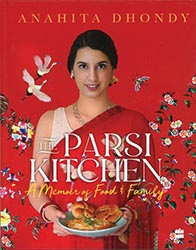
Do gush over the family pictures and personal anecdotes associated with food that intersperse this Parsi section. For instance, we are told of grandfather Dinyar’s love for mangoes that father Navroze inherited in the section on "Kairi Chicken: Mango summers at Dada’s house.” The bonus in this section is a recipe for ambakalio. Whether the chopped coriander she uses as garnish for this traditional mango relish will bode well with those Bombay grannies who do not like tampering with age-old recipes remains to be seen.
The section on "Pork Vindaloo” reveals Anahita’s epiphany moment. Homesick and tired after a day in the kitchens at Le Cordon Bleu in London, she washed the sauce off a take-away pork dish, took out the masala kit Nilufer had packed for her and attempted a "recipe that resonated with my personality, heritage and character… Mom’s Pork Vindaloo.” In the section on "Khara Bheeda,” Anahita reveals that this dish is closest to her heart and that of husband Arush Bhandari. "I seem to remember eating a lot of it during our first year of marriage,” she states.
For her semi-final round at a global talent search competition in 2015 Anahita prepared a Parsi Fish Breakfast, a modern interpretation of Patra ni Machhi where the chutney is a gel. She served it with a potato nest and a soft-boiled quail egg. Sadly, no recipe is available for this in the book. Anahita hints at a modern take on the akuri she made in 2017 at a food carnival in Bangalore for then MasterChef Australia judges George Calombaris, Gary Mehigan and Matt Preston. She used paneer instead of eggs and served it with sambhar masala in three ways, piped, pureed and brushed, and topped it all with micro greens. "They loved it,” she states.
Anecdotes from forays to Udvada, Navsari and Sanjan with the assistance of Parzor’s Dr Shernaz Cama and World Zoroastrian Organisation Trusts’ Dinshaw Tamboly feature in the section "Fried Boomla: On the road to discovering my roots.” It was in Udvada that she rediscovered Doodh na Puff and "chanced upon a miraculous sight” — rows and rows of her absolute favorite fish, Bombay duck. The chef says that during her Gujarat sojourn she picked up a vital tip from distant relative Freny Ginwalla who told her that if you don’t have banana leaves for Patra Ni Machhi, use butter paper. "This is the kind of homespun advice I wanted to incorporate in my book,” she says.
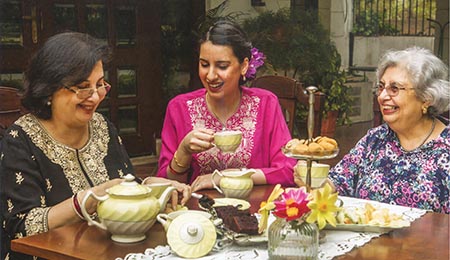
Anahita Dhondy (center) with mother Nilufer (l) and grandmother Vera Ghandhi
Above, from l: Arush Bhandari, Anahita; Navroze and
Nilufer Dhondy, holding baby Anahita
Most recipes end with "Pro Tips” to save time, or enhance flavors, or convert a non-vegetarian dish to one palatable for those who abstain from meat and poultry. "Parsi Pantry” highlights pastes, ingredients for a standard spice box and for the fridge. These include must-haves like sambhar masala, curry powder, chilli-garlic paste, tamarind paste and the like, with handy preparation tips. Dishes listed in her meal plans helpfully link up to the recipes scattered over the book.
A two-page section "The Future” reveals Anahita’s fondness for millets. "They are good for the planet as they require less water to grow, unlike rice or wheat.” Part of an 800-chef network from 77 countries, she advocates the benefits of Indian ingredients, especially millets. Look out for an unusual salad that uses buckwheat or foxtail millets.
The photos that accompany the recipes, all shot in the Dhondy family home in Gurgaon, are credited to Shiva Kant Vyas and Saumya Gupta. They are a delight, as are the black and white photos from the Dhondy family albums. The author is wearing the trademark flowers in her hair and a red Ashdeen Lilaowala sari for the cover photograph.
Erstwhile chef-manager at the SodaBottleOpenerWala chain of pan-India restaurants and sometime home chef with Nilufer, Anahita had told Parsiana in a 2016 interview that the book which is seeing the light of day now will be "a mix of stories and recipes… I’d say it’s a food journey into the past with trendy new Parsi recipes… I’m doing a lot of research because there isn’t much out there for our generation to read and cook from. I want stories to be personal, all intertwined (see "Soda’s ‘chilled out’ boss,” Parsiana, August 7, 2016). Anahita has largely delivered on that promise.
FARROKH JIJINA
The chef shared two recipes with Parsiana:
DHUN’S CARAMEL CUSTARD
Preparation time: 1 hour
Serves 4
For the caramel
Sugar — 200 g
For the custard
Eggs — 8 whole
Egg yolks — 4, this is the trick to extra creaminess
Milk — 1.1 l.
Sugar — 200 g
Vanilla essence as per taste (a vanilla pod will give you a stronger flavor)
Fresh strawberries (or a compote) for garnish
Pre-heat your oven to 160-180°C. Keep your custard molds ready. Two four-inch or one eight-inch mold works fine. If you prefer making one large bowl of custard, steam bake (bake in a moist oven) for about 30 to 40 minutes.
To make the caramel, melt the sugar in a pan over medium heat. Don’t add any water or milk, just heat the sugar till it is a light golden color. Pour the caramel into the mold and leave it to harden.
To make the custard, combine all the ingredients in a bowl and whisk well. Fine strain the entire mixture to make sure there are no lumps. Pour into the mold and cover with a lid or aluminum foil if needed.
Steam bake the custard in a bain marie (water bath) for 25 to 30 minutes. If you are using smaller molds, the custard will be ready in 12 to 15 minutes. Don’t overcook it.
Cool the caramel custard to room temperature, then chill. Once chilled well, demold and serve with strawberries (or any fruit compote).
Tip: You can add a pinch of elaichi-jaiphal, a green cardamom and nutmeg powder, which is a typically Parsi thing to do, instead of vanilla.
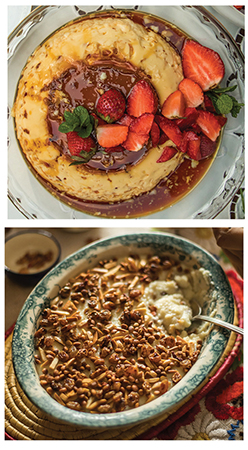
VERA’S RAVO
Preparation time: 30 mins
Serves 4
Sugar — 1 cup, granulated
Ghee — 4 to 5 tbsp
Sooji (semolina) — 1 cup
Full-cream milk — 4 cups
Rose water — 1 tbsp, optional
Vanilla essence — 1 tsp
For garnish
Chironji seeds, almond flakes, cashewnuts and raisins — ¼ cup of each tossed in ghee
In a pan, add milk and sugar. Warm the milk just till the sugar dissolves.
In another pan, heat the ghee and then add the sooji. Slowly roast till it becomes a light almond color.
Slowly pour the hot milk over the sooji. Keep stirring till it thickens and you can see small bubbles. Make sure the milk is hot or there will be lumps in the ravo. Add the rose water and vanilla essence.
Once the ravo thickens, pour it into dessert bowls and let it cool. (I usually do one big bowl which gets polished off very quickly!) Garnish with dry fruits. Serve cold or warm, directly from the pan [which is how (husband) Arush likes it].
Pro tips: Don’t brown the semolina; it needs to be a light almond color, which should take about 10 to 12 minutes over low heat. For my friends who insist that there needs to be a crunch to the ravo: take the slivers of cashews and almonds alongwith the chironji seeds and raisins, and roast them in a pan with ghee till they are golden brown and crunchy. Make a layer of the browned nuts and raisins on top of your ravo, completely covering it. Garnish with rose petals.